Project 2025: How Trump’s Actions Align with Conservative Goals

Project 2025, a comprehensive conservative policy roadmap, is increasingly being implemented through President Donald Trump’s executive actions, despite his public disavowal of the initiative. As of April 2025, the evidence shows a striking alignment between Trump’s policies and this extensive blueprint for reshaping the federal government.

What is Project 2025?

Project 2025 is a multi-pronged initiative overseen by the Heritage Foundation, a conservative think tank, designed to provide a detailed roadmap for the next Republican president. At its core is the “Mandate for Leadership,” a 922-page blueprint that outlines ways to completely overhaul the executive branch of the federal government[1][2]. This extensive document was crafted in 2023 by the Heritage Foundation and other conservative groups as a comprehensive guide for implementing conservative policies across all aspects of federal governance[4].

The initiative covers a wide range of policy areas, from immigration and defense to regulatory reform and federal workforce management. Its stated goal is to dramatically reshape federal governance according to conservative principles, with particular emphasis on reducing the size of government, promoting “America First” policies, and rolling back progressive initiatives implemented during the Biden administration[4][5].

Trump’s Public Stance on Project 2025

Throughout his presidential campaign, Donald Trump repeatedly distanced himself from Project 2025. He insisted that he had “nothing to do with Project 2025,” claimed he had not read it, and had no intention of reading it[1]. As Democrats highlighted the initiative as a key reason to vote against Trump in the election, he further reinforced his disavowal, describing some of its proposals as “abysmal” and “ridiculous”[1][5].

Despite these public statements, there is significant evidence that the Trump administration is implementing policies that closely align with the Project 2025 blueprint. This has led Paul Dans, who previously oversaw Project 2025 at the Heritage Foundation, to express enthusiasm about Trump’s actions, describing them as “home runs” and “in many cases more than we could have even dared hope for”[1].

Evidence of Implementation

Personnel Connections

A notable indication of alignment between Trump’s administration and Project 2025 is the presence of key personnel who contributed to the initiative. Several authors of Project 2025’s policy chapters served in Trump’s first administration and now hold positions in his second term. These include Russ Vought, Trump’s pick to lead the Office of Management and Budget, and John Ratcliffe, who now serves as CIA director[1].

Policy Alignments

Federal Workforce Restructuring

One of the most dramatic implementations of Project 2025 principles has been Trump’s aggressive approach to downsizing the federal workforce. By March 2025, federal agencies faced a deadline to provide the administration with plans for a reduction in force, known as ARRPs (Agency Reorganization and Reduction in Force Plans)[3]. This initiative, guided by billionaire Elon Musk and his Department Of Government Efficiency (DOGE), has already resulted in mass firings of federal employees across multiple agencies[3].

The layoffs have particularly affected probationary federal workers, including employees in their first year or two on the job, those who recently moved between federal agencies, and those who were recently promoted. These cuts have impacted all 50 states and included employees at agencies that Americans frequently interact with, such as the National Park Service, U.S. Department of Agriculture, Veterans Affairs, Internal Revenue Service, and National Institutes of Health[3].

FEMA Restructuring

In alignment with Project 2025’s recommendations, Trump has established a review council to advise him on the Federal Emergency Management Agency’s capabilities and has suggested he could potentially “get rid” of FEMA entirely, leaving disaster response management to the states[1][2].

This action directly reflects Project 2025’s call for “reforming FEMA emergency spending to shift the majority of preparedness and response costs to states and localities instead of the federal government.” The initiative’s blueprint specifically recommends changing the cost-sharing arrangement so the federal government covers only 25% of costs for small disasters and up to 75% for “truly catastrophic disasters,” a significant reduction in federal responsibility[1].

Immigration and Border Security

Trump has taken significant actions on immigration that mirror Project 2025 proposals, including assigning troops “the mission to seal the borders and maintain the sovereignty, territorial integrity and security of the United States”[1]. This aligns with Project 2025’s recommendation that the Pentagon should “explicitly acknowledge and adjust personnel and priorities to participate actively in the defense, including using military personnel and hardware to prevent illegal crossings between ports of entry”[1].

Additionally, Trump has suspended entry into the U.S. by refugees under the U.S. Refugee Admissions Program, reflecting Project 2025’s call for “rightsizing refugee admissions” and an “indefinite curtailment” of refugee admissions[1].

Dismantling DEI Initiatives

Trump has taken substantial steps to dismantle diversity, equity, and inclusion (DEI) initiatives throughout the government and in the private sector, signing multiple executive orders aimed at abolishing these programs[4]. This mirrors Project 2025’s calls for the next conservative president to “eliminate every one of [the Biden administration’s] wrongful and burdensome ideological projects,” asserting that “Nondiscrimination and equality are the law; DEI is not”[4].

In a particularly striking alignment, Trump revoked a 60-year-old policy from 1965 that prohibited employment discrimination by government contractors. Project 2025 explicitly called for revoking this Lyndon B. Johnson-era executive order, arguing that abolishing it would mean contractors will “be less subject to the changing political whims of a President that might impose significant new costs or burdens”[4].

The Scale of Implementation

A CNN analysis of Trump’s first week in office found that more than two-thirds of his executive orders and actions (36 out of 53) evoked proposals outlined in Project 2025’s blueprint[2]. This extensive alignment covers not only Trump’s most-touted pledges like cracking down on illegal immigration and dismantling DEI initiatives but also more provocative and unexpected early actions[2].

These included punishing countries that refuse deported migrants, revoking security clearances of top national security officials accused by conservatives of political bias, and curbing foreign aid from countries “not fully aligned” with his global aims—all policies that were foreshadowed in Project 2025’s recommendations[2].

Conclusion

Despite President Trump’s public disavowal of Project 2025, the evidence demonstrates a substantial alignment between his administration’s actions and the initiative’s policy recommendations. From federal workforce cuts to immigration policy changes, from dismantling DEI initiatives to restructuring FEMA, Trump’s executive actions appear to be following much of the conservative blueprint laid out in Project 2025’s “Mandate for Leadership.”

As former Project 2025 director Paul Dans stated, the initiatives being implemented are “exactly the work we set out to do”[2]. While Trump continues to maintain distance from the project publicly, the implementation of its recommendations suggests that Project 2025 is indeed serving as an influential roadmap for his second administration’s approach to governance and policy.

Citations:
[1] https://www.cbsnews.com/news/trump-project-2025-playbook/
[2] https://www.cnn.com/2025/01/31/politics/trump-policy-project-2025-executive-orders-invs/index.html
[3] https://www.usatoday.com/story/news/politics/2025/03/12/trump-doge-federal-layoffs-timeline/82240271007/
[4] https://www.forbes.com/sites/alisondurkee/2025/03/17/heres-how-trumps-executive-orders-align-with-project-2025-as-he-touts-agenda-in-speech-to-congress/
[5] https://www.forbes.com/sites/alisondurkee/2025/03/05/heres-how-trumps-executive-orders-align-with-project-2025-as-he-touts-agenda-in-speech-to-congress/
[6] https://www.npr.org/2025/03/15/nx-s1-5328721/reduction-in-force-rif-federal-workers-job-cuts-musk-doge-layoffs
[7] https://progressivereform.org/tracking-trump-2/project-2025-executive-action-tracker/
[8] https://en.wikipedia.org/wiki/Project_2025
[9] https://www.whitehouse.gov/fact-sheets/2025/02/fact-sheet-president-donald-j-trump-works-to-remake-americas-federal-workforce/
[10] https://www.pbs.org/newshour/show/the-project-2025-policies-the-trump-administration-is-already-implementing
[11] https://www.npr.org/2025/01/31/nx-s1-5280364/trump-enacts-project-2025-policies-which-he-distanced-himself-from-while-campaigning
[12] https://www.selc.org/news/we-all-suffer-from-federal-workforce-cuts/
[13] https://www.aclu.org/project-2025-explained
[14] https://www.bbc.com/news/articles/c977njnvq2do
[15] https://www.brookings.edu/articles/trumps-dramatic-plan-to-cut-the-federal-workforce/
[16] https://www.nature.com/articles/d41586-025-00780-2
[17] https://www.cnn.com/politics/tracking-federal-workforce-firings-dg/index.html
[18] https://www.project2025.org
[19] https://apnews.com/article/trump-elon-musk-federal-workers-layoffs-d295d4bb2cdd5023c27d9cb03754e81b
[20] https://nul.org/node/6770


Answer from Perplexity: pplx.ai/share
Understanding the US Non-Fraternization Policy in China

In January 2025, the U.S. government implemented a sweeping prohibition. It prevents American government personnel stationed in China from engaging in romantic or sexual relationships with Chinese citizens. This also applies to their family members and contractors with security clearances. This policy, described as a “non-fraternization” directive, represents a significant expansion of previous restrictions and was instituted by outgoing U.S. Ambassador Nicholas Burns shortly before his departure from China and just prior to President Donald Trump assuming office. The comprehensive ban applies to all U.S. diplomatic missions in mainland China and Hong Kong. It sets strict boundaries for government representatives. It raises questions about both security considerations and personal freedom in the context of escalating U.S.-China tensions.

Historical Context and Policy Evolution

Cold War Precedents

The current prohibition echoes similar measures implemented during the Cold War era. Declassified State Department documents reveal that in 1957, the U.S. government prohibited personnel stationed in Soviet bloc countries and China from forming friendships. They were also prohibited from dating or engaging in sexual activities with locals. This was set following an incident where a U.S. Marine was compromised by a Soviet spy[1]. These comprehensive restrictions became less common after the dissolution of the Soviet Union in 1991. Security priorities shifted due to changing global dynamics[1].

Gradual Tightening of Restrictions

Before the current comprehensive ban, U.S. personnel in China operated under a reporting requirement system rather than an outright prohibition. Staff were obligated to disclose any intimate interactions with Chinese citizens to their superiors. They were not explicitly forbidden from entering into romantic or sexual relationships[1]. This approach allowed for greater personal freedom while still maintaining some level of security oversight through transparency requirements.

The transition toward stricter controls began in the summer of 2024. The Biden administration implemented a limited version of the current policy at that time. This initial restriction prohibited U.S. personnel from romantic and sexual relations with Chinese citizens. These citizens were specifically employed as security personnel and other support staff at the U.S. Embassy and its five consulates in China[1][3][4]. The limited scope reflected a targeted approach to security vulnerabilities rather than a blanket prohibition.

Scope and Implementation of the Current Ban

Comprehensive Coverage

The January 2025 policy significantly expands the previous restrictions. It implements a complete ban on romantic or sexual relationships between U.S. government personnel and any Chinese citizens within China[1]. This comprehensive prohibition applies to all American government employees stationed in China, their family members, and contractors who hold security clearances[1][2][3]. The policy was communicated to affected individuals both verbally and electronically, though it has not been made public[1].

Geographic Application

The ban specifically covers all U.S. diplomatic missions in mainland China, including those in Beijing, Guangzhou, Shanghai, Shenyang, and Wuhan, as well as the American Consulate in the semi-autonomous region of Hong Kong[1][3]. An important limitation of the policy is that it does not extend to U.S. personnel stationed outside of China, suggesting that the geographic context of the relationship is a critical factor in determining potential security risks[1][3].

Exemptions and Enforcement

The policy does provide some flexibility for personnel who were already in relationships with Chinese citizens prior to its implementation. These individuals may apply for exemptions to the ban, though if an exemption is denied, they face a difficult choice: terminate the relationship or resign from their position[1][2]. The consequences for violating the policy are severe, with offenders facing immediate expulsion from China[1][3]. Despite the clarity of these consequences, the exact definition of what constitutes a “romantic or sexual relationship” under the policy remains somewhat ambiguous[1][3].

Strategic and Security Considerations

Intelligence Vulnerabilities

A primary motivation behind the policy appears to be counterintelligence concerns. Intelligence agencies worldwide have historically utilized attractive individuals to extract sensitive information, a practice that gained notoriety during the Cold War[1]. U.S. diplomats and intelligence analysts assert that Beijing continues to actively employ so-called “honeypot” operations to gain access to American secrets[1]. During pre-deployment briefings, U.S. personnel are educated on case studies demonstrating how Chinese intelligence has utilized such tactics to compromise American diplomats[1].

Congressional Pressure and Security Assessments

The implementation of the new policy followed expressions of concern from congressional members regarding the inadequacy of existing restrictions[1]. According to sources familiar with the situation, discussions about strengthening the policy began in the summer of 2024 after these concerns were communicated to Ambassador Burns[1]. Peter Mattis, a former CIA analyst and president of The Jamestown Foundation, suggested that the policy change indicates China’s Ministry of State Security has become “significantly more aggressive in attempting to infiltrate the embassy and U.S. government”[1].

Broader Context of U.S.-China Tensions

The ban comes amid escalating tensions between Washington and Beijing over trade, technology, and geopolitical rivalry[1][2]. The FBI has characterized counterintelligence and economic espionage efforts from China as “a grave threat to the economic well-being and democratic values of the United States”[2]. This policy can be viewed as part of a broader effort to address vulnerabilities in an increasingly confrontational relationship between the two global powers.

Comparison with Chinese Policies

Chinese Restrictions on Officials

Interestingly, China maintains similar or even stricter regulations on its own personnel. China’s foreign ministry and many other government bodies prohibit their officials and staff from engaging in sexual or romantic relations with foreign citizens[1]. Additionally, Chinese governmental policies restrict promotions for civil servants whose spouses have obtained foreign citizenship and limit diplomats’ duration of stay in any single country[1]. Members of the Chinese military or police typically face restrictions on leaving China without explicit permission from their supervisors[1].

Global Context of Such Restrictions

While information about non-fraternization policies in other countries remains limited due to their classified nature, the implementation of such restrictions is not unprecedented in diplomatic and intelligence contexts[1]. The parallel approaches by both the United States and China highlight how personal relationships are increasingly viewed through a national security lens by competing global powers.

Implications and Reactions

Personal Freedom Versus Security Concerns

The policy has sparked debate about the balance between security requirements and personal freedom. On social media platforms, some have questioned whether the ban constitutes a form of national discrimination[4]. Others have countered that security concerns may justify such restrictions, particularly if recent security incidents have been triggered by exploited personal relationships[4]. The emphasis on prohibiting sexual relationships has also been criticized as potentially narrow-minded, with some arguing that meaningful intelligence can be gathered through various types of close personal relationships[4].

Effectiveness Questions

Some commentators have raised practical concerns about the enforceability and effectiveness of such bans. Critics argue that prohibiting personal relationships may be impractical when people are socially interacting with Chinese citizens on a daily basis[4]. There are also questions about the long-term sustainability of such policies, with some suggesting that affected individuals might simply choose to forgo their security clearances or seek alternative employment rather than comply with restrictions on their personal lives[4].

Conclusion

The U.S. government’s ban on romantic and sexual relationships between its personnel in China and Chinese citizens represents a significant policy shift that reflects the increasingly complex and confrontational nature of U.S.-China relations. By implementing this comprehensive prohibition, the U.S. has reverted to Cold War-era security practices in response to perceived intelligence threats. While the policy aims to protect American interests by reducing potential vulnerabilities, it also raises important questions about personal freedom, practicality, and the growing social disconnection between two global powers whose cooperation remains essential on many international issues. As tensions continue to evolve, such policies may become increasingly common, further isolating diplomatic communities from the societies in which they operate and potentially contributing to a cycle of mistrust and suspicion.

Citations:
[1] https://www.usnews.com/news/us/articles/2025-04-03/us-bans-government-personnel-in-china-from-romantic-or-sexual-relations-with-chinese-citizens
[2] https://www.jpost.com/international/article-848812
[3] https://san.com/cc/us-government-employees-banned-from-relationships-with-chinese-citizens-ap/
[4] https://www.reddit.com/r/centrist/comments/1jqr6mt/us_bans_government_personnel_in_china_from/
[5] https://hongkongfp.com/2025/04/03/us-bans-govt-staff-in-china-and-hong-kong-from-romantic-or-sexual-relations-with-chinese-citizens-report/
[6] https://www.newsweek.com/us-bans-sex-between-personnel-chinese-citizens-china-report-2054727
[7] https://www.scmp.com/news/china/diplomacy/article/3305075/us-china-decoupling-washington-bans-diplomats-and-staff-romance-and-sex-chinese
[8] https://www.bloomberg.com/news/articles/2025-04-03/us-bans-personnel-from-romantic-relations-with-chinese-ap-says
[9] https://cbsaustin.com/news/nation-world/us-bans-govt-personnel-in-china-from-romantic-or-sexual-relations-with-chinese-citizens
[10] https://economictimes.com/news/international/global-trends/us-news-us-government-bans-no-romantic-or-sexual-relationship-with-chinese-trump-admins-diktat-to-employees-in-china-amid-tariff-war/articleshow/119944030.cms
[11] https://www.youtube.com/watch?v=7gF3O3SEwIQ
[12] https://www.instagram.com/kagan.dunlap/reel/DH-7K_JxTN5/
[13] https://www.foxnews.com/us/us-bans-romantic-sexual-relationships-chinese-citizens-government-employees-china
[14] https://apnews.com/article/chinese-beijing-honeypot-spies-diplomat-agent-intelligence-c077ef57b0f7ae43dd0db41bea92238b
[15] https://www.ndtv.com/world-news/why-the-us-has-banned-diplomats-from-romantic-sexual-relations-with-chinese-8078314


Answer from Perplexity: pplx.ai/share
The Evolution of Presidential Term Limits in America

The original U.S. Constitution (1787) did not set any limits on how many terms a president could serve. Instead, it only outlined a four-year term with the possibility of reelection. Article II, Section 1, simply stated:

“The executive Power shall be vested in a President of the United States of America. He shall hold his Office during the Term of four Years, and, together with the Vice President, chosen for the same Term, be elected, as follows…”

This meant that, in theory, a president could serve for an unlimited number of terms as long as they kept winning elections. The decision to impose a two-term limit did not come until 1951, with the passage of the 22nd Amendment, following Franklin D. Roosevelt’s four-term presidency.

The history of U.S. presidential term limits is closely tied to the precedent set by early presidents and the eventual passage of the 22nd Amendment to the U.S. Constitution.

1. The Two-Term Tradition (1789–1940)

  • George Washington, the first U.S. president (1789–1797), voluntarily stepped down after two terms, establishing an informal precedent.
  • This tradition was followed by nearly all presidents afterward, with the notable exception of Theodore Roosevelt, who ran for a third (non-consecutive) term in 1912 but lost.

2. Franklin D. Roosevelt’s Four Terms (1932–1945)

  • Franklin D. Roosevelt (FDR) broke the two-term tradition by winning four consecutive terms (1932, 1936, 1940, 1944).
  • His extended presidency was due to the Great Depression and World War II, where voters sought continuity in leadership.

3. The 22nd Amendment (1951)

  • After FDR’s death in 1945, Congress moved to formally limit presidential terms.
  • In 1947, Congress proposed the 22nd Amendment, which was ratified on February 27, 1951.
  • It limits a president to two elected terms or a maximum of 10 years (if they assumed office due to succession and served less than two years before being elected twice).

4. Impact and Attempts to Repeal

  • Dwight D. Eisenhower (1953–1961) was the first president affected by the amendment.
  • Several lawmakers have proposed repealing it, but no serious effort has succeeded.
  • Ronald Reagan and Bill Clinton both suggested that term limits restrict voter choice, but no changes were made.

Key Takeaway

The two-term limit became law after FDR’s unprecedented four terms, and since then, no president has served more than eight years in office.

The Kindness Marathon

The idea for the Kindness Marathon started with a simple question.

“What if we treated kindness like a sport?” asked 12-year-old Ava Thompson during a town council meeting.

The room fell silent, and Mayor Patel raised an eyebrow. “What do you mean, Ava?”

“Well,” Ava explained, “we have marathons where people run to show how strong they are. What if we had a marathon to show how kind we can be? Everyone could do as many acts of kindness as possible in 24 hours.”

The idea struck a chord. By the end of the meeting, the Kindness Marathon was born, and the small town of Brookhaven began planning the event that would change their community forever.

Rallying the Town

News of the Kindness Marathon spread quickly. Flyers went up in store windows, announcements were made at school, and the local radio station broadcast interviews with Ava and Mayor Patel.

Volunteers signed up to help organize, and local businesses offered prizes for participants who completed the most acts of kindness. The event wasn’t about competition, though—it was about creating a ripple effect of positivity.

Participants were encouraged to think creatively. Kindness could be as small as helping a neighbor carry groceries or as big as organizing a community cleanup.

The Starting Line

On a crisp Saturday morning, the marathon began. The town square buzzed with excitement as families, students, and even senior citizens gathered to kick off the event. Each participant received a “Kindness Card” to log their acts of kindness throughout the day.

Ava stood on stage, holding a megaphone. “Remember,” she said, her voice echoing through the square, “kindness isn’t about winning. It’s about making someone’s day better. Ready? Go!”

The crowd cheered and scattered in all directions, eager to spread kindness.

Acts of Kindness Everywhere

By mid-morning, Brookhaven was transformed.

At the local diner, high school students paid for strangers’ meals. At the park, kids handed out handmade cards to passersby. Elderly neighbors received surprise visits from volunteers who helped with yard work and house chores.

The fire station hosted a free pancake breakfast for families, while the library waived overdue book fees for the day.

Ava and her friends spent hours visiting the animal shelter, walking dogs, and cuddling cats. At one point, they spotted a group of kids who had set up a “Free Hugs” booth outside the grocery store.

Unexpected Connections

As the day turned into evening, acts of kindness began creating unexpected connections.

Mrs. Reynolds, who had lived alone for years, found herself laughing with a group of teenagers who came to rake her leaves. “I haven’t had this much company in ages,” she said, her eyes twinkling.

At the town’s only gas station, a man who had been struggling financially received an anonymous gift card. “Whoever did this, thank you,” he said, his voice breaking. “You’ve given me hope.”

Even rival businesses joined forces. The owners of the town’s two competing coffee shops partnered to deliver free coffee to the local hospital staff working overnight.

The Midnight Finale

As the clock neared midnight, participants gathered back in the town square to celebrate the end of the marathon. A large board had been set up to tally the acts of kindness completed.

“Let’s see what we accomplished together!” Mayor Patel announced as the final numbers were revealed.

Over 3,000 acts of kindness had been logged in 24 hours. The crowd erupted in cheers, hugging one another and sharing stories of their experiences.

Ava took the stage again, her face glowing with pride. “Look what we did,” she said. “We proved that kindness isn’t just an idea—it’s something we can do every single day.”

A Lasting Impact

The Kindness Marathon didn’t just end when the clock struck midnight. The event inspired new traditions and initiatives in Brookhaven. A kindness club was formed at the high school, neighbors organized regular volunteer days, and the town decided to make the marathon an annual event.

For Ava, the best part wasn’t the recognition or the applause—it was seeing how a single idea could bring people together and make the world a little brighter.

In the days that followed, acts of kindness continued to ripple through Brookhaven, proving that the impact of the marathon would last far longer than 24 hours.

Adopt a Stranger’s Wish

The Parker family’s holiday season had been running on autopilot for years. Every December, they put up the same decorations, exchanged predictable gifts, and went through the motions of the holidays without much thought. This year felt no different—until a chance encounter at the mall.

Discovering the Giving Tree

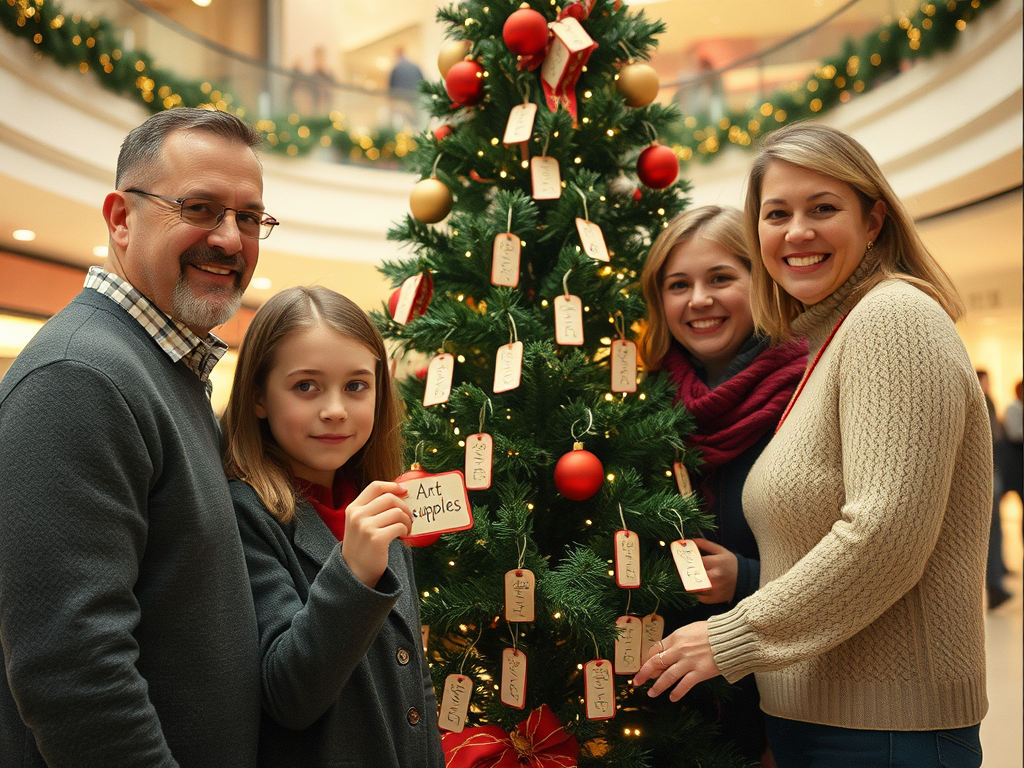
The Parkers were at the mall to buy last-minute gifts when 10-year-old Emma spotted the brightly lit “Giving Tree” in the corner of the main atrium.

“What’s that?” Emma asked, tugging on her mom’s sleeve.

“It’s a giving tree,” her dad, Greg, explained. “People write down things they need for the holidays, and others can choose to fulfill their wishes.”

Emma’s eyes widened. “Can we pick one?”

Greg hesitated. “We’re already behind on our shopping.”

But Emma was persistent. “Please, Dad? Someone might really need our help.”

Greg sighed but smiled. “Alright, let’s take a look.”

The family approached the tree, which was covered in small, handwritten tags. Each tag bore a wish—some simple, others heartbreaking:

  • “A warm coat for my daughter.”
  • “Groceries for our family.”
  • “A toy train for my son.”
  • “Shoes so I can walk to work.”

One tag caught Emma’s attention. It read: “Art supplies. I want to be an artist someday.”

“This one!” Emma said, holding up the tag.

“Let’s take a few more,” her mom, Sarah, suggested. They ended up choosing five wishes in total, each one reflecting something they could relate to or felt compelled to help with.

Fulfilling the Wishes

Back home, the Parkers got to work. Emma and her older brother, Ben, searched online for the perfect art supplies—sketchbooks, paints, and pencils. Greg went out to buy a coat for the little girl who needed one, while Sarah packed a box with non-perishable groceries.

For the boy who wanted a toy train, the family picked out a beautifully detailed set that Emma insisted was “the coolest.” And for the man who needed shoes, they bought a sturdy pair along with warm socks.

“It feels different, doesn’t it?” Sarah said that evening as they wrapped the gifts. “Doing this instead of just shopping for ourselves.”

“It feels good,” Ben admitted.

Delivering More Than Gifts

The family returned to the mall to drop off the gifts. As they placed their packages under the tree, a woman who worked with the Giving Tree program approached them.

“Thank you for doing this,” she said warmly. “You’d be amazed at how much these simple gestures mean to people.”

“Do we ever get to meet the people we’re helping?” Emma asked.

“Not usually,” the woman replied. “But sometimes, they send thank-you notes. Keep an eye on your mailbox.”

A Ripple Effect

The Parkers returned to their routine, but something had shifted. Their conversations at dinner turned from gift lists and holiday plans to wondering about the people behind the tags.

“Do you think the kid who wanted art supplies will paint something amazing someday?” Emma asked one night.

“Maybe,” Sarah said. “And maybe we’ll have helped them take the first step.”

Two weeks later, a thank-you card arrived in the mail. It was from the young artist:

“Dear strangers, thank you for the art supplies. No one has ever given me something like this before. I promise to use them to make beautiful things. Happy holidays!”

The family read the note together, their hearts swelling.

“That’s the best gift we’ve gotten this year,” Greg said.

A New Tradition

The experience stayed with the Parkers long after the holidays. The next December, they returned to the Giving Tree, but this time they did more. Greg organized a coat drive at work, Sarah baked cookies to sell for charity, and Ben got his school involved in collecting toys.

By the third year, they had inspired other families in their neighborhood to “adopt” wishes, turning a single act of kindness into a community-wide tradition.

For the Parkers, the Giving Tree became more than just a holiday activity—it was a reminder of what the season was truly about: connection, generosity, and the joy of helping others.

And in fulfilling strangers’ wishes, they found something they hadn’t even realized was missing: a deeper bond with one another and a renewed sense of purpose that carried them through every season of the year.

The Midnight Rescuers

The storm that swept through Willow Creek was the worst anyone had seen in decades. Fierce winds howled through the night, tearing off roofs and uprooting trees. By morning, the small town lay in shambles, and the swollen river had flooded its banks, leaving homes submerged and roads impassable.

As the townspeople began assessing the damage, 14-year-old Olivia Taylor peered out her bedroom window at the rising water. Her heart sank when she spotted a shivering dog stranded on the roof of a shed half-submerged in the flood.

“We have to help it,” Olivia said to her father, who was busy boarding up broken windows.

“It’s too dangerous right now,” he replied, shaking his head. “We’ll call the shelter later.”

But Olivia couldn’t wait. She grabbed her raincoat and ran outside to get a better look.

A Call for Help

By the time Olivia reached the end of her street, she had seen more animals in trouble—cats perched in trees, chickens clinging to a fence, and even a horse stuck in a muddy field.

Determined to help, Olivia ran to her neighbor Ethan, a high school senior known for his calm demeanor and love of animals. “Ethan, there are animals everywhere that need saving,” she said breathlessly.

Ethan frowned but nodded. “You’re right. Let’s see who else we can get to help.”

The two of them knocked on doors, recruiting neighbors who were willing to brave the stormy aftermath. By the time the sun began to set, they had assembled a group of six:

  • Mrs. Daniels, a retired veterinarian
  • Jonah, a college student home on break
  • Maya and Carlos, siblings who volunteered at the local animal shelter
  • And, of course, Olivia and Ethan

The Midnight Plan

The group gathered in Ethan’s garage to make a plan. Mrs. Daniels sketched a map of the area, marking the locations where animals had been reported stranded.

“We need to act quickly,” she said. “But safety comes first. Stick together, and don’t go near the river—it’s too dangerous.”

Ethan divided the group into pairs and assigned each team a section of the neighborhood to search. Jonah brought his canoe, and Maya grabbed the shelter’s supply of animal carriers.

By nightfall, they were ready.

Rescues Under the Stars

Armed with flashlights, the neighbors ventured into the flooded streets. The sound of rushing water filled the air, but the rescuers pressed on.

Olivia and Ethan were the first to make a rescue—a tiny kitten stranded on a piece of driftwood. Ethan waded carefully into the water while Olivia held the flashlight steady.

“Got it!” Ethan said, cradling the soaked but unharmed kitten.

Meanwhile, Jonah and Carlos used the canoe to reach the stranded dog Olivia had seen earlier. The dog wagged its tail weakly as they lifted it into the boat.

Maya and Mrs. Daniels found a coop full of chickens clinging to the top of a collapsed fence. Maya gently scooped up each bird while Mrs. Daniels checked them for injuries.

A Race Against Time

As the night wore on, the group’s teamwork paid off. They saved a horse by guiding it to higher ground, coaxed a family of ducks out of a storm drain, and even rescued a frightened raccoon stuck on a floating log.

But the most challenging rescue came just before dawn.

Ethan received a call from a neighbor who had spotted a deer trapped in the corner of a flooded pasture. The water was rising fast, and the deer couldn’t climb over the fence to safety.

The group hurried to the scene. With ropes and makeshift tools, they worked together to break open the fence and guide the panicked animal to dry land.

By the time they succeeded, the sun was beginning to rise, casting a golden glow over the town.

A Community United

In the days that followed, news of the midnight rescues spread throughout Willow Creek. The rescued animals were taken to the local shelter, where they received care and were reunited with their owners or rehomed.

The rescuers became local heroes, but they didn’t see themselves that way.

“We just did what anyone would do,” Ethan said humbly when interviewed by the local paper.

Olivia, however, felt differently. “We showed that even in the darkest times, we can come together to help those who can’t help themselves,” she said.

A New Tradition

Inspired by their success, the neighbors decided to form a permanent group called “The Midnight Rescuers.” They met regularly to train for future emergencies, ensuring that no animal—or person—would be left behind again.

And every time Olivia looked at the kitten she had adopted from that stormy night, she remembered how a simple act of courage could ripple into something extraordinary.

Shoes That Travel

Fifteen-year-old Maya Perez had a habit of noticing things other people overlooked. Walking home from school one chilly afternoon, she saw a boy about her age sitting on the curb outside a bus stop. His jacket was worn, but what caught her attention were his shoes—tattered sneakers with holes so big she could see his socks poking through.

“Are you okay?” she asked, hesitating a few steps away.

The boy looked up, startled. He nodded but didn’t say anything. Maya glanced at his shoes again.

“I—uh—have an extra pair of sneakers at home,” she said awkwardly. “If you want them, I could bring them tomorrow?”

The boy’s face softened, and he gave a small smile. “That’d be cool. Thanks.”

The Start of an Idea

That night, Maya rummaged through her closet and found the sneakers she had outgrown last year. They were still in good shape—practically new.

As she packed them into a bag, a thought struck her. If she had shoes she didn’t need, others probably did too. And there had to be more kids like the boy at the bus stop who could use them.

By the time she fell asleep, Maya had a plan.

Collecting Shoes

The next day at school, Maya stood in the cafeteria holding a poster she had hastily made the night before. It read:

“Shoes That Travel: Donate Your Gently Used Shoes to Someone in Need!”

“Are you starting a shoe store or something?” joked her friend Liam as he walked by.

“No,” Maya said, grinning. “I’m starting a shoe movement.”

She explained her idea: to collect shoes from the community and distribute them to people who needed them. Liam was intrigued. “I’ve got a couple of pairs at home I can bring in. Want help spreading the word?”

With Liam’s help, Maya’s project took off. They set up donation boxes at school, the local library, and the community center. Over the next few weeks, the boxes filled with sneakers, boots, sandals, and even some shiny dress shoes.

Finding the Right Homes

Collecting the shoes was the easy part. The challenge was figuring out where they should go. Maya reached out to local shelters, youth centers, and even an organization that supported refugees. Each group welcomed her donations with open arms.

But Maya wanted to do more than just drop off the shoes. She wanted to know their stories—where they went and how they helped.

Following the Shoes

Maya included a small card with each pair of shoes, inviting the recipients to share their journey if they wanted to.

One card came back from a single mom named Clara, who had picked out a sturdy pair of boots for her son, Alex. “These boots mean Alex can walk to school comfortably in the winter,” Clara wrote. “Thank you for helping us keep going.”

Another card came from Lina, a refugee from Syria who had fled to the U.S. with her family. She wrote, “The shoes remind me of my old life, where I worked in a shoe factory. They also remind me of hope—for a new beginning.”

Even the shiny dress shoes found a purpose. A teenager named Marcus wore them to a job interview. “I got the job,” he wrote. “First step toward my dreams.”

Growing the Movement

Encouraged by these stories, Maya shared them on social media. Her posts caught the attention of a local news station, which aired a segment about “Shoes That Travel.” Donations poured in from neighboring towns, and Maya had to recruit more friends to sort and distribute the shoes.

The project grew beyond anything she had imagined. A nearby shipping company offered to help transport shoes to distant communities, and a local nonprofit partnered with Maya to expand her reach.

One Pair at a Time

Maya never forgot the boy at the bus stop who started it all. She saw him again a few months later, wearing the sneakers she had given him.

“Hey,” she called out, waving.

He grinned. “Hey! Thanks again for these. They’re awesome.”

Maya smiled. “They look great on you.”

As she walked away, her heart swelled with pride. She realized that each pair of shoes wasn’t just about covering feet—it was about giving people the confidence and comfort to take their next step.

And step by step, the shoes kept traveling, connecting lives and stories, proving that even something as simple as an old pair of sneakers could change the world.

The Forgotten Heroes

The small town of Millfield was a quiet place where everyone knew each other. But, like many towns, there were people who worked tirelessly behind the scenes—keeping the streets clean, delivering mail in rain or shine, and ensuring everyone was safe—without much recognition.

For 12-year-old Rosie and her friends, these people were the town’s forgotten heroes.

The Spark of an Idea

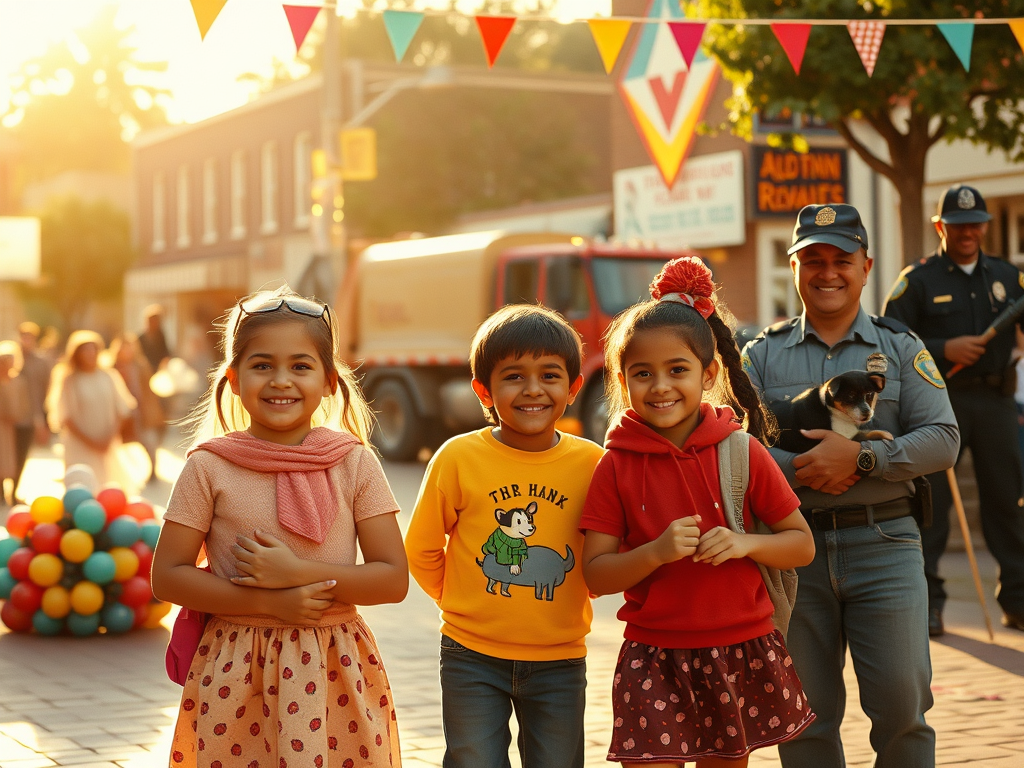
One afternoon, while sitting on the swings at the park, Rosie noticed Mr. Hank, the garbage collector, picking up litter left behind after the weekend fair. His back was hunched, and his movements were slow, but his determination was steady.

“Does anyone ever thank him?” Rosie wondered aloud.

Her best friend, Leo, shrugged. “Probably not. People just expect him to do it.”

“What about Mrs. Patel at the library?” chimed in Emma, another friend. “She stays late to help kids with their homework, but no one ever talks about her.”

Rosie’s eyes lit up. “What if we change that? What if we throw a party for all the people who do so much for Millfield but never get the thanks they deserve?”

Planning the Celebration

The group got to work immediately. They called themselves the “Hero Hunters” and started brainstorming.

First, they made a list of unsung heroes:

  • Mr. Hank, the garbage collector
  • Mrs. Patel, the librarian
  • Officer Ramirez, the kind-hearted cop who always helped lost pets
  • Ms. Green, the crossing guard who braved every kind of weather
  • Mr. Joe, the mailman who always greeted everyone with a smile

Then, they started planning the surprise celebration. They decided to hold it in the town square on a Saturday afternoon.

To keep it a secret, they enlisted the help of their parents, teachers, and even the mayor. Everyone was excited to help, donating food, decorations, and even a local band to play music.

Invitations with a Twist

The trickiest part was getting the heroes to the event without spoiling the surprise. Rosie came up with a clever plan: each hero received a letter that simply said, “Please come to the town square on Saturday at 3 PM for a special community event.”

No further details were given.

The Big Day

When Saturday arrived, the town square was transformed. Colorful banners hung from the lampposts, tables were piled with food, and a stage was set for speeches and performances.

As the clock struck three, the heroes began to arrive. Mr. Hank showed up in his work uniform, looking confused. Mrs. Patel walked in, clutching her ever-present stack of books. Officer Ramirez and Ms. Green arrived together, both equally puzzled.

“What’s going on?” Mr. Joe asked, adjusting his mailbag.

That’s when Rosie stepped onto the stage, microphone in hand.

“Welcome, everyone!” she began, her voice shaking slightly but growing stronger. “Today is a special day because it’s all about you—our heroes.”

A Day of Gratitude

The crowd cheered as Rosie introduced each hero and shared why they were being celebrated. Stories poured out—how Mr. Hank once returned a lost wallet he found while collecting trash, how Mrs. Patel stayed late to help Emma learn to read, and how Officer Ramirez reunited a stray dog with its family.

Each hero was presented with a handmade certificate, a bouquet of flowers, and a heartfelt thank-you from the kids.

By the time the band started playing, there wasn’t a dry eye in the square.

A Lasting Impact

The celebration was a turning point for Millfield. It reminded everyone to appreciate the quiet, everyday acts of kindness that kept the town running.

The “Hero Hunters” didn’t stop there. They turned their group into an annual event-planning committee, organizing celebrations for new heroes every year.

As for the original heroes, they carried their certificates and memories with pride, knowing they were seen, valued, and loved.

And for Rosie and her friends, it was proof that even the smallest voices could create something big—a wave of gratitude that would ripple through Millfield for years to come.

A Bridge to the Future

When the storm swept through Maple Grove, it brought more than just rain and wind—it brought devastation. Trees were uprooted, power lines downed, and the bridge that connected the town to its neighboring communities was completely destroyed.

The old wooden bridge had been more than just a way across the river; it was a lifeline. Farmers used it to transport their goods to market, children crossed it to reach their school, and friends met halfway for picnics by its banks. Without it, the town felt cut off from the world—and from each other.

Assessing the Damage

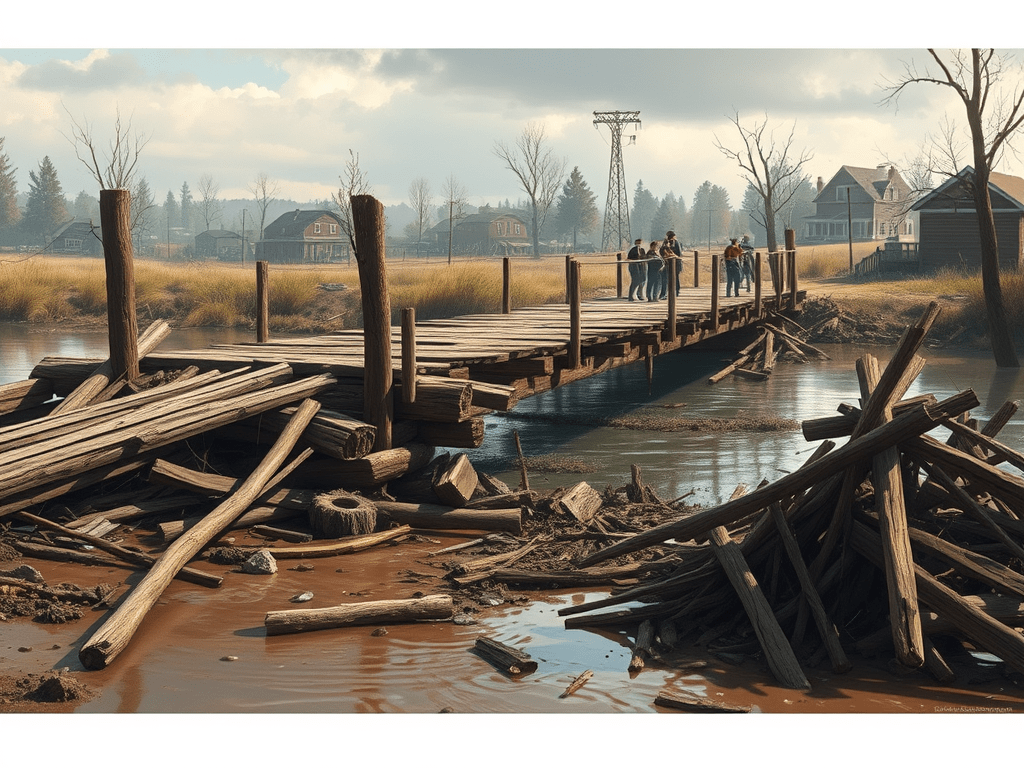
The morning after the storm, the townspeople gathered by the river. The once-sturdy bridge was now a pile of splintered wood and twisted metal, scattered like matchsticks along the muddy banks.

“What are we going to do?” asked Mr. Carter, the town’s baker. “We can’t afford to rebuild it. And even if we could, it would take months.”

The mayor, a pragmatic woman named Ellen, nodded grimly. “We’ll find a way,” she said. “This bridge isn’t just about crossing the river—it’s about who we are.”

The First Steps

The town held a meeting in the school gym that evening. Ideas were tossed around, but no one could agree on a solution. Then, a quiet voice cut through the noise.

“We could do it ourselves,” said Jonah, a retired carpenter.

The room fell silent.

Jonah stood and cleared his throat. “I know it sounds impossible. But if we work together—if everyone contributes what they can—I think we can rebuild this bridge.”

A murmur of agreement spread through the crowd.

“I can design it,” said Lisa, an architect who had moved back to Maple Grove to care for her aging parents.

“And I’ll provide the wood,” offered Mr. Langley, who owned the lumber mill on the outskirts of town.

One by one, people raised their hands, volunteering their skills, time, and resources.

Rebuilding Together

The next weekend, work began. Jonah taught a group of volunteers how to sand and shape the wood. Lisa organized the construction plan, breaking it down into manageable tasks.

Children painted signs to cheer on the workers, and Mrs. Thompson, the town’s unofficial chef, set up a food station to keep everyone fed.

At first, progress was slow. There were arguments over how to handle certain tasks and setbacks when materials ran short. But the community persisted, driven by the belief that they were building something bigger than a bridge—they were rebuilding their town’s spirit.

Overcoming Challenges

One day, heavy rains threatened to wash away the foundations they had laid. The workers scrambled to secure the site, forming a human chain to carry sandbags to the riverbank. Soaked and exhausted, they managed to save their progress.

“Nothing worth building is ever easy,” Jonah said, patting the shoulder of a teenage boy who had been ready to give up.

Those words became the team’s motto, written in chalk on the makeshift workstation and repeated whenever morale faltered.

The New Bridge

Months later, on a crisp autumn morning, the new bridge was finally complete. Made of strong timber and reinforced steel, it was sturdy and beautiful, with decorative railings carved by local artisans.

The whole town gathered for the ribbon-cutting ceremony. Jonah, Lisa, and the mayor stood at the center, scissors in hand.

“This bridge is more than a structure,” Ellen said, addressing the crowd. “It’s a symbol of what we can accomplish when we come together. It’s a bridge to our future.”

As the ribbon was cut, cheers erupted, and the first group of children ran across, their laughter echoing in the crisp air.

A Lasting Legacy

The new bridge quickly became a source of pride for Maple Grove. It brought back commerce, reconnected families, and became a destination for visitors who admired its craftsmanship and the story behind it.

More importantly, it reminded the townspeople of their resilience and the strength of their community.

Years later, a plaque was added to the bridge’s entrance. It read:

“This bridge was built by the hands and hearts of Maple Grove. May it always stand as a testament to the power of unity and hope.”

And stand it did, carrying the weight of countless stories, dreams, and journeys for generations to come.

The School with No Boundaries

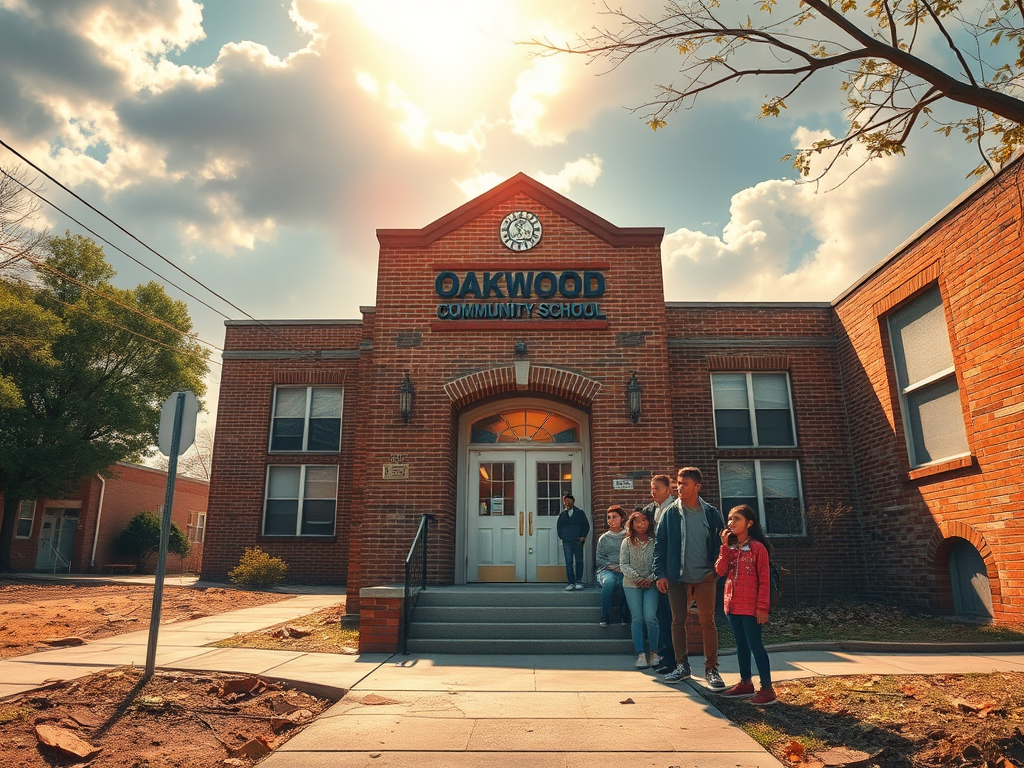
The faded brick building of Oakwood Community School sat at the edge of the city, surrounded by crumbling sidewalks and neglected lots. Its students were often dismissed as “troublemakers” or “lost causes,” and many teachers came and went, unable to connect with the kids who walked through its doors.

But when Ms. Clara Dawson arrived, she saw something different. A new hire straight out of graduate school, she didn’t see the defiance in their eyes as hostility; she saw fear. She didn’t interpret their silence as apathy; she saw potential waiting to be unlocked.

Meeting the Students

Clara’s first day was chaotic. Kids shuffled into her classroom, some talking loudly, others slouching in their seats with earbuds in. The walls were bare, the desks were scratched with years of graffiti, and the air buzzed with tension.

“Good morning, everyone,” Clara began with a warm smile. She wrote her name on the board. “I’m Ms. Dawson, and this is our classroom.”

One student, a tall boy named Jamal, snorted. “What’s that supposed to mean?”

“It means we’re going to make this a space where we all belong,” she said confidently. “A space where you get to decide what you want to learn and who you want to be.”

The room fell silent for a moment, the students exchanging skeptical glances.

Breaking Down Walls

Clara quickly realized that traditional methods wouldn’t work. Many of her students came from difficult circumstances—poverty, unstable homes, systemic inequities—and carried those burdens into the classroom.

So, she tore up the curriculum.

One day, she brought in a collection of discarded materials: wood scraps, fabric, old paint cans, and a box of broken tools. “We’re building something,” she announced.

“What kind of something?” asked Maria, a quiet girl who often sat in the back doodling in her notebook.

“Anything you want,” Clara replied. “A birdhouse, a sculpture, a piece of furniture. The only rule is that you work together.”

The students were hesitant at first, but soon, Jamal started sketching out ideas, Maria joined in to add her artistic flair, and others chipped in with their unique skills. By the end of the week, they had built a colorful bench for the school’s front lawn.

“This is what you’re capable of,” Clara said as they admired their work. “You can create things that make the world better.”

Expanding Horizons

Clara introduced projects that connected her students to the world beyond their neighborhood. She arranged a partnership with a local university, where the students could use the science lab. They studied water quality in their community and presented their findings at a city council meeting, advocating for cleaner parks and playgrounds.

She organized field trips to museums, theaters, and even a tech startup, showing them possibilities they hadn’t considered before.

“You belong in these spaces,” Clara told them repeatedly. “Never let anyone tell you otherwise.”

Discovering Potential

Jamal, who had a reputation for being disruptive, revealed a talent for engineering. Clara helped him apply for a summer robotics program, and he got in.

Maria, once shy and withdrawn, blossomed as an artist. Clara encouraged her to submit her work to a citywide contest, where she won first place.

And then there was Noah, who had struggled with reading. Clara stayed after school with him every day, patiently helping him decode words. By the end of the year, he stood up during a school assembly and read a poem he’d written himself.

A Classroom Without Limits

Word spread about Ms. Dawson’s class. Other teachers began adopting her hands-on, student-centered approach. The school transformed from a place of frustration and failure to a hub of creativity and hope.

The following year, Clara painted a mural with her students on the side of the school. It depicted a tree with roots spreading wide and branches reaching toward the sky, filled with books, tools, and stars.

At the base of the tree were the words:
“There are no boundaries to what you can achieve.”

The Legacy of Hope

Years later, many of Clara’s students returned to Oakwood to share their stories. Jamal was now an engineer, Maria a graphic designer, and Noah a teacher working with kids who struggled like he once had.

They credited their success to a teacher who saw their potential when no one else did, who created a school without boundaries—a place where they learned not just academics, but how to believe in themselves.

And Clara, watching her former students thrive, knew that her dream had come true.

The Wish That Grew

The town of Willow Creek had seen better days. Once a thriving community, its factory had closed down a decade ago, leaving many out of work. The streets were quieter, the storefronts emptier, and hope seemed as distant as the stars.

But for ten-year-old Mia Harper, the world was still full of wonder. She spent her days exploring the fields near her house, collecting shiny pebbles, and dreaming of brighter days.

One summer evening, as the town prepared for an unusually brilliant meteor shower, Mia’s mother, a waitress at the town diner, took her to the park. The sky was a deep indigo, and the first streaks of light danced across the heavens.

“Make a wish, Mia,” her mother said, leaning close.

Mia clasped her hands together and squeezed her eyes shut. Her lips moved silently as she whispered a single wish:
“I wish for Willow Creek to feel happy again.”

The First Spark

The next morning, Mia found an envelope on their front porch. It had no name, just the words: “For Something Beautiful.” Inside was a $20 bill.

“Mama, look!” she exclaimed, running into the kitchen.

Her mother was just as surprised. “Who would leave this here?”

Mia didn’t know, but she had an idea. “Let’s do something good with it,” she said.

Her mother agreed, and together they bought a packet of wildflower seeds. They spent the afternoon sprinkling them in the bare patch of land outside the diner.

A Garden of Hope

Over the next few weeks, something magical happened. The flowers began to grow, bringing splashes of vibrant color to the gray, cracked soil. Customers at the diner noticed and smiled as they passed.

One day, old Mr. Thompson, who owned the hardware store, stopped by to admire the blooms. “This place needs more of that,” he said, tipping his hat.

The next morning, he left a box of paint and brushes outside the diner. “For Something Beautiful,” the note read.

Inspired, the townsfolk started painting murals on the sides of buildings. Bright flowers, cheerful suns, and even a giant rainbow soon adorned Willow Creek’s streets.

A Ripple of Kindness

Mia’s simple act sparked a chain reaction. Mrs. Carter, who ran the bookstore, decided to host a free story hour for kids every Saturday. The town librarian started a seed exchange program, encouraging residents to grow their own gardens.

Even the mayor got involved, organizing a town cleanup day. “If we’re going to bring back Willow Creek,” he said, “we need to start with pride.”

For the first time in years, laughter and chatter filled the town square.

The Meteor Shower Festival

As summer turned to fall, the town decided to hold a festival to celebrate their progress. They called it the Meteor Shower Festival, in honor of the night that had started it all.

Mia was invited to speak at the event. Nervous but excited, she stood on a small stage in the town square, a bouquet of wildflowers in her hands.

“I made a wish that night,” she said, her voice clear and bright. “I wished for Willow Creek to feel happy again. But it wasn’t the wish that made it happen—it was all of you. Together, we turned this town into something beautiful.”

The crowd erupted in cheers and applause.

A Wish Fulfilled

By the next year, Willow Creek was unrecognizable. New businesses opened, tourists came to see the murals, and the gardens flourished. The spirit of the town had returned, thanks to a little girl’s wish and the kindness it inspired.

And every summer, during the Meteor Shower Festival, the people of Willow Creek looked to the stars—not to make new wishes, but to celebrate the one that had already come true.

The Butterfly Garden

The Johnson family’s backyard had always been a patch of uneven grass and wild weeds. But to nine-year-old Sophie, it was her kingdom. She’d sit for hours imagining castles, magical creatures, and secret adventures.

One spring morning, Sophie was sitting by the window, watching a lone butterfly flutter among the dandelions. Her mother, Laura, walked in with a cup of tea and a weary smile. Sophie’s illness had taken a toll on the whole family, but her daughter’s spirit remained unbroken.

“Mom,” Sophie said, her voice filled with quiet wonder, “what if we turned the yard into a garden? A garden just for butterflies.”

Laura hesitated, unsure of how much energy Sophie had for such a big project. But Sophie’s eyes sparkled with excitement. “A garden where everyone could feel happy, just like I do when I see butterflies.”

Laura nodded, her heart full. “Let’s do it.”

Planting Hope

The next weekend, Sophie and her parents began transforming the yard. Sophie picked out colorful flowers—milkweed, zinnias, and marigolds—that would attract butterflies. Her dad, Eric, dug up the weeds while Sophie directed him like a foreman, giggling whenever he dramatically wiped his brow.

Neighbors noticed the activity and stopped by to help. Mrs. Bennett from next door brought over a bag of soil, and Mr. Patel offered wooden planks for raised flower beds. Soon, it wasn’t just Sophie’s family working on the garden—it was the whole community.

As the garden grew, Sophie spent her days painting small signs with names like “Butterfly Bistro” and “Puddle Paradise.” Her favorite spot was a small bench beneath a willow tree, where she could sit and watch the butterflies dance.

The First Visitor

By mid-summer, the garden was alive with color. Butterflies of all shapes and sizes flitted between the flowers, and Sophie’s giggles echoed through the yard.

One afternoon, a boy named Ben visited with his mom. Ben had recently moved to the neighborhood and was painfully shy. Sophie, sitting on her bench, waved him over.

“Do you like butterflies?” she asked.

Ben nodded but didn’t say much. Sophie handed him a tiny painted rock shaped like a butterfly. “This is your ticket to the garden,” she said with a grin.

For the first time, Ben smiled. He began visiting the garden daily, helping Sophie water the plants and even painting rocks for other visitors.

A Garden of Connection

As word spread, more people came to see the garden. Some came to admire its beauty; others came seeking solace.

One day, Mrs. Thompson, who had recently lost her husband, sat on Sophie’s bench. “This place feels magical,” she said, her voice trembling.

Sophie, now frailer but just as spirited, smiled warmly. “Butterflies always bring good things. Maybe they’ll bring you something happy, too.”

Mrs. Thompson nodded, tears glistening in her eyes.

Sophie’s Legacy

As summer turned to autumn, Sophie grew weaker. She could no longer spend as much time in the garden, but her parents would wheel her out to the bench whenever the weather allowed. One crisp October morning, Sophie sat quietly, watching a monarch butterfly land on her hand.

“They’re so free,” she whispered. “That’s what I want this garden to be—a place where people can feel free, happy, and loved.”

Those were her last words in the garden.

Sophie passed away peacefully a few days later, surrounded by her family.

Blooming Hope

In the weeks following Sophie’s passing, the community came together to honor her memory. They added a plaque near her bench that read:

“The Butterfly Garden: A place of hope, joy, and love, created by Sophie Johnson, who believed in the magic of butterflies and the beauty of life.”

The garden didn’t wither in her absence. It flourished. Visitors continued to come—not just for the flowers and butterflies, but for the peace the garden seemed to offer.

Children painted rocks, families planted new flowers, and people from all walks of life found comfort on Sophie’s bench. Ben, now one of the garden’s young caretakers, often told visitors about Sophie’s dream.

“She wanted everyone to feel happy here,” he’d say, his voice filled with pride. “And they do.”

The Garden That Grew Hearts

Years later, the garden remained a vibrant sanctuary. Sophie’s story inspired others to create similar gardens in nearby towns. What began as one child’s dream became a ripple of kindness and connection that reached far beyond her backyard.

And on quiet days, when the sun was just right, visitors to the garden could see butterflies soaring high, as if carrying Sophie’s spirit with them, spreading joy wherever they went.

The Lighthouse Keeper’s Gift

For fifty years, Arthur Winslow had tended the North Point Lighthouse. Perched high on the rocky cliffs, the lighthouse had stood as a beacon for sailors braving the treacherous waters of the northern coast. And Arthur, with his weathered hands and steady resolve, had been its keeper, ensuring the light never faltered, no matter how fierce the storm.

But time, like the tides, could not be stopped. At seventy-five, Arthur knew it was time to retire. The town of Windmere, nestled just below the cliffs, planned a farewell party in his honor. Arthur appreciated the gesture, but he had something far grander in mind—a parting gift for the community he cherished.

The Hidden Map

On his final morning as lighthouse keeper, Arthur climbed the spiral stairs one last time. In the small room beneath the lantern, he placed a sealed envelope on the desk. Written on it in his careful script were the words:

“To the People of Windmere—A Gift Awaits You.”

Then, he left the lighthouse, locking the heavy wooden door behind him.

At his farewell party that evening, Arthur stood before the gathered townsfolk. “This lighthouse has been my life,” he said, his voice steady but tinged with emotion. “But the real treasure of Windmere isn’t its light. It’s all of you.”

Before he could continue, a child’s voice called out, “What’s in the envelope, Mr. Winslow?”

Arthur chuckled. “That’s for you all to discover. But I’ll say this: it’s a map. And if you follow it, you’ll find something that I hope will bring this town a little hope and a lot of joy.”

Curiosity swept through the crowd. A map? A treasure hunt? The envelope was opened, revealing a hand-drawn map of Windmere and its surroundings, marked with clues and a large “X” near the cliffs.

The Hunt Begins

The next morning, nearly the entire town gathered at the starting point—a weathered oak tree in the town square. The first clue was nailed to the trunk:

“Where the gulls take flight and the waves kiss stone, your journey begins—look beneath the groan.”

“That’s the old dock!” called Mrs. Langley, the bakery owner. “The planks groan under your feet when you walk there!”

Excited chatter filled the air as the townsfolk hurried to the dock. Beneath a loose plank, they found the next clue:

“Follow the path where wildflowers grow, to the place where the wind and memories blow.”

The townspeople laughed and worked together, their imaginations ignited. Young and old joined in, from toddlers holding parents’ hands to retired fishermen who hadn’t been this lively in years. The clues took them through the meadow, past the abandoned windmill, and up the winding trail to the cliffs.

The Final Clue

At the top of the cliffs, where the lighthouse stood tall against the sky, the final clue awaited, etched into a stone at its base:

“Beneath the beacon’s gaze, where light meets earth, the treasure lies.”

Everyone fanned out, searching. It was young Ella, the same child who’d interrupted Arthur at the party, who found the spot—a small patch of disturbed earth near the lighthouse. With a little digging, they uncovered a wooden chest.

The crowd fell silent as the chest was opened, revealing its contents:

  1. A leather-bound journal filled with Arthur’s handwritten stories and sketches of the town and its people over the years.
  2. A bundle of letters addressed to various townsfolk, each containing personal notes of gratitude and encouragement.
  3. A rolled-up deed to the lighthouse, accompanied by a letter:

“Dear Windmere,
This lighthouse has guided many through storms, but it has also been a symbol of hope for this town. I leave it to you, the community, to preserve as a beacon—not just for sailors, but for all who seek light in their darkest hours. Together, you can ensure it shines for generations to come.”

Inside the chest was also a small pouch of gold coins. Arthur’s savings, enough to start a fund for the lighthouse’s upkeep.

A Legacy of Light

Tears filled many eyes as they read Arthur’s words. The treasure wasn’t gold or jewels—it was the reminder of their shared strength, history, and responsibility to one another.

Over the next months, the town rallied. They restored the lighthouse, transforming it into a museum and community center. Arthur’s journal and letters became a cherished exhibit, inspiring future generations to contribute to their town in meaningful ways.

Though Arthur moved to a quiet cottage a few miles away, he often visited the lighthouse. Every time he did, he saw a thriving community that had been brought closer by his gift. The light at North Point still shone, but so, too, did the light within the people of Windmere.

And in that, Arthur knew, his legacy would endure.