Free Haircuts for Hope

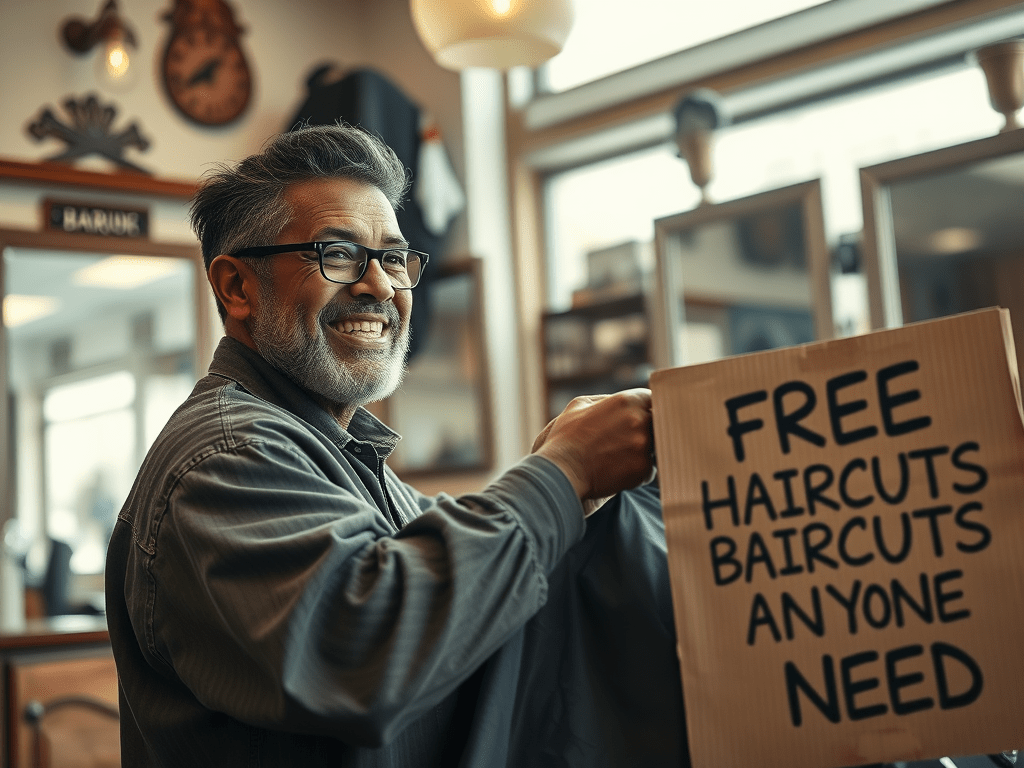
Elliot “Eli” Carter loved being a barber. For years, his small shop on the corner of Main and Elm had been a sanctuary for people from all walks of life. He wasn’t just cutting hair—he was listening, laughing, and connecting. But recently, Eli noticed fewer familiar faces.

The neighborhood was struggling. Layoffs at the factory had left many without steady income, and the rising cost of living made it hard for people to afford even the basics, let alone a haircut.

One rainy Tuesday, Eli looked out the window of his empty shop and made a decision. He grabbed a piece of cardboard, scribbled a message with a marker, and propped it up in his shop window:
“Free Haircuts for Anyone in Need. No Questions Asked.”

A Simple Start

The next morning, Eli wasn’t sure what to expect. At first, no one came. But just as he was about to sweep the floor, a man hesitantly walked in. His clothes were worn, and he avoided eye contact.

“Are you really offering free haircuts?” the man asked.

Eli smiled. “You bet. Have a seat.”

As he worked, the man relaxed and started talking. His name was Dave, and he’d been out of work for months. “I have a job interview tomorrow,” he said quietly. “Figured a haircut might help me look the part.”

Eli handed him a mirror when he was done. “You’ve got this,” he said, clapping Dave on the shoulder.

Word spread quickly. By the end of the week, Eli’s shop was buzzing with people. Parents brought their kids before school. A young woman who was couch-surfing came in for her first trim in over a year. A man with a scruffy beard joked that Eli had shaved off a decade of his life.

Eli didn’t just give haircuts—he gave dignity. Each person walked out a little taller, their burdens a little lighter.

The Ripple Effect

One afternoon, a local reporter stopped by after hearing about Eli’s free haircuts. The story aired on the evening news, and soon, Eli’s small act of kindness became the talk of the town. People began dropping by the shop—not for haircuts, but to leave tips, supplies, and even food for those in need.

Inspired by Eli’s example, other barbers and stylists in the city started offering free haircut days. A salon downtown organized a “Cuts for Confidence” event, while a barber school began teaching students the importance of giving back.

Eli’s idea even spread beyond barbershops. A nearby bakery started giving out free bread to families. A mechanic offered discounted repairs for single parents. Acts of kindness multiplied, creating a wave of hope that touched the entire city.

The Day That Changed Everything

One day, as Eli was finishing up a haircut for a young boy, a familiar face walked into the shop—it was Dave, the man who’d come in that first day. This time, he was wearing a suit and holding a bouquet of flowers.

“I got the job,” Dave said, grinning. “And it’s all thanks to you.”

Eli laughed, shaking his head. “Nah, you did that yourself.”

Dave insisted on handing Eli the flowers. “You didn’t just cut my hair. You gave me a chance to see myself differently. That made all the difference.”

A Legacy of Kindness

As the years went by, Eli’s shop remained a cornerstone of the community. Though he never charged for the free haircuts, the generosity of others always kept the lights on and the scissors sharp.

Eli often said that the best part of the experience wasn’t the haircuts—it was seeing how one small act could inspire so many.

“You never know who needs a little hope,” he’d tell new barbers who came to learn from him. “And sometimes, all it takes is a haircut.”

The city eventually declared September 15th “Hope Day” in honor of Eli’s contribution, encouraging residents to perform acts of kindness. But for Eli, every day was a chance to give.

And so, with clippers in hand and a heart full of compassion, Eli continued his mission: to remind everyone that hope could start small but grow into something beautiful.

The Traveling Toy Chest

The idea for the Traveling Toy Chest began on a rainy afternoon in the Lambert family’s cluttered garage. Ten-year-old Ellie had been trying to find a place for her old dollhouse when she stumbled over a stack of forgotten board games.

“Mom,” she called, holding up a dust-covered box. “We haven’t played this in years.”

Her mom, Rachel, peered into the garage and sighed at the rows of neglected toys, books, and games. “You’re right, Ellie,” she said. “There’s a lot in here we don’t use anymore.”

That night, Ellie overheard her parents talking at the dinner table. Her dad, a social worker, mentioned how some of the kids he worked with didn’t have toys to play with at home. Ellie’s heart ached at the thought. An idea started to form in her mind.

“What if we share our toys?” she blurted out. “With kids who don’t have any?”

Her parents exchanged a surprised look, and then her dad smiled. “You know, that’s not a bad idea.”

Building the Toy Chest

The next weekend, the Lambert family began their project. They gathered all the toys, books, and games they no longer used and sorted them into piles. Ellie’s little brother, Ben, reluctantly gave up his old train set but quickly brightened when Ellie explained their plan.

Rachel designed colorful flyers that read:
“Do you have gently used toys to share? Help us create the Traveling Toy Chest to bring smiles to kids in need!”

The family spread the word at schools, libraries, and community centers. Donations poured in. Neighbors, coworkers, and even strangers dropped off bags filled with stuffed animals, action figures, puzzles, and art supplies.

The next step was finding a way to deliver the toys. Ben had an idea. “What about Grandpa’s old camper?” he asked. The camper had been sitting unused in the backyard for years. With Grandpa’s blessing, the family scrubbed, painted, and transformed it into a mobile toy library, complete with shelves, bins, and a cheerful sign on the side that read:
The Traveling Toy Chest – Bringing Joy to Kids Everywhere!

Hitting the Road

The Traveling Toy Chest made its first trip to a community center in a nearby town. As the camper pulled up, children’s faces lit up with excitement. Ellie and Ben helped the kids explore the shelves, letting them pick toys to borrow or keep.

One little boy named Jace hugged a teddy bear tightly. “I’ve never had one of these before,” he said softly. His mom wiped away tears as she thanked the Lamberts.

The family continued to visit underserved neighborhoods, schools, and shelters. Each stop brought new smiles and stories. A group of girls giggled over a set of matching bracelets. A boy with a knack for puzzles proudly completed a 500-piece challenge. Ellie even started a “toy repair” station, fixing broken doll limbs and mending stuffed animals.

Growing the Mission

Word spread about the Traveling Toy Chest. Local businesses began donating new toys, and volunteers joined the effort. A retired librarian started a storytime corner with donated books. A high school art club painted murals on the camper’s sides, turning it into a moving masterpiece.

The Traveling Toy Chest became more than a mobile library—it became a beacon of hope. Children eagerly awaited its visits, and parents expressed gratitude for the simple joy it brought their families.

One day, during a stop at a rural school, a teacher approached Rachel with an idea. “Why stop at toys? What about school supplies or sports equipment?” she suggested. The Lamberts agreed, and soon the Toy Chest expanded to include backpacks, notebooks, and even soccer balls.

A Legacy of Love

As the years passed, the Traveling Toy Chest became a cherished part of the community. Ellie and Ben, now teenagers, continued to help, but the project grew far beyond their family. Other families started their own Toy Chests in nearby towns, creating a network of kindness.

Ellie reflected on how it all began—just a few unused toys in a garage. “It’s funny,” she said one day as they packed the camper for another trip. “We thought we were just giving toys, but it feels like we’re giving something even bigger.”

Her dad nodded. “We’re giving joy,” he said. “And joy has a way of spreading.”

And so, the Traveling Toy Chest rolled on, a humble camper with a powerful mission: to remind everyone, young and old, that even the smallest acts of giving can create ripples of happiness.

Grandma’s Garden

The summer of the food shortage hit Oak Hollow harder than anyone expected. Grocery store shelves were bare, and families lined up for hours at food banks, only to leave with small bags that barely lasted a few days. The once-lively little town seemed to grow quieter with every passing week, as worry and hunger set in.

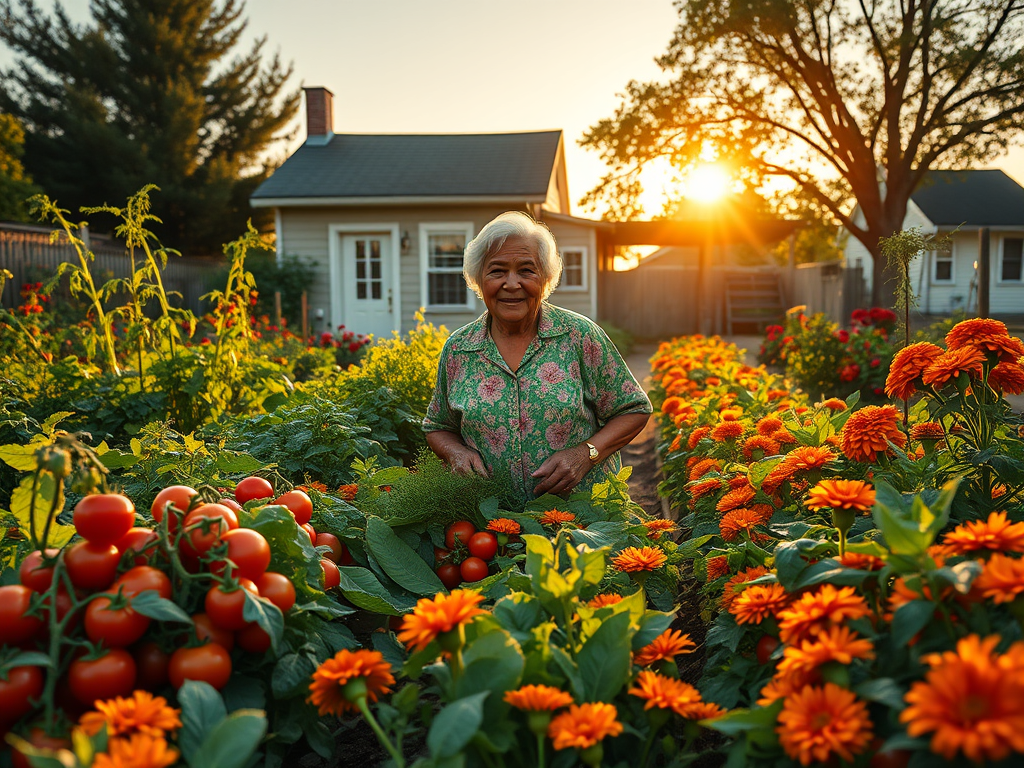
At the end of Maple Lane, there was a modest house surrounded by an expansive garden. The house belonged to Grandma Bea, a sprightly 78-year-old with a love for two things: growing vegetables and helping people. Her garden was the envy of the town—rows of tomatoes, peppers, beans, and leafy greens stretched as far as the eye could see, punctuated by bursts of vibrant marigolds.

When the food shortage began, Bea noticed the change immediately. The children playing in the streets seemed thinner, and their laughter was replaced by the sound of parents whispering about how to make ends meet.

That evening, Bea stood in her garden, the setting sun casting a golden glow over the rows of produce. She gently patted the soil around a row of carrots and made a decision. “This garden isn’t just for me anymore,” she murmured. “It’s for all of us.”

The Garden Opens

The next morning, Bea posted a handwritten sign on her front gate:
“Free Vegetables. Take What You Need.”

The first few days were slow. People were hesitant, unsure if they were allowed to just walk into her garden and take food. Bea made it easier by setting out baskets filled with freshly picked produce on her porch.

Word spread quickly. Soon, neighbors began stopping by daily, grateful for the bounty. A single mother took home zucchini and peppers to make stir-fry for her kids. An elderly man picked tomatoes for his famous sauce. Even the shy teenager next door, who rarely spoke, came by to grab a handful of beans for his family.

Bea welcomed them all with a smile and a story about her late husband, who had helped her plant the first seeds in the garden decades ago. “He always said food tastes better when it’s shared,” she’d say, handing over a bundle of kale.

A Community Effort

One afternoon, as Bea watered her cucumbers, a group of neighbors approached her. “We want to help,” said Mr. Alvarez, who lived across the street. He brought along his teenage sons, who eagerly offered to pull weeds and water plants.

Others soon joined in. A retired teacher donated packets of seeds she’d been saving. A young couple brought compost from their backyard. Someone even set up a rainwater collection system to keep the garden thriving during dry spells.

Grandma Bea’s garden became more than just a source of food—it was a gathering place. Parents brought their kids to help harvest vegetables. Neighbors swapped recipes and cooking tips. On weekends, they held potluck dinners in Bea’s backyard, sharing dishes made from the garden’s produce.

A Surprising Harvest

By late summer, the garden was flourishing beyond anyone’s expectations. Bea’s neighbors had expanded it into nearby vacant lots, growing enough to supply not just Maple Lane but other parts of Oak Hollow. People who had once been strangers were now friends, united by the shared goal of feeding their community.

One evening, as Bea sat on her porch sipping lemonade, the mayor stopped by with a small group. “Mrs. Bea,” he said, smiling warmly, “the town owes you a great deal. You’ve not only fed us but reminded us how strong we are when we come together.”

Bea chuckled, waving him off. “Oh, it wasn’t just me,” she said, gesturing to the bustling garden, where children and adults alike worked side by side. “It was all of us.”

A Lasting Impact

The food shortage eventually passed, but Grandma Bea’s garden continued to grow. It became a permanent community project, with new crops and even a small orchard added over the years. Schools brought students to learn about gardening, and the annual harvest festival became a beloved tradition.

Grandma Bea remained the heart of it all, her hands in the soil and her door always open. “A garden’s like a community,” she often said. “It takes care and love, but when it thrives, it feeds more than just bellies—it feeds souls.”

And so, the little garden at the end of Maple Lane became a symbol of resilience and generosity, proof that even in the hardest times, kindness and collaboration could bloom like the most beautiful of flowers.

The Restaurant That Gave Back

The Cozy Plate had always been a staple of the small town of Meadowbrook. It wasn’t fancy, but it was known for hearty meals, warm smiles, and the best apple pie for miles. But times were tough, and business had slowed.

Samantha “Sam” Rivers, who inherited the diner from her mother, sat in the empty dining room one evening, staring at the stack of unpaid bills on the counter. She sighed, her heart heavy. She couldn’t bear the thought of closing the diner—it wasn’t just a business; it was a piece of the town’s soul.

As she sat there, lost in thought, the jingling of the bell above the door pulled her from her worries. A man walked in, his clothes worn and his face weathered. “Sorry, ma’am,” he said hesitantly. “I don’t have much, but I’m real hungry. Could I maybe work for a meal?”

Sam blinked, her mother’s words echoing in her mind: “No one should ever leave this place hungry.” She stood up, a determined smile forming on her face. “You don’t have to work. Sit down, and I’ll get you something.”

The man’s gratitude was written all over his face as he devoured the warm bowl of chili and cornbread she placed before him. Watching him, Sam had an idea.

A New Way Forward

The next morning, Sam made a sign and hung it in the front window:
“Pay What You Can. No One Goes Hungry.”

Her employees were skeptical. “Are you sure about this, Sam?” asked Maria, the cook. “We’re already struggling to make ends meet.”

Sam nodded. “We’ve been struggling anyway. This way, at least we’re helping people.”

Word spread quickly. At first, a few hesitant customers trickled in—families down on their luck, college students on tight budgets, and senior citizens living on fixed incomes. Each was met with kindness and a meal, no questions asked.

But something surprising happened. Customers who could pay started leaving extra. A man ordered a cup of coffee and left a $50 bill, saying, “Pay for the next few meals.” A local bakery donated fresh bread. Farmers brought in surplus produce. Even the town’s small grocery store pitched in with a monthly donation of ingredients.

The Heart of the Town

Soon, The Cozy Plate wasn’t just a diner—it was a community hub. People came not just to eat but to connect. Regulars helped serve meals. Children drew “thank you” pictures to hang on the walls. Musicians played in the evenings for free, adding to the welcoming atmosphere.

One day, Sam received a letter in the mail. It was from a woman who had visited months earlier with her two children. Enclosed was a check for $500. The letter read:
“When I came to your diner, I had nothing. Your kindness gave me hope. Now that I’m back on my feet, I want to give back. Thank you for believing in people.”

Sam wiped tears from her eyes, her resolve stronger than ever.

A Ripple Effect

The Cozy Plate’s success caught the attention of a local newspaper, which wrote a feature story about the “pay-what-you-can” diner. Donations and support poured in from neighboring towns. Inspired by Sam’s model, other restaurants began adopting similar practices.

Sam often marveled at how the diner had changed. It wasn’t just about food anymore—it was about dignity, hope, and the power of community. The Cozy Plate was thriving, not in wealth but in purpose.

A Legacy of Kindness

Years later, when Sam handed the keys to the diner to her daughter, she shared the same advice her mother had given her: “No one should ever leave this place hungry.”

The Cozy Plate remained a beacon of compassion, proving that a simple meal served with love could transform not just lives but an entire town.

The Coat Drive Miracle

Snow had come early to the small town of Willow Creek. By mid-November, the streets were already blanketed in white, and the biting wind cut through even the thickest jackets. It was the harshest winter the town had seen in decades, and it quickly became clear that many families were struggling.

At the community center, volunteers had been overwhelmed by the number of people seeking shelter from the cold. Among them were families with young children, bundled in mismatched layers that barely kept the chill at bay. One volunteer, Rosa Martinez, couldn’t shake the image of a little girl wearing a too-small sweatshirt as her only protection against the freezing temperatures.

“We have to do something,” Rosa told her friend and fellow volunteer, Tom Jenkins. “No one should face a winter like this without a coat.”

The Idea

That evening, Rosa went home and posted on the town’s social media page:
“Willow Creek neighbors, let’s come together for a coat drive. If you have any spare jackets, coats, or winter gear, please drop them off at the community center. Let’s make sure no one goes cold this winter.”

Within hours, her post was flooded with responses. People shared it, commented with promises to donate, and tagged others to spread the word.

Coming Together

The next morning, Rosa arrived at the community center to find a line of cars waiting to drop off donations. A woman handed over a bag of gently used coats. “My kids outgrew these,” she said. “I’m glad they can help someone else.”

An elderly man, Mr. Benson, showed up with a stack of wool coats. “I’ve been holding onto these for years. Seems like now’s the right time to let them go.”

The donations poured in—puffy jackets, warm scarves, knitted hats, thick gloves. Local businesses joined the effort, too. The owner of the town’s thrift shop offered her entire stock of winter coats. The high school knitting club began making hats and scarves. Even the diner down the street set up a “hot cocoa jar,” where customers could leave cash donations for the cause.

The Miracle

As the days passed, the community center transformed into a hub of activity. Volunteers sorted, cleaned, and organized the donations by size. Families in need were invited to pick out coats and winter gear, and the look of relief on their faces was enough to warm even the coldest hearts.

Word of the coat drive spread to nearby towns, and more donations arrived. A local news station ran a story about the effort, inspiring others to start similar drives. Rosa was amazed by the ripple effect. “It’s like a snowball,” she said with a laugh. “But the good kind.”

On Christmas Eve, the community center hosted a “Winter Warmth Celebration.” Families who had received coats came together with those who had donated, sharing food, music, and laughter. The little girl Rosa had noticed weeks before ran up to her, twirling in a bright red coat that fit her perfectly.

“Thank you!” the girl said, beaming. Rosa knelt down, tears in her eyes. “You’re welcome, sweetheart. Stay warm, okay?”

A Lasting Impact

By the time spring arrived, the coat drive had provided winter gear to hundreds of people. But more than that, it had reminded the town of Willow Creek what they could accomplish when they worked together.

Years later, the coat drive became an annual tradition. Rosa often reflected on how a simple idea had brought her community closer, proving that even in the harshest of winters, the warmth of kindness could shine through.

The Unexpected Dancer

Evergreen Middle School’s annual talent show was the biggest event of the year. Students spent weeks practicing their acts—singing, playing instruments, performing skits, and showing off everything from juggling to magic tricks. The auditorium was always packed with students, parents, and teachers, ready to cheer on their peers.

This year’s show was no different. The air buzzed with excitement as performers took the stage. Backstage, the student emcees huddled over the program schedule, making last-minute adjustments. One of them, Emma, frowned.

“There’s a gap in the program,” she said. “Five minutes with no one scheduled.”

Her co-host, Ryan, shrugged. “We’ll just tell a joke or two.”

Before they could decide, Mr. Ramirez, the school janitor, approached them. He was dressed in his usual blue uniform, pushing a mop bucket. “I can fill in, if you’d like,” he said casually.

The students exchanged skeptical looks. Mr. Ramirez had always been friendly but quiet, and no one knew much about him. “You want to perform?” Emma asked, surprised.

Mr. Ramirez nodded with a small smile. “If you’ll let me.”

Ryan shrugged. “Why not? Go for it.”

When the time came, the emcees announced him with amused grins. “Ladies and gentlemen, please welcome… our janitor, Mr. Ramirez!”

Polite applause filled the room as Mr. Ramirez walked onto the stage, mop in hand. He set the mop aside, adjusted his cap, and took a deep breath. Then, to everyone’s astonishment, he struck a dramatic pose. Music filled the auditorium—a lively salsa tune—and Mr. Ramirez began to dance.

And what a dance it was.

He moved with an elegance and energy no one expected, spinning, sliding, and stepping in perfect rhythm. His feet tapped the stage with lightning speed, and his arms moved fluidly as if painting pictures in the air. The audience erupted into cheers and claps, their jaws dropping at the sight.

The students backstage peeked out, whispering in awe. “Where did he learn to dance like that?” Emma asked, wide-eyed.

Parents and teachers joined the applause, many of them standing as Mr. Ramirez twirled across the stage, ending his routine with a powerful spin and a graceful bow. The auditorium erupted into a standing ovation.

Mr. Ramirez smiled humbly and waved as he left the stage, his face flushed with excitement.

The Story Behind the Dance

Later, as students and parents mingled in the lobby, many approached Mr. Ramirez to congratulate him. “I had no idea you could dance like that!” said Mrs. Thompson, the music teacher.

Mr. Ramirez chuckled. “Dancing was my first love,” he explained. “I grew up in Puerto Rico, where dancing is a way of life. I even competed in a few contests when I was younger. But life happened, and I had to set it aside.”

“But why now?” a curious student asked.

Mr. Ramirez looked around at the excited faces. “I’ve seen so many of you walking through the halls, afraid to show who you really are, hiding your talents because you’re scared of what others might think. I figured, if I could dance, maybe it would inspire you to be brave, too.”

The students were silent for a moment, taking in his words. Then Emma stepped forward. “It worked,” she said with a grin. “You just became the coolest person at school.”

A Ripple Effect

The next day, the energy in the school was different. Inspired by Mr. Ramirez, students started talking openly about their hidden talents. A shy girl in the library brought her sketchbook to art class for the first time. A boy who loved poetry volunteered to read his work during lunch. Even the teachers began sharing stories about their hobbies and passions.

Mr. Ramirez became a beloved figure, not just as the janitor but as the man who reminded everyone that talent is everywhere, even where you least expect it.

By the time the next talent show rolled around, participation had doubled. And when Mr. Ramirez was invited to perform again, he smiled and said, “Only if you all promise to shine as bright as you can.”

That year, Evergreen Middle School wasn’t just a place where students learned math and history—it became a place where they learned to embrace their unique gifts, all thanks to the unexpected dancer who showed them how.

The Music Box

The Patterson family home had been in disarray ever since Grandma Eleanor passed away. The once warm and bustling house had grown silent, with family members speaking only when necessary and often at odds when they did. It wasn’t just grief dividing them—it was disagreements over what to do with the old house, the belongings, and the memories tied to them.

One dreary Saturday afternoon, twelve-year-old Sophie found herself alone in the attic. Her parents had tasked her with sorting through boxes to “help with the cleanup.” She wasn’t thrilled, but anything was better than listening to another argument downstairs.

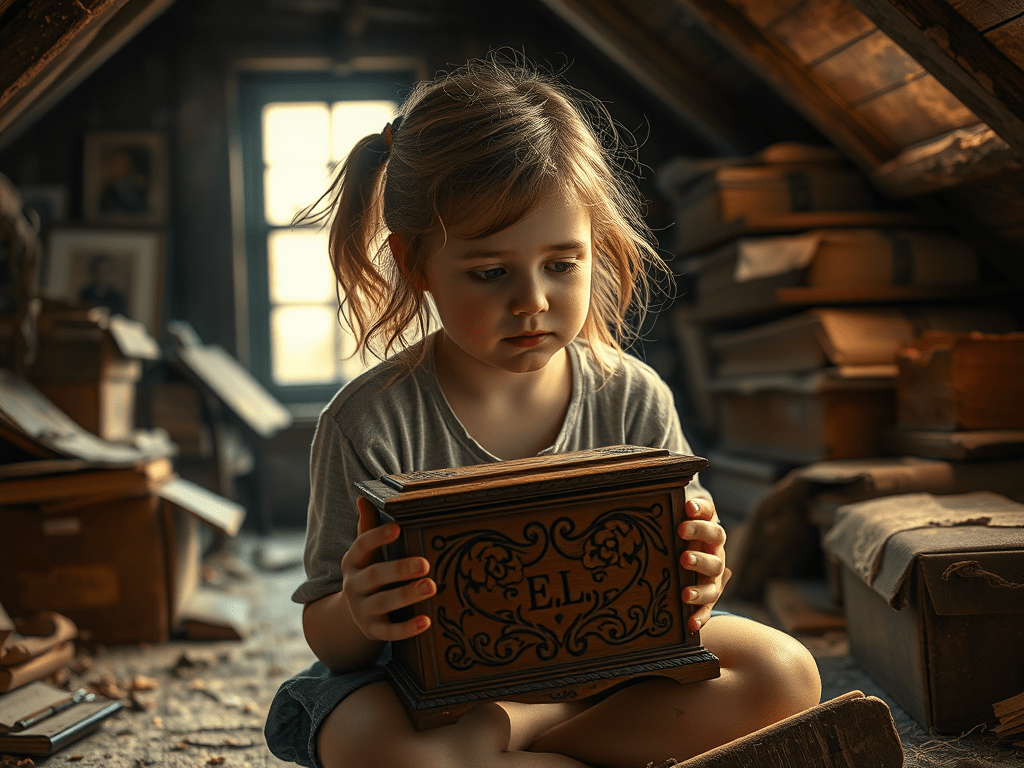
The attic was dusty and dimly lit, its air thick with the smell of aged wood and mothballs. As Sophie sifted through boxes of old photographs and yellowed books, she stumbled upon a small, ornately carved wooden box tucked beneath a pile of blankets. Curious, she pulled it out and brushed off the dust.

It was a music box, intricately decorated with floral patterns and tiny, engraved initials: E.L. Sophie’s fingers traced the letters as she wondered what they stood for. She turned the tiny crank on the side, and a soft, melodic tune began to play.

The sound was mesmerizing, delicate yet powerful, and it carried through the house. Before Sophie knew it, her father appeared at the attic door. “What’s that?” he asked, his tone softer than usual.

“I found it up here,” Sophie replied. “It plays this beautiful song.”

Her father stepped closer, his eyes widening as he recognized the music. “That’s… that’s the tune Grandma used to hum when she was baking cookies.” His voice cracked slightly, and for a moment, the tension between them seemed to dissolve.

Soon, Sophie’s mother and older brother appeared, drawn by the melody. “I haven’t heard that song in years,” her mother said, her eyes misty. “Eleanor used to play it every Christmas when we decorated the tree.”

The family gathered around Sophie as she wound the crank again. The music filled the room, bringing a bittersweet comfort that none of them had felt since Eleanor’s passing. They sat down together, the music box resting between them like a tiny beacon of light.

“I wonder where this came from,” Sophie mused aloud.

Her father smiled faintly. “Let’s find out.”

Uncovering the History

The next few days were spent piecing together the story of the music box. Old photo albums revealed pictures of Grandma Eleanor as a young woman, often with the box by her side. In one photo, she was holding it on her wedding day. Another showed her playing it for her children, including Sophie’s dad.

A letter tucked into an old diary revealed that the music box had been a gift from Eleanor’s mother, passed down through generations. The initials E.L. stood for Eleanor’s maiden name, Eleanor Larkins.

As the family delved into the history, they discovered more about Eleanor’s life—her dreams, her struggles, and her love for music. They learned that she had once dreamed of becoming a pianist but gave it up to raise her family. The music box had been her way of keeping music alive in her heart.

A New Tradition

Inspired by their discovery, the Pattersons decided to honor Grandma Eleanor’s memory by sharing her music. That Christmas, they played the music box as they decorated the tree, just as Eleanor had done. They laughed, reminisced, and, for the first time in months, felt like a family again.

The music box became a symbol of unity and healing. It reminded them that despite their differences, they were bound by shared memories and the love Eleanor had instilled in them. They even started a new tradition: every family gathering began with someone winding the music box and playing its tune.

Years later, when Sophie was grown with children of her own, the music box found a place in her home. She would wind it for her kids, telling them stories of their great-grandma Eleanor and the way a forgotten treasure had brought their family back together.

The melody of the music box continued to play, echoing through generations, a testament to the power of love, memory, and the little things that bind us all.

A Birthday for Everyone

Nine-year-old Mia loved birthdays. The balloons, the cake, the streamers—it was all magical to her. So, she was shocked one day when her elderly neighbor, Mr. Horace, mentioned he had never celebrated a birthday.

“Not even once?” Mia asked, her big brown eyes wide with disbelief.

Mr. Horace chuckled softly, leaning on his cane. “Nope. Growing up, my family didn’t have much. And as I got older, well… life got busy. Birthdays just weren’t a priority.”

Mia couldn’t imagine such a thing. To her, birthdays were a celebration of life, a way to remind people how special they were. The thought of someone going their whole life without that kind of joy made her heart ache.

That evening, Mia decided to fix things. She was going to throw Mr. Horace his very first birthday party—whether it was his actual birthday or not.

The Plan

The next morning, Mia recruited her best friend, Liam, to help. Together, they brainstormed ideas in Mia’s treehouse.

“We’ll need balloons, streamers, and a big cake!” Mia declared, scribbling on her notepad.

“And a gift!” Liam added. “Something he’ll really like.”

Mia nodded. They didn’t have much money, but she was sure they could figure it out. She started by asking her mom for help with the cake. “We can bake it together,” her mom said, smiling at Mia’s enthusiasm.

Next, Mia and Liam visited their neighbors, explaining the plan. Everyone was eager to help. Mrs. Carter offered to bring chairs, the Ramirez twins promised to make decorations, and Mr. Patel volunteered to bring his ukulele for music.

The Surprise

On the day of the party, Mia and her crew worked tirelessly in Mr. Horace’s backyard while he was at his weekly bingo game. They hung colorful streamers, set up tables with bright tablecloths, and placed a stack of presents on a makeshift gift table.

The centerpiece was the cake Mia and her mom had baked—a towering chocolate cake with “Happy Birthday, Mr. Horace!” written in bright blue frosting.

When everything was ready, Mia and Liam ran to the bingo hall to bring Mr. Horace home. “You need to come with us!” Mia said, tugging his hand. “It’s important!”

Mr. Horace raised an eyebrow, clearly confused, but let himself be guided back to his house. As they rounded the corner to his backyard, the crowd of neighbors shouted, “Surprise!”

Mr. Horace froze, his eyes wide as he took in the decorations, the cake, and the beaming faces of his neighbors. “What… what is all this?”

“It’s your birthday party!” Mia said, practically bouncing with excitement. “Your first one ever!”

Tears glistened in Mr. Horace’s eyes as he looked at the crowd. “But it’s not my birthday.”

Mia grinned. “It doesn’t matter! Everyone deserves to have a birthday party.”

A Birthday to Remember

The party was a huge success. Mr. Horace laughed harder than he had in years as he opened gifts, including a hand-knitted scarf from Mrs. Carter and a scrapbook filled with photos of his garden from Mia and Liam.

When it was time to cut the cake, the neighbors sang “Happy Birthday” so loudly that it echoed down the street. Mr. Horace blew out the candles, his hands shaking with emotion. “I don’t know what to say,” he whispered. “This is the kindest thing anyone has ever done for me.”

As the sun set and the party wound down, Mr. Horace pulled Mia aside. “You’re a special girl, you know that? You didn’t just give me a birthday. You reminded me that I’m surrounded by people who care.”

Mia hugged him tightly. “You deserve it, Mr. Horace. Everyone does.”

That night, as Mia lay in bed, she thought about how one simple idea had brought so much joy. Birthdays, she realized, weren’t just about balloons and cake—they were about making people feel loved.

From that day on, Mr. Horace became a regular at every birthday party in the neighborhood, always bringing his famous apple pie and his bright, heartfelt smile. And every year, on a random summer day, the neighbors would throw another “birthday” for him, because, as Mia always said, “A birthday isn’t about the date—it’s about the love.”

Sunshine Letters

In the quaint little town of Meadowbrook, nestled between rolling hills and golden fields, life moved at a slower, simpler pace. But even the picturesque charm of the town couldn’t shield it from hardship. The local factory, the heart of Meadowbrook’s economy, had recently closed, and the town was cloaked in an air of gloom.

Twelve-year-old Clara watched this change unfold from the window of her small bedroom. She noticed her once-chatty neighbors walking with heads bowed, shopkeepers with weary smiles, and even her parents whispering worriedly at the kitchen table. The warmth of the town felt like it had been snuffed out, and it weighed heavily on Clara’s heart.

One gray morning, while rummaging through a box of old belongings in the attic, Clara found a stack of letters tied together with a faded yellow ribbon. The letters were from her grandmother, who had passed away the previous year, addressed to Clara’s mother during her college years.

As Clara read through them, she felt something she hadn’t felt in weeks—a spark of hope. Each letter was filled with words of encouragement, funny anecdotes, and little doodles that made her smile. Her grandmother had called them her “Sunshine Letters” because they were meant to brighten dark days.

Clara had an idea.

That night, armed with colorful stationery and her favorite pens, she began writing her own Sunshine Letters. She crafted messages like, “You’re stronger than you think!” and “A tough day is just a stepping stone to a brighter tomorrow!” She added little drawings of flowers, sunshine, and animals to make them cheerful. She signed each one, “A friend who cares.”

The next morning, Clara slipped out of the house early and began leaving the letters in unexpected places: tucked under windshield wipers, slipped into mailboxes, and taped to shop windows.

At first, she wasn’t sure if anyone would even notice. But by the end of the week, the letters had started to work their magic.

Mrs. Benson, the florist, found a letter on her shop door and put it in her display window with a sign that read, “Whoever you are, thank you!” Mr. Grady, the retired school principal, received one in his mailbox and read it aloud at the diner, declaring it “the best surprise I’ve had in years.” People began sharing their letters with neighbors, displaying them on fridges, and even passing them along to others.

Curiosity about the mysterious writer grew. Meadowbrook’s newspaper ran a front-page story titled, “Who’s Behind the Sunshine Letters?” Townsfolk began calling them “the little rays of hope” that were bringing Meadowbrook back to life.

Clara remained anonymous, but she noticed the change. The postman smiled again. The grocer hummed while stocking shelves. Her parents’ whispers at the kitchen table became conversations filled with laughter.

One evening, Clara’s mother came home with a Sunshine Letter she had found at work. “Whoever is doing this,” she said, holding the letter to her chest, “they’ve reminded me that there’s still good in the world.”

Clara’s heart swelled with pride, but she just smiled and said, “I think they’re pretty special too.”

As weeks turned into months, the factory reopened, and the town’s economy began to recover. But the spirit of the Sunshine Letters remained. People started writing their own notes of encouragement and passing them on. Acts of kindness multiplied, turning Meadowbrook into a town not just of golden fields but golden hearts.

Clara kept her secret, content knowing she had sparked something bigger than herself. One evening, as she slipped another letter into a neighbor’s mailbox, she looked up at the stars and whispered, “Thank you, Grandma. Your Sunshine Letters worked wonders, just like you said they would.”

The Christmas Carnival

The little town of Evergreen was known for its annual Christmas Carnival—a magical event that transformed the town square into a winter wonderland. For decades, it had brought joy to generations, with its twinkling lights, carolers, and a towering Christmas tree at the center of it all. But this year was different.

A storm had swept through the town weeks before, leaving damaged buildings, fallen trees, and a spirit of despair in its wake. The town council, overwhelmed with repairs and a dwindling budget, announced that the Christmas Carnival would be canceled.

When nine-year-old Ellie heard the news, she refused to accept it. The Christmas Carnival wasn’t just an event to her—it was where her parents had met, where her grandpa always read the Christmas story to kids, and where she’d learned to ice skate. It was the heartbeat of Evergreen.

Ellie decided to take matters into her own hands. Armed with her notebook, she marched into her fifth-grade classroom the next day and declared, “We’re saving the Christmas Carnival!”

Her classmates buzzed with excitement, and soon they were brainstorming ideas. Some offered to bake cookies to sell, while others suggested using their allowance to buy decorations. Ellie’s teacher, Mrs. Grant, overheard the chatter and decided to help. She sent letters home to parents, explaining the kids’ plan, and before long, the entire school was on board.

News of Ellie’s mission spread like wildfire. Local businesses donated materials, volunteers gathered to clear debris from the square, and the high school drama club offered to put on a holiday play. The fire department even agreed to set up the Christmas tree—provided someone could find one.

Ellie had an idea. She remembered an old pine tree on her grandparents’ farm, one her grandpa had always called “the perfect Christmas tree.” She rushed to ask him if they could use it.

Her grandpa chuckled. “I planted that tree when your mom was born,” he said. “It’s been waiting for a moment like this.”

With tears in her eyes, Ellie watched as the fire department carefully cut down the tree and transported it to the town square. Once it was set up, the kids decorated it with handmade ornaments, popcorn strings, and ribbons.

Finally, the night of the carnival arrived. The square sparkled with lights, laughter echoed in the air, and the scent of hot cocoa filled the streets. Ellie’s grandpa read the Christmas story as planned, and a choir of carolers led the town in singing “Silent Night.”

When Santa arrived in his sleigh—actually the town’s fire truck decorated with tinsel—the crowd erupted in cheers. Ellie stood beside her parents, watching it all unfold. For the first time in weeks, Evergreen felt alive again.

As the night drew to a close, the mayor took the stage. “This carnival almost didn’t happen,” she said, her voice filled with emotion. “But thanks to Ellie and all of you, we’ve proven that the spirit of Christmas is stronger than any storm.”

The crowd roared with applause, and Ellie felt her cheeks flush. She didn’t do it alone, she thought. This was everyone’s Christmas Carnival.

As snow began to fall gently, Ellie looked up at the towering Christmas tree, its lights twinkling against the night sky. She whispered to herself, “This is the best Christmas ever.”

Lessons from a Monk: The Path to Peace

A weary traveler, known for his restless spirit, came across a monastery perched atop a serene mountain. Seeking guidance, he approached the monk who was meditating in the courtyard.

“Master,” the traveler began, “I’ve journeyed across lands, seas, and skies, yet I feel no peace. My heart is heavy, and my mind is a storm. Please, show me the way.”

The monk, with a calm demeanor, studied the traveler and replied, “Stay here for fifteen days. Do as I say, and you shall find the peace you seek.”

Reluctantly, the traveler agreed. On the first day, the monk handed him a broom and directed him to sweep the monastery grounds. “Focus on each stroke,” the monk said. “Let the broom carry your thoughts away.”

Each day, the monk gave him simple tasks: cleaning the garden, lighting lamps, fetching water, or preparing meals. The traveler found the tasks mundane, but he obeyed, all the while yearning for a grand revelation.

On the seventh day, the monk gave him a cup and asked him to fill it with water from the mountain stream. “Carry it back without spilling a drop,” he instructed.

The path was steep and uneven, but the traveler concentrated. Step by step, he brought the cup back to the monk, the water intact.

“You’ve learned focus,” the monk said with a faint smile. “But your heart still carries burdens.”

Over the next days, the monk asked the traveler to sit and observe the sunrise, the rustling leaves, and the quiet stars. The traveler began to notice things he’d overlooked before: the warmth of the sun on his face, the melody of the wind, and the vastness of the night sky.

On the fifteenth day, the monk approached him as he meditated by the stream. “Your time here is complete. Tell me, traveler, what have you learned?”

The traveler, once restless, now spoke with calm clarity. “I have learned that peace is not something to chase. It is found in the present moment, in the simplest of tasks and the quietest of places.”

The monk nodded. “Go now, and carry this lesson with you. Wherever you travel, remember: the journey to peace begins within.”

The traveler bowed deeply and descended the mountain. Though he continued to wander, his heart was no longer heavy, for he had found what he had been searching for all along.

The Cycle of Strength: Hard Times Build Resilience

“Hard times create strong men. Strong men create good times. Good times create weak men. Weak men create hard times.”

This phrase emphasizes the cyclical nature of human history. It highlights the relationship between challenges and the strength of individuals in society.

The saying illustrates a cyclical view of history. Difficult periods lead to the emergence of strong, resilient individuals. These individuals then create prosperous, stable times. But these prosperous times can lead to a decline in resilience. This decline in strength eventually results in a new cycle of challenges.

Hard Times Create Strong Men

    • Struggles and difficulties develop strength, resilience, and strong leadership.
    • People become resourceful and capable in the face of adversity.

    Strong Men Create Good Times

      • Resilient individuals use their strength to build a stable, prosperous society.
      • Progress, safety, and comfort become prevalent due to their efforts.

      Good Times Create Weak Men

        • Comfort and ease lead to complacency and a loss of resilience.
        • People become less prepared to handle adversity.

        Weak Men Create Hard Times

          • The lack of strength and preparedness causes society to become vulnerable to crises.
          • New challenges and struggles emerge, restarting the cycle.

          Trump’s Victory: Celebrations and Future Challenges

          The recent presidential election has resulted in Donald Trump’s victory, leading to celebrations among his supporters. However, the aftermath of the election has been marked by significant developments and challenges.

          Initial Celebrations

          Donald Trump secured a commanding victory over Vice President Kamala Harris, achieving what many considered an unlikely political comeback[4]. The election night was marked by jubilant scenes at Mar-a-Lago, where Trump and his allies gathered to celebrate[4]. The atmosphere was one of triumph, with Trump declaring it a day when “the American people regained control of their country”[4].

          Voter Shifts and Political Landscape

          Trump’s victory revealed significant shifts in the American electorate:

          • Improved Republican margins across the nation
          • Increased support from non-White voters, particularly among Latino communities
          • Gains in both urban and rural areas

          These changes have posed substantial challenges for the Democratic Party, fracturing their national coalition[3].

          Trump’s Post-Election Mindset

          Following his win, Trump has been described as buoyant and optimistic:

          • He feels empowered by his popular vote victory, which he sees as a mandate for his agenda
          • Trump has been engaging with global leaders, top advisors, and his transition team
          • He has appointed Susie Wiles as his White House chief of staff
          • The president-elect has expressed amazement at the positive reactions from foreign leaders[5]

          Emerging Challenges

          Despite the initial euphoria, several issues have begun to surface:

          1. Legal Concerns: Trump still faces numerous legal challenges, including four indictments and 34 felony convictions. He has also been found liable for sexual abuse and faces potential fines exceeding half a billion dollars[4].
          2. Security Concerns: A recent assassination attempt has led to increased security measures, with Trump refraining from his usual golfing activities[5].
          3. Political Divisions: While Trump’s victory was decisive, the country remains deeply divided, with Democrats entering a period of introspection[3].
          4. Transition Challenges: The transition process is underway, with Trump’s team working to staff his administration. However, the process of handing over power from the current administration may present its own set of challenges[5].

          Looking Ahead

          As Trump prepares to return to the White House, he faces the task of implementing his campaign promises while navigating a complex political and legal landscape. His popular vote win has bolstered his confidence, but the coming months will likely test his administration’s ability to govern effectively in the face of ongoing controversies and opposition[5].

          Citations:
          [1] https://www.scmp.com/magazines/style/entertainment/article/3286755/who-wayne-gretzkys-trump-supporting-wife-janet-jones-gretzky-police-academy-5-actress-celebrated
          [2] https://www.newyorker.com/news/dispatch/donald-trumps-west-palm-beach-victory-celebration
          [3] https://www.cnn.com/2024/11/10/politics/trump-voter-shifts-nationwide/index.html
          [4] https://apnews.com/article/trump-victory-harris-dd64fe5fac158025058a45f21388a6b2
          [5] https://www.cnn.com/2024/11/07/politics/donald-trump-mindset/index.html