
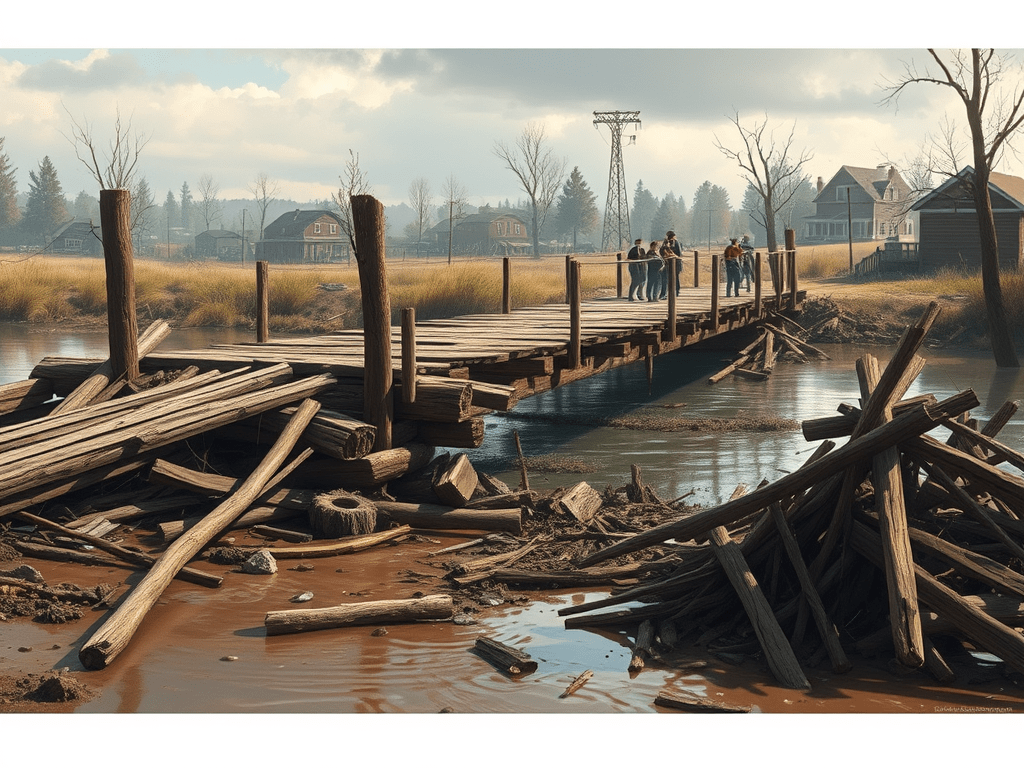
When the storm swept through Maple Grove, it brought more than just rain and wind—it brought devastation. Trees were uprooted, power lines downed, and the bridge that connected the town to its neighboring communities was completely destroyed.
The old wooden bridge had been more than just a way across the river; it was a lifeline. Farmers used it to transport their goods to market, children crossed it to reach their school, and friends met halfway for picnics by its banks. Without it, the town felt cut off from the world—and from each other.
Assessing the Damage
The morning after the storm, the townspeople gathered by the river. The once-sturdy bridge was now a pile of splintered wood and twisted metal, scattered like matchsticks along the muddy banks.
“What are we going to do?” asked Mr. Carter, the town’s baker. “We can’t afford to rebuild it. And even if we could, it would take months.”
The mayor, a pragmatic woman named Ellen, nodded grimly. “We’ll find a way,” she said. “This bridge isn’t just about crossing the river—it’s about who we are.”
The First Steps
The town held a meeting in the school gym that evening. Ideas were tossed around, but no one could agree on a solution. Then, a quiet voice cut through the noise.
“We could do it ourselves,” said Jonah, a retired carpenter.
The room fell silent.
Jonah stood and cleared his throat. “I know it sounds impossible. But if we work together—if everyone contributes what they can—I think we can rebuild this bridge.”
A murmur of agreement spread through the crowd.
“I can design it,” said Lisa, an architect who had moved back to Maple Grove to care for her aging parents.
“And I’ll provide the wood,” offered Mr. Langley, who owned the lumber mill on the outskirts of town.
One by one, people raised their hands, volunteering their skills, time, and resources.
Rebuilding Together
The next weekend, work began. Jonah taught a group of volunteers how to sand and shape the wood. Lisa organized the construction plan, breaking it down into manageable tasks.
Children painted signs to cheer on the workers, and Mrs. Thompson, the town’s unofficial chef, set up a food station to keep everyone fed.
At first, progress was slow. There were arguments over how to handle certain tasks and setbacks when materials ran short. But the community persisted, driven by the belief that they were building something bigger than a bridge—they were rebuilding their town’s spirit.
Overcoming Challenges
One day, heavy rains threatened to wash away the foundations they had laid. The workers scrambled to secure the site, forming a human chain to carry sandbags to the riverbank. Soaked and exhausted, they managed to save their progress.
“Nothing worth building is ever easy,” Jonah said, patting the shoulder of a teenage boy who had been ready to give up.
Those words became the team’s motto, written in chalk on the makeshift workstation and repeated whenever morale faltered.
The New Bridge
Months later, on a crisp autumn morning, the new bridge was finally complete. Made of strong timber and reinforced steel, it was sturdy and beautiful, with decorative railings carved by local artisans.
The whole town gathered for the ribbon-cutting ceremony. Jonah, Lisa, and the mayor stood at the center, scissors in hand.
“This bridge is more than a structure,” Ellen said, addressing the crowd. “It’s a symbol of what we can accomplish when we come together. It’s a bridge to our future.”
As the ribbon was cut, cheers erupted, and the first group of children ran across, their laughter echoing in the crisp air.
A Lasting Legacy
The new bridge quickly became a source of pride for Maple Grove. It brought back commerce, reconnected families, and became a destination for visitors who admired its craftsmanship and the story behind it.
More importantly, it reminded the townspeople of their resilience and the strength of their community.
Years later, a plaque was added to the bridge’s entrance. It read:
“This bridge was built by the hands and hearts of Maple Grove. May it always stand as a testament to the power of unity and hope.”
And stand it did, carrying the weight of countless stories, dreams, and journeys for generations to come.
 Life's Adventure