Some Bible verses are so famous they feel like old friends. We see them on coffee mugs, embroidered on pillows, and shared in elegant script over a social media sunset. They become cultural shorthand for comfort, inspiration, or praise. Familiarity, however, can sometimes breed misunderstanding. When a line is lifted from its original context, it can become a kind of spiritual cliché, its sharp edges worn smooth and its explosive power defused.
But what if the original stories behind these famous lines were more dramatic, messy, and surprisingly relevant than we ever imagined? What if they were forged not in moments of quiet contemplation, but in the heat of social crises, professional burnout, and bitter church arguments? This post will journey back in time to explore the surprising, counter-intuitive origins of four well-known verses. By uncovering the stories they were born from, we’ll discover their deeper, more powerful meanings—and find that they speak to our lives in ways we never expected.
——————————————————————————–
1. A Grand Command About God’s Glory Was Originally a Ruling on… Barbecue. (1 Corinthians 10:31)
“So, whether you eat or drink, or whatever you do, do all to the glory of God.” It’s the ultimate statement of a life wholly devoted to God, a call to sanctify every moment. But this grand, universal principle wasn’t delivered from a serene pulpit; it was the rhetorical climax of a messy argument about a very specific problem in ancient Corinth.
Imagine walking through the bustling Corinthian marketplace, the smell of roasted meat from the temple of Apollo filling the air. For a new Christian, every invitation to a business lunch or a family wedding was a spiritual minefield. In Corinth, pagan temples weren’t just for worship; they were the social centers of the city, often functioning as public restaurants. The meat served at these feasts or sold in the market (eidōlothyta) had first been offered to an idol. For a Christian, was eating this meat an act of idolatry?
The Corinthian church was bitterly split. One faction, the “strong,” argued from a position of theological knowledge. “An idol is nothing,” they reasoned, so the meat is just meat. They championed their “Christian liberty,” but their arguments were trending toward self-gratification rather than self-sacrifice, prioritizing their personal rights without considering how their actions might affect others.
After a long and winding argument, the Apostle Paul delivers 1 Corinthians 10:31. It isn’t just a general pious statement; it is a universal principle designed to solve this specific, messy conflict. Paul intentionally uses the most mundane, daily acts—eating and drinking—to establish a new ethical baseline. The implication is radical. First, he shows that no part of life is “secular”; even a simple meal is an opportunity to honor God. More importantly, he establishes an ethical test for any action. Does it glorify God? According to Paul, the answer is only yes if it passes a crucial stress test: an action cannot glorify God if it wounds the conscience of another person or hinders the mission of the gospel.
“an action only genuinely glorifies God if it successfully passes the mission test. If an action, though deemed permissible in theory, results in harm to the communal body (causing a believer to stumble) or impedes the evangelistic outreach… it ultimately fails to bring God honor.”
——————————————————————————–
2. A Famous Declaration of Trust Was Born from a Crisis of Professional Burnout and Envy. (Psalm 73:26)
“My flesh and my heart may fail, but God is the strength of my heart and my portion forever.” This is a bedrock verse for anyone facing sickness, loss, or deep discouragement. It’s a powerful declaration of trust in God’s eternal sufficiency. Yet, this cry of faith was born from a profound crisis of envy, disillusionment, and what we might call professional burnout.
The author is Asaph, a prominent temple musician and Levite. He opens his song with a shocking confession: he was on the verge of abandoning his faith entirely. “My feet had almost slipped,” he writes. The reason? He was consumed with envy at the prosperity of the wicked. His crisis was grounded in a specific cultural moment. During the unprecedented economic expansion under kings like David and Solomon, a significant wealth gap had emerged. From the temple courts, Asaph saw a new class of arrogant, corrupt people enjoying luxury goods and easy lives, while he, a faithful servant of God, was “stricken all the day long.”
Here is the surprising twist. The Levites, the priestly tribe to which Asaph belonged, were unique in Israel: they received no land inheritance. Their divine inheritance, their “portion” (cheleq), was God Himself. Asaph’s professional duty was to lead worship and teach that God was the greatest treasure. But he looked out and saw people with tangible, earthly inheritances thriving through wickedness, which made him question the value of his own unique, non-material calling. His crisis was intensely vocational.
Overwhelmed, Asaph couldn’t reason his way out of his despair. The breakthrough came not through logic but through worship. He writes, “till I entered the sanctuary of God; then I understood their final destiny.” In God’s presence, his perspective was radically re-framed. He saw the fleeting, slippery nature of the wicked’s prosperity and, more importantly, the true, eternal value of his own inheritance. When Asaph declares, “God is… my portion forever,” it is a stunning, full-circle reaffirmation of his Levitical identity. He moves from questioning the worth of his unique calling to proclaiming it as the only treasure of eternal value—infinitely more valuable and secure than all the land and wealth in the world.
——————————————————————————–
3. The “Glory” Jesus Gives Believers Isn’t What You Think It Is. (John 17:22)
“The glory that you have given me I have given to them.” When we hear the word “glory,” we often think of heavenly light, divine splendor, or a kind of radiant aura. But in the original context of Jesus’s final prayer, this “glory” is something surprisingly concrete and its purpose is shockingly practical.
Jesus’s prayer does mention the kind of glory we often imagine. He prays that one day, believers will be with him in heaven “to see my glory” (v. 24). This is the eschatological glory—the unveiled, breathtaking splendor of his eternal divine nature, which we will one day behold.
But that’s not the glory he says “I have given to them” in the here and now. This communicable glory isn’t a flash of light but something far more radical: it is the glory of His self-giving, sacrificial love, supremely revealed not in a moment of divine splendor but on the cross. When Jesus gives us His glory, He is imparting to us the very character of God and commissioning us to manifest that cruciform love in the world.
Why does Jesus give believers this glory? He immediately gives the reason: “that they may be one.” The purpose of this imparted glory is to create a visible, supernatural unity among Christians. This radical, self-giving oneness is meant to be the Church’s primary apologetic to a watching world, the public proof that the Father truly sent the Son. The glory Jesus gives isn’t for our personal status or individual splendor. It is a divine resource given for a collective, missional witness, empowering the Church to display God’s love to the world.
——————————————————————————–
4. A Famous Doxology Was a Pastoral Strategy to Heal a Divided Church. (Romans 11:36)
“For from him and through him and to him are all things. To him be the glory forever. Amen.” This is one of the most majestic statements of God’s sovereignty in all of Scripture. It feels like a hymn sung from the heights of heaven. But its original function was to solve a messy social problem on the ground in the church at Rome.
Imagine being a Jewish Christian returning to Rome around 54 CE after five years of forced exile. The Emperor Claudius had expelled all Jews from the city in 49 CE, and you were one of them. Now, you walk back into the house church you helped start, only to find it transformed. The songs are different, the leadership is new, and a subtle but sharp arrogance has taken root among the Gentile believers who now see you as obsolete. The church was a community with “ruffled feathers,” fractured along ethnic and theological lines.
Romans 11:36 isn’t just a beautiful flourish at the end of a theological section. It is the “ultimate theological resolution to this pressing social problem.” After a long, complex argument about God’s mysterious plan for both Jews and Gentiles, the Apostle Paul concludes with this massive, God-centered vision.
This doxology was a pastoral masterstroke. It directs the gaze of both factions toward a God so sovereign and a plan so inscrutable that their “internecine struggles are rendered insignificant in comparison.” The verse humbles both Jewish pride in their unique heritage and Gentile arrogance in their new inclusion, forcing them to find their identity not in their own ethnic story but in God’s cosmic one. It forges unity not by taking sides, but by elevating everyone’s perspective until they see themselves as actors in a single, God-orchestrated drama that is entirely from Him, sustained through Him, and directed to Him.
——————————————————————————–
Conclusion: The Power of the Original Story
Understanding the original context of these famous verses doesn’t diminish them; it enriches them, transforming them from familiar platitudes into powerful tools for our lives. The original stories reveal how grand theology intersects with our messy reality, offering practical guidance for our relationships, an unshakeable anchor for our work, and a unifying mission for our communities.
Which of these original stories most changes how you’ll read, pray, or live out the verse next time you encounter it?
Does your faith ever feel confusing? Does suffering sometimes seem meaningless, or do religious systems that once felt safe now feel stagnant? These are common struggles, and it can be tempting to think that modern problems require entirely new answers. But what if some of the most profound clarity for these issues comes from an ancient letter written nearly two thousand years ago?
The Epistle to the Hebrews, a powerful section of the New Testament, offers surprisingly modern and impactful answers to these timeless struggles. This article explores five of the most counter-intuitive takeaways from this text—insights that can reshape our understanding of faith, suffering, and community in the 21st century.
1. The Most Powerful Action Was Sitting Down
In the ancient religious system described in Hebrews, the work of a priest was never finished. The text explains that every priest had to “stand daily” to offer the same sacrifices over and over again. This posture of standing was deeply significant; it symbolized a perpetual, unending, and ultimately incomplete task.
In stark contrast, after Jesus Christ offered his single, perfect sacrifice for sins, he “sat down on the right hand of God.” This simple physical act is an authoritative confirmation that the work of atonement was perfectly and finally completed. But this seated posture holds a profound tension. Christ’s work as a Priest is finished, yet his work as a King is ongoing. He sits in priestly finality while simultaneously waiting “until his enemies be made a footstool for his feet.”
This dual reality—the “already-but-not-yet”—is the foundation for everything that follows. The finished priestly work of Christ is what grants believers unprecedented, bold access to God, empowering us to navigate the ongoing kingly work of a world still in process.
2. Your Suffering Might Be a Good Sign
Because Christ’s priestly work is utterly complete, believers can radically reframe their own struggles. We often interpret suffering as a sign of God’s absence or punishment. Hebrews presents the opposite view. In a radical theological departure from Old Covenant frameworks where suffering was often seen as immediate divine retribution, this letter argues that hardship is evidence of God’s love.
The text uses the Greek term paideia, which means training or spiritual maturing from a loving father, not punishment. But it goes even further. This discipline is the definitive proof of legitimacy as a child of God. The author argues that God trains his legitimate children, while illegitimate children are left undisciplined. Therefore, hardship is not a sign of abandonment but a confirmation of your identity as a true heir. While this training is “painful rather than pleasant,” its goal is to produce the holiness that proves our status as true sons and daughters.
3. Real Faith Requires Leaving Your ‘Camp’
In what the source material calls the “central and most radical ethical command of the entire book,” believers are called to a profound act of dislocation. For the original audience, the “camp” represented everything safe: the established religious structure, social acceptance, and cultural comfort.
The power of the command comes from its visceral imagery. On the Day of Atonement, the sin offering—the animal that bore the people’s guilt—was taken outside the camp to be burned, signifying it was accursed. The author of Hebrews explains that Jesus, in his crucifixion, identified with this ultimate shame by suffering “outside the gate.” The command is therefore not just a suggestion but the necessary response to Christ’s work:
“Let us, then, go to him outside the camp, bearing the disgrace that he bore.”
This is a call to willingly abandon comfortable systems and identify with the one who bore our reproach, the very one cast out by the religious establishment. The motivation is purely forward-looking: “for here we have no lasting city, but we seek the city that is to come.”
4. Faith Is the Evidence of Things You Can’t See
The call to leave a visible camp for an invisible city requires a radical reorientation of what is real. The letter’s audience was tempted to retreat to the visible and tangible security of Old Testament rituals they could see and touch. As a direct antidote, the author defines faith itself as a form of substance and evidence, shifting the very locus of reality from the seen to the unseen.
The definition has two key parts:
First, faith is the “hypostasis“—the assurance or substance of things hoped for. It gives concrete reality to our future hope.
Second, faith is the “elenchos“—the conviction or evidence of things not seen. It acts as the proof of a reality that is currently invisible.
In a world that demands empirical proof, this text redefines the terms. Faith is not a blind leap; it is the faculty that perceives the reality of God’s unseen promises as more solid and real than the shifting circumstances of our visible world.
5. History’s Greatest Heroes Died Without Getting Their Reward (Yet)
Chapter 11 of Hebrews, the “Hall of Faith,” lists Old Testament heroes who demonstrated exemplary trust in God. After detailing their incredible acts, the chapter comes to a shocking conclusion: despite being commended for their faith, “none of them received what had been promised.”
These heroes died without seeing the ultimate fulfillment of God’s promises. The theological reason given is staggering: God “had planned something better for us so that only together with us would they be made perfect.”
This implies a mutual dependency across generations. The entire story of faith, spanning millennia, finds its climax and completion in the perseverance of the New Covenant community. This powerful idea elevates the stakes immeasurably, transforming our present struggles from personal trials into moments of cosmic and historical significance. The faith of past heroes finds its ultimate fulfillment in us.
Conclusion: A Forward-Looking Faith
Taken together, these takeaways from Hebrews paint a clear picture. Authentic faith is not about finding comfort in present systems or demanding visible proof. It is a confident pilgrimage toward an unseen, eternal city, made possible by the completely finished work of Christ. It redefines suffering as the confirming training of a loving Father, commands a break from the comfortable “camps” that offer false security, and calls us to live based on the substance of a reality we cannot yet see—knowing that our endurance brings to completion the story of all who have gone before.
What comfortable ‘camp’ in your own life might be preventing you from experiencing a more authentic faith?
The third chapter of Genesis marks the pivotal moment where the story of the world, and humanity’s relationship with its Creator, takes a dramatic and tragic turn. Before this chapter, the world was a paradise. Adam and Eve lived in perfect harmony with God, with each other, and with all of creation. They had a face-to-face relationship with their Creator, and work was a source of joy, not a burden of sweat and toil.
This document will explain four foundational concepts introduced in this narrative: Temptation, Sin, Consequence, and Redemption. The story of the first Sin is an act of Disobedience that illustrates the meaning of trespass and falling short of God’s perfect standard. This perfect harmony was broken by a cunning conversation that introduced the concept of temptation.
2. The Temptation: Questioning God’s Goodness
The Anatomy of Temptation
The story introduces a serpent, described as “more crafty” than any other beast. Later scripture identifies this being as Satan (Revelation 12:9, 20:2). The original Hebrew text highlights this dynamic with a deliberate wordplay: Adam and Eve were “naked” (arom), while the Serpent was “crafty” (arum). The serpent’s interaction with Eve reveals a timeless, three-stage strategy for temptation.
Casting Doubt The Serpent began by questioning God’s Word with the phrase, “Indeed, has God said…?” This tactic is designed to create suspicion about God’s goodness, framing His commands as restrictive and questioning His truthfulness. It plants a seed of doubt that God might not have humanity’s best interests at heart.
Denying the Consequence Next, the Serpent directly contradicted God’s clear warning by stating, “You will not surely die.” This is the core lie of temptation: that one can disobey God’s command—that is, sin—and completely avoid the penalty. It minimizes the danger and promotes a false sense of security in disobedience.
Substituting a False Promise Finally, the Serpent offered a deceptive promise: “you will be like God, knowing good and evil.” This appealed directly to the human desire for autonomy and self-assertion. It suggested that by disobeying, Adam and Eve could elevate themselves, defining good and evil on their own terms, which is a fundamental act of rebellion against the Creator.
This pattern of temptation—doubting God’s Word, denying the consequences of sin, and offering a false promise of self-gain—remains a fundamental model for how temptation works. This is the same pattern seen when an advertisement promises fulfillment while hiding the consequence of debt, or when a peer pressures someone into a risky behavior by minimizing the danger and promising social acceptance. Having listened to the temptation, Eve’s altered view of God’s command led directly to an act of disobedience.
3. The Disobedience: The First Sin
What is Sin?
The act of eating the forbidden fruit was the first sin. The Bible defines the core concept of sin in two primary ways, both of which are illustrated in this event.
Trespass: This means deviating from the right course, crossing a known boundary, or breaking a specific command. By eating from the one tree God had forbidden, Adam and Eve trespassed against God’s clear instruction.
Falling Short: This means failing to meet God’s perfect standard of holiness. Through their disobedience, Adam and Eve fell short of the perfect obedience required of them in their relationship with God.
Eve’s conversation with the serpent revealed how distorted her view of God’s command had become. A direct comparison of God’s words with her recollection shows a pattern of minimizing God’s generosity and exaggerating His restrictions.
God’s Actual Command (Genesis 2:16-17)
Eve’s Misquoted Version (Genesis 3:2-3)
“From any tree of the garden you may eat freely;”
“From the fruit of the trees of the garden we may eat;” (Omits the generosity of “any” and “freely”)
“but from the tree of the knowledge of good and evil you shall not eat,”
“but from the fruit of the tree which is in the middle of the garden, God has said, ‘You shall not eat from it or touch it,’” (Adds a restriction God did not make)
“for in the day that you eat from it you will surely die.”
“or you will die.” (Weakens the certainty and immediacy of the penalty by removing “surely” and “in the day”)
The sequence of the fall is precise: Eve, being deceived, ate first. She then gave the fruit to her husband Adam, “who was with her,” and he ate. Scripture is clear that while Eve was deceived, Adam’s disobedience was willful and not the result of deception (1 Timothy 2:14).
This leads to the crucial concept of Federal Headship. Because God appointed Adam as the head of the human race, his willful choice had consequences for all of humanity. As explained in Romans 5, it was through Adam’s “one man’s disobedience” that sin and death entered the world and spread to all people. This single act of disobedience immediately shattered the perfection of their world, leading to a cascade of devastating consequences.
4. The Consequences: A Broken World
The Fall was not a single event with a single outcome; it was a cataclysm that fractured the four primary relationships that defined humanity’s existence. This one act of sin broke humanity’s perfect relationship in four directions:
With God (manifested in fear and hiding).
With Self (manifested in guilt and shame).
With Each Other (manifested in blame-shifting and marital conflict).
With Creation (manifested in painful toil and the curse on the ground).
4.1. Immediate Consequences: Guilt, Shame, and Fear
The results of their sin were immediate and profound, affecting their relationship with themselves, with God, and with each other in a devastating chronological sequence.
Guilt and Shame: The first result was that their “eyes were opened.” This was not the divine enlightenment the Serpent promised, but a new, painful awareness of their nakedness, which produced feelings of guilt and shame.
Self-Righteous Covering: Their first action was to sew fig leaves to cover themselves. This represents humanity’s first attempt to cover its own sin through its own works—an effort that is ultimately inadequate before a holy God.
Fear of God: Their second action was to hide from God. The perfect, open fellowship they once enjoyed with their Creator was broken, replaced by fear and a desire to avoid His presence.
Blame-Shifting: Their third action was to refuse personal responsibility. When confronted, Adam blamed Eve and, indirectly, God (“The woman whom You gave to be with me…”). Eve, in turn, blamed the serpent (“The serpent deceived me…”). This blame-shifting further damaged their relationships and demonstrated the alienating effect of sin.
4.2. Divine Judgment: The Curse
In response to their disobedience, God pronounced a series of judgments, or curses, upon each party involved, fundamentally altering the nature of their existence.
The Serpent: Cursed to crawl on its belly and eat dust, a symbol of ultimate humiliation and future defeat.
The Woman (Eve): Judged with greatly multiplied pain in childbearing. The curse also introduced conflict into the marital relationship, described as a sinful desire to usurp her husband’s authority, which he would in turn resist (“Your desire will be for your husband, and he will rule over you”).
The Man (Adam): The ground itself was cursed because of his sin. Work, once a joyful ministry, would now be characterized by painful toil, sweat, and frustration, producing “thorns and thistles.”
All Humanity: The final sentence for their sin was physical death. Adam, who was made from dust, would now return to the dust. Death became the ultimate wage for sin.
Yet, even in the midst of this terrible judgment, God provided the first glimmer of redemption.
5. The Redemption: The First Glimmer of Hope
The First Gospel
In the curse pronounced on the Serpent, God embedded the first promise of the gospel, a verse known as the Protoevangelium.
“And I will put enmity Between you and the woman, And between your seed and her seed; He shall bruise you on the head, And you shall bruise him on the heel.” — Genesis 3:15
This profound prophecy contains the entire story of redemption in embryonic form.
A Promised Conflict: God declares there will be ongoing hostility (“enmity”) between the serpent’s “seed” (followers of evil) and the woman’s “seed” (humanity, culminating in one specific descendant).
A Promised Victor: The verse prophesies that “He” (a male descendant of the woman) will crush the serpent’s head, which represents a fatal, decisive, and final blow.
A Promised Sacrifice: At the same time, the serpent will “bruise his heel.” This describes a wound that is painful and causes suffering but is not fatal. This is the first promise of a future Redeemer—Jesus Christ—who would suffer in His conflict with Satan but would ultimately emerge victorious, destroying him completely.
Following this promise, God performed a symbolic act. He replaced their self-made, inadequate fig leaves with garments of skin (Genesis 3:21). The significance of this act is immense: for Adam and Eve to be properly covered, an innocent animal had to die. The shedding of blood was necessary to provide a covering for their sin and shame. This act is a powerful picture of a substitute sacrifice, pointing forward to the ultimate sacrifice of Christ, whose righteousness clothes all who believe.
6. Conclusion: The Story’s Enduring Importance
Genesis 3 provides the foundational explanation for the origin of sin, suffering, and death in our world. It reveals the timeless pattern of Temptation—doubting God’s goodness, denying His warnings, and disobeying His commands—that leads to spiritual and physical ruin. The devastating Consequence of this first Sin was the fracturing of humanity’s relationship with God, self, others, and creation.
However, the story does not end in despair. It demonstrates that God’s immediate response to humanity’s fall was not just judgment, but also mercy. Woven into the very fabric of the curse is the promise of a plan for Redemption. This chapter sets the stage for the rest of the Bible’s story: God’s unfolding plan to rescue and restore humanity from the devastating consequences of the Fall.
In modern discourse, “faith” is often equated with credulity—a readiness to believe something without sound evidence. It’s frequently portrayed as a blind leap into the dark, a concept fundamentally at odds with reason and logic. This common perception paints a picture of belief that is based more on wishful thinking than on solid ground.
But what if the original definition of faith was something else entirely—something more like a legal guarantee backed by evidence? What if the concept, at its root, was not about ignoring reality but about understanding it more deeply? This article will explore a few surprising and counter-intuitive truths about faith, drawn directly from an analysis of its biblical roots.
Faith Isn’t a Leap in the Dark; It’s a “Title-Deed”
The biblical definition of faith, found at Hebrews 11:1, begins with the phrase, “The assured expectation of things hoped for.” This might sound poetic, but the original Greek term for “assured expectation,” hy·poʹsta·sis, carries a surprisingly concrete and business-like meaning. This term was common in ancient papyrus business documents and was used to convey the idea of a guarantee that ensures a future possession.
In view of this, noted lexicographers Moulton and Milligan suggest the rendering:
“Faith is the title-deed of things hoped for.”
This legal and commercial analogy is powerful. It reframes faith not as a vague hope or a wish, but as a firm, guaranteed claim on something real. It suggests that a person with faith possesses the legal right, the title-deed, to what has been promised, even before they have it in hand. It is not an uncertain leap but a confident standing on a guaranteed foundation.
Faith Isn’t Blind; It’s a Conviction Based on Evidence
The second part of the Hebrews 11:1 definition describes faith as “the evident demonstration of realities though not beheld.” The Greek word used here, eʹleg·khos, conveys the idea of bringing forth evidence to demonstrate something. This evidence is so powerful that it makes clear what was previously unseen, actively refuting what only appeared to be true.
According to the source material, this means genuine faith is not based on emotion or wishful thinking, but on concrete evidence. It is a logical conclusion reached after examining the facts. Several categories of evidence are presented as the foundation for this conviction:
The visible creative works, which testify to the existence of an invisible Creator.
The historical events of Jesus Christ’s life and ministry, which serve to identify him as the Son of God.
God’s reliable record of providing for creation, which serves as a valid basis for trusting in future provision and the resurrection.
The accurate fulfillment of prophecies in God’s Word, which instills confidence in the realization of all of His promises.
This point directly contradicts the notion that faith and reason are opposites. Instead, it presents faith as a reasoned conviction—the result of a thorough examination of available evidence.
You Probably Exercise Faith Every Single Day
The concept of building trust based on evidence and past reliability is not an exclusively religious one. The source material argues that even a person who might ridicule religious faith still possesses and exercises it in many other areas of life. Faith, in this broader sense, is a fundamental human process.
Consider these everyday analogies:
A person has faith in “tried and trusted friends,” believing what they say because of a history of truthfulness.
A scientist has faith in “the principles of his branch of science,” using past discoveries as a reliable basis for designing new experiments and anticipating new discoveries.
A farmer has faith in “the stability of the natural laws,” sowing seed with the confident expectation that, as in previous years, it will sprout and grow with sun and moisture.
These examples demystify the concept of faith. They show it as a core function of how we operate, whether in our relationships, scientific pursuits, or daily activities. It is a trust built on a record of dependability and tangible evidence, not just a theological concept.
Faith Is Not a Feeling; It Must Be Paired with Action
A final crucial point is that Christian faith is not a passive or static internal belief. It must be demonstrated through consistent works and actions. It is an active commitment that governs a person’s entire life course.
An analogy is used to illustrate this point: “A young man may court a young lady, telling her that he loves her. But if he never asks her to marry him, is he really demonstrating that his love is thorough?” In the same way, faith without corresponding action is considered incomplete. The Bible writer James puts it even more directly:
“Indeed, as the body without spirit is dead, so also faith without works is dead.”
Furthermore, faith is described not as a one-time decision but as something that “grows” and requires a “hard fight” to maintain—a constant effort to resist immorality, materialism, and “faith-destroying philosophies.” This counters the idea that it is a passive state of being, positioning faith as a living, dynamic principle that must be actively nourished, defended, and demonstrated through one’s deeds.
Conclusion: A Conviction to Live By
Ultimately, the biblical concept of faith is not a blind leap but an active, evidence-based conviction. It begins with a “title-deed”—a legal guarantee founded on concrete proof—which is then lived out through the same daily acts of trust we apply in science and relationships. Confirmed by experience and demonstrated through consistent works, it is a reasoned conclusion that demands a lived response.
Given this evidence-based perspective, how might we re-evaluate what it truly means to “live by faith”?
If you’re a man trying to figure out your place in the world today, it can feel like navigating a maze in the dark. Society’s messages about masculinity are often confusing and conflicting, pushing men toward extremes of hyper-aggression or passivity. This leaves many wondering what a “real” man is supposed to look like, think like, and act like. The pressure to measure up to these flawed cultural standards can be exhausting.
In a world filled with questions, the Bible offers a surprisingly clear and counter-cultural picture of manhood. It’s a vision that isn’t rooted in fleeting trends or stereotypes but in the unchanging character of God. This article will explore five of the most impactful and perhaps unexpected truths about masculinity found in Scripture, offering a more profound and life-giving definition of what it means to be a man.
——————————————————————————–
1. Greatness Isn’t Dominance—It’s Service.
While our culture often equates masculine leadership with authority, control, and dominance, Jesus completely redefines it as servanthood. In God’s kingdom, the path to greatness is not found in being served, but in serving others. True leadership, according to Christ, involves putting the needs of others before your own and using your strength to uplift and support them.
This principle is a radical departure from worldly power structures. Jesus taught that the ultimate model for a man is not the one who sits at the head of the table demanding respect, but the one who humbly serves everyone there.
“Not so with you. Instead, whoever wants to become great among you must be your servant, and whoever wants to be first must be your slave —just as the Son of Man did not come to be served, but to serve, and to give his life as a ransom for many.” (Matthew 20:26-28)
It’s a definition of strength that finds its ultimate expression not in a clenched fist, but in a humble posture of service.
2. God Cares More About Your Heart Than Your Appearance.
Society places immense pressure on men to conform to certain external standards—physical strength, height, or a particular look. These superficial markers are often treated as the primary indicators of masculinity. The Bible, however, points to a much deeper and more significant standard: a man’s inner character.
When the prophet Samuel was sent to anoint the next king of Israel, he was naturally drawn to the most physically impressive candidate. God, however, had a different perspective, instructing Samuel to look past the outward appearance and focus on the heart. This powerful moment reveals that God’s valuation of a man has nothing to do with physical stature and everything to do with integrity, faith, and a heart aligned with His will.
“But the Lord said to Samuel, ‘Do not consider his appearance or his height, for I have rejected him. The Lord does not look at the things people look at. People look at the outward appearance, but the Lord looks at the heart.’” (1 Samuel 16:7)
In a world of curated profiles and constant comparison, this truth isn’t just freeing—it’s a lifeline. It calls us away from a focus on external image and toward the more meaningful work of cultivating a heart of integrity before God.
3. True Strength is a Balance of Toughness and Tenderness.
A common cultural stereotype suggests that “real men” are stoic, suppress their emotions, and never show vulnerability. The Bible offers a far more balanced and complete picture of masculine strength. Jesus Christ, the perfect model of manhood, demonstrates that true strength is a seamless blend of toughness and tenderness.
Think about it. He could boldly overturn tables in the temple to defend God’s honor, and He could also comfort grieving people and hold children in His arms. He was a leader and also a servant. He was incredibly bold when rebuking religious leaders, yet He described Himself as “gentle and humble in heart” and wept openly at the tomb of a friend. Biblical manhood doesn’t require men to be emotionless; it calls them to a Spirit-led maturity that embraces love, gentleness, and self-control alongside courage and strength.
“For the Spirit God gave us does not make us timid, but gives us power, love, and self-discipline.” (2 Timothy 1:7)
This multifaceted character is infinitely more powerful than the one-dimensional “tough guy” because it reflects the complete, compassionate, and powerful nature of Christ himself.
4. Manhood Isn’t a Solo Mission; It’s Forged in Community.
The idea of the “lone wolf” or the rugged individualist who needs no one is a powerful cultural myth. However, the Bible makes it clear that this is not God’s design for men. Scripture emphasizes the vital importance of community for a man’s spiritual and personal growth. Manhood is not a solo mission; it is forged in the context of meaningful relationships.
God designed men to challenge, encourage, and sharpen one another through accountability and mutual respect. Isolation leads to stagnation and vulnerability, while engaging in authentic community fosters resilience and wisdom. This is where we are honed spiritually, emotionally, and mentally, providing the support needed to navigate life’s challenges with integrity.
“As iron sharpens iron, so one person sharpens another.” (Proverbs 27:17)
This is God’s design: for a man’s character not to rust in isolation, but to be honed to a fine edge in the company of brothers.
5. The Ultimate Mandate is Sacrificial Love.
Perhaps the most counter-cultural and challenging aspect of biblical masculinity is its ultimate mandate: sacrificial love. The highest calling for a man, especially in the context of marriage and family, is to love others in the same way that Christ loved the church. This Christlike love redefines a man’s strength not as a tool for self-gain, but as an instrument for protecting, nurturing, and prioritizing the spiritual well-being of others, even at great personal cost.
This is the ultimate demonstration of Christlike manhood.
“Husbands, love your wives, just as Christ loved the church and gave himself up for her.” (Ephesians 5:25)
In a world that prioritizes self-fulfillment, this call to lay down one’s life for others remains the most profound and defining characteristic of a man following in the footsteps of Jesus.
——————————————————————————–
Conclusion: A Better Definition of Manhood
Biblical masculinity is far richer and more profound than the shallow stereotypes offered by culture. It is a manhood defined by service, built on character, balanced by strength and tenderness, forged in community, and ultimately perfected in sacrificial love.
In a world with so many conflicting messages, what is one step you can take today to pursue a manhood defined not by culture, but by Christ?
“He said, ‘I am the voice of one crying in the wilderness, Make straight the way of the Lord,’ as said the prophet Isaiah.” — John 1:23 (ESV), cf. Isaiah 40:3
John the Baptist’s mission was clear: he was not the Messiah, but a voice calling people to prepare their hearts for Him. His life was marked by courage, urgency, and clarity in pointing others toward Christ.
When we think of leaders like Charlie Kirk, we see someone who also sought to use his voice in the public square—calling people to pay attention, to think carefully, and to prepare for the moral and cultural challenges of our time. While his mission was not the same as John’s, the parallel reminds us that every believer is entrusted with a voice. Our role may not be to baptize in the Jordan, but to stand firm in our generation, pointing to the One who saves.
Reflection: What voices are we listening to today? Are they preparing us to walk closer with Christ, or distracting us from Him? John’s boldness reminds us that each of us has a responsibility to use our influence—whether in our family, workplace, or community—to make Christ known.
Call to Action: Today, ask yourself: How can I be a voice that “makes straight the way of the Lord”? Perhaps it means speaking truth in love, offering encouragement to someone discouraged, or standing firm in your convictions even when it’s unpopular. Like John, and like Charlie in his own way, let your voice matter—for God’s glory and for the good of others.
🙏 Prayer: Lord, give me the courage to be a faithful voice in the wilderness of this world. Help me prepare the way for others to know You through my words and actions. Amen.
In a world that often feels overwhelming, many believers wrestle with a profound question about their place within it. We are called to a life of faith and trust in God’s ultimate sovereignty, yet we are also confronted daily by forces of evil that demand a response. This is not a contradiction but a divine tension, a dual calling to both rest in God and act for Him. One speaker powerfully frames the question we may one day be asked:
“why did you not trust in me and not fight evil?”
This guide is intended as a scriptural compass, offering both clarity for the mind and courage for the heart. By exploring a handful of key scriptures, we can build a biblical framework for understanding this divine calling, equipping us to live with conviction. Our exploration begins with the foundational command that inextricably links our love for God to our stance against evil.
The Mandate: If You Love God, You Must Hate Evil
The starting point for understanding our responsibility is not a suggestion, but a clear biblical mandate. It establishes that our devotion to God is not merely a private, internal feeling but a public, active stance. The speaker powerfully renders the heart of Psalm 97:10 this way:
“for those of you that love god you must hate evil”
This verse asserts that a genuine love for God naturally produces a righteous hatred for that which opposes Him. Love, in this context, is an action demonstrated through decisive and unwavering opposition to wickedness. This conviction becomes the very definition of a believer’s mission in the world, a principle that shapes a personal calling, as the speaker notes:
“my call is to fight evil and to proclaim truth”
Once we grasp why we are called to this fight, we can better understand the nature of the spiritual battleground itself.
The Battleground: Life vs. Destruction
Scripture clearly defines the two primary, opposing forces at work in the world. Speaking to college students, one pastor uses John 10:10 to present this contrast not as a philosophical idea, but as two distinct missions with radically different goals for humanity. In the speaker’s words:
“the enemy has come to lie steal cheat and destroy but I have come to give life and life more abundantly”
This verse draws a clear line in the sand, allowing us to understand the fundamental conflict between the kingdom of God and the forces of darkness. The two missions can be summarized as follows:
The Enemy’s Mission
Christ’s Mission
To lie, steal, cheat, and destroy
To give life, and life more abundantly
For the believer, this comparison is clarifying. It defines the stakes and reveals the ultimate goal of our faith: to align ourselves with Christ’s mission of promoting abundant life and to stand against the enemy’s mission, which is rooted in destruction. Recognizing that we are aligned with Christ’s mission in a world threatened by this destruction begs a critical question: how do we stand firm without being consumed by fear?
The Protection: Wearing the Armor of Christ
When faced with direct threats to his family for his public stance, the speaker’s confidence is not rooted in bravado or “thick skin,” but in a profound reliance on God’s spiritual protection. He dismisses personal worry, stating with confidence: “Do I worry for my safety or my family safety no.” This assurance, he explains, comes directly from the spiritual defense provided by God.
“it’s the full it’s the armor of christ as it says in ephesians”
While the full armor described in Ephesians has many components, the speaker highlights two that are essential for this mission:
The Breastplate of Righteousness: This is our primary defense for our spiritual core. It is our alignment with God’s character—our righteousness in Christ—that protects our most vulnerable spiritual center from accusations, condemnation, and the spiritual wounds of evil.
The Sword of Truth: This represents the Word of God, our one offensive weapon in the armor. It is the power of divine truth wielded to cut through the lies, deception, and darkness that are foundational to evil.
The core insight is that this spiritual armor empowers a believer to act with faith instead of fear. It is not our own strength, but God’s divine provision that protects us. Shielded by this heavenly protection, we can hold fast to the ultimate promise of God’s power over any evil we may face.
The Promise: God’s Power to Redeem
As pastoral counsel to college students going through difficulty, the speaker offers verses of ultimate hope. These scriptures provide assurance that God’s power is supreme and that no act of evil has the final say in the life of a believer.
Genesis 50:20 The speaker powerfully paraphrases the promise of this verse, which speaks to God’s ability to overturn malicious human intent:
Romans 8:28 Expanding on this theme, this well-known promise assures us of God’s active involvement in every aspect of our lives:
The combined message of these verses is one of profound hope and trust. They declare that God is sovereign over all circumstances. He possesses the ultimate power to take what was intended for harm and skillfully weave it into His greater plan for a good and redemptive purpose.
Conclusion: A Summary for Living with Courage
Our scriptural journey has guided us from the divine call to oppose evil, through an understanding of the spiritual battle, to the assurance of God’s protection and the ultimate promise of His redemptive power. It is a roadmap for living a life of faithful and courageous action. For the believer seeking to navigate this world, the most critical lessons can be distilled into three key truths.
Our Mandate: Loving God means actively hating and opposing evil (Psalm 97:10).
Our Protection: We do not need to fear because we are protected by the spiritual armor of Christ (Ephesians).
Our Hope: We can trust that God will ultimately use all things for good, even what the enemy intends for evil (Genesis 50:20, Romans 8:28).
Armed with this biblical understanding, believers are called and fully equipped to live with a courageous faith that triumphs over fear.
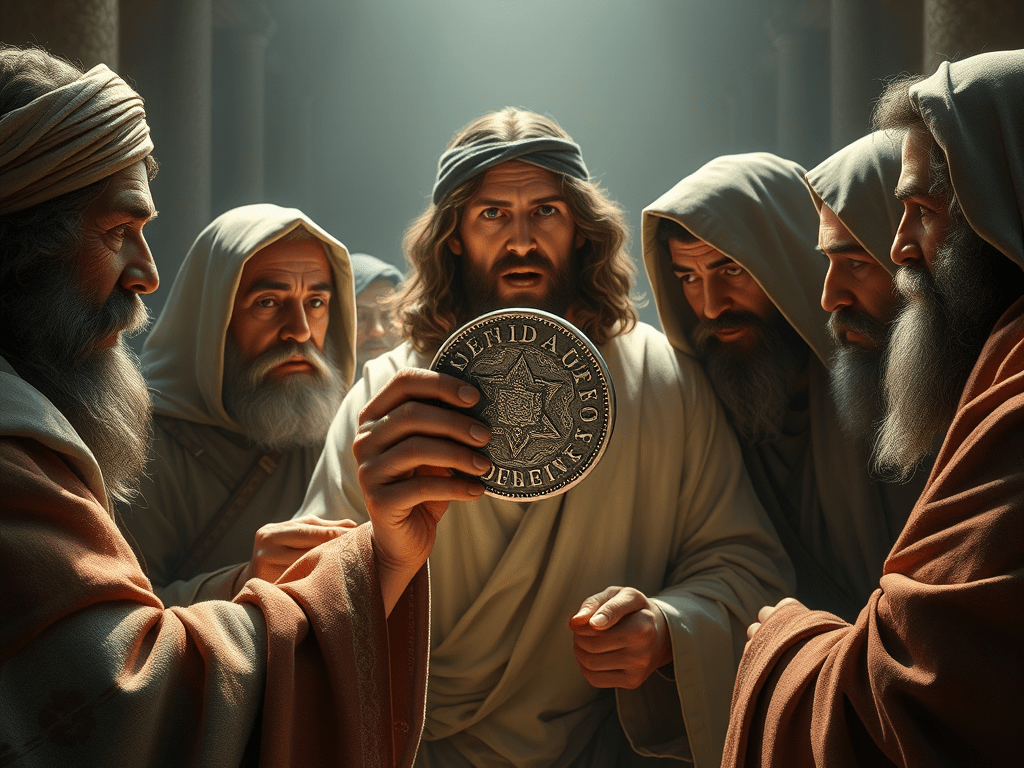
The scene is charged with tension. Religious and political adversaries, the Pharisees and Herodians, approach Jesus with a question designed not for enlightenment, but for entrapment.1 “Is it lawful to pay taxes to Caesar, or not?” (Matthew 22:17). Their query was a carefully laid snare. An affirmation would alienate His Jewish compatriots, who chafed under Roman occupation and the idolatrous implications of Caesar’s image on the imperial currency. A denial would mark Him as a revolutionary, inviting the swift and brutal retribution of Rome.1 They sought to impale Him on the horns of an impossible political dilemma.
Jesus, perceiving their malice, called for a denarius, the coin used for the tax. “Whose image and inscription is this?” He asked. “Caesar’s,” they replied. Then came His masterful and eternally resonant response: “Therefore render to Caesar the things that are Caesar’s, and to God the things that are God’s” (Matthew 22:21, Mark 12:17, Luke 20:25).1 His interrogators were “utterly amazed” 2, their trap disarmed. Yet, Jesus’ words were far more than a clever evasion; they laid down a foundational principle for navigating the complex interplay of allegiance, authority, civic duty, and devotion to God 2—a principle that continues to challenge and guide believers as they seek to live faithfully in a world of competing claims.
The very nature of this “trick question” reveals a persistent human tendency to construct false dichotomies, particularly where faith intersects with public life. Often, individuals attempt to force an “either/or” decision—either complete subservience to the state or outright rejection of its authority—where a more nuanced understanding of distinct yet coexisting obligations under a sovereign God is required. Jesus’ answer refused this binary. Furthermore, by adding the crucial clause, “and to God the things that are God’s,” Jesus immediately elevated the discussion beyond a mere political or fiscal matter to a profoundly theological one. This masterstroke subtly asserted God’s ultimate sovereignty over all earthly powers, including Caesar himself. It implied that even our duties to terrestrial authorities must be understood and enacted within the overarching framework of our primary and all-encompassing allegiance to God.
Section 1: Honoring Earthly Authorities – A Divine Expectation
1.1 God’s Ordination of Government
The Scriptures consistently teach that governing authorities are not accidental or purely human constructs but are, in principle, instituted by God. The Apostle Paul, writing to believers in Rome, the very heart of imperial power, states unequivocally: “Let every person be subject to the governing authorities. For there is no authority except from God, and those that exist have been instituted by God. Therefore whoever resists the authorities resists what God has appointed, and those who resist will incur judgment” (Romans 13:1-2).4 This divine institution does not signify an unconditional endorsement of every governmental action or policy. Rather, it affirms the principle of governance itself as a necessary framework for maintaining order, restraining evil, and promoting a degree of stability in a fallen world.4
It is profoundly significant that Paul penned these words under the reign of Emperor Nero, a ruler who would become infamous for his cruelty and persecution of Christians.5 This historical context underscores that the command to submit is primarily to God’s ordained structure of authority rather than an implicit approval of the individual ruler’s character or their specific decrees. The legitimacy of the office, in God’s design for societal order, is distinct from the personal righteousness (or lack thereof) of the office-holder. Consequently, a Christian’s submission, in this sense, becomes an act of obedience to God’s overarching plan for human society, allowing for a respectful posture even amidst profound disagreement or suffering under unjust rule. This understanding also implies that rebellion against legitimate governing authority, as an institution, is viewed as rebellion against what God has instituted, carrying with it inherent consequences, both civil and potentially spiritual, for disrupting God’s intended order.4 This does not negate the possibility of conscientious objection in specific circumstances, as seen in Acts 4:19-20, but it sets a high bar, reserving such actions for instances where government commands direct disobedience to God’s clear mandates.
1.2 The Purpose of Government
The divine ordination of government is not arbitrary; it has a defined purpose. According to the Apostle Peter, rulers are “sent by him [God] to punish those who do evil and to praise those who do good” (1 Peter 2:14).6 Similarly, Paul, in his letter to Titus, encourages believers “to be subject to rulers and authorities, to be obedient, to be ready for every good work” (Titus 3:1), which includes cooperating with governmental structures for the common welfare.8 The ideal function of government, from a biblical perspective, is therefore to uphold justice, protect its citizens from harm, and maintain a societal environment where good can flourish and evil is restrained.
When a government fundamentally and persistently acts contrary to this God-ordained purpose—for instance, by consistently punishing good and rewarding evil—it begins to forfeit its moral legitimacy in the eyes of God, even if its coercive power remains intact. While a general submission to the structure of authority might still be counseled to avoid societal chaos (as some commentators suggest, even bad government can be preferable to anarchy 4), the moral foundation for enthusiastic cooperation erodes. In such situations, the grounds for prophetic critique and, in extreme cases, conscientious objection, gain strength. Conversely, the call for believers to be “ready for every good work” 9 implies a proactive and constructive form of citizenship. This involves more than mere compliance; it suggests a positive responsibility to contribute to the common good, utilizing one’s skills and resources within societal structures, including those related to governance, to seek the peace and welfare of the community. This demonstrates that faith is not merely a private affair but entails a public responsibility.
1.3 Our Response: Submission, Respect, and Civic Duties
The scriptural mandate to honor earthly authorities translates into specific, practical responses from believers. These include submission “for the Lord’s sake” (1 Peter 2:13), an act that recognizes God’s ultimate sovereignty even in our civic interactions.6 Paying taxes, the very issue brought to Jesus, is affirmed as a legitimate duty.4 Paul elaborates in Romans 13:6-7: “For because of this you also pay taxes, for the authorities are ministers of God, attending to this very thing. Pay to all what is owed to them: taxes to whom taxes are owed, revenue to whom revenue is owed, respect to whom respect is owed, honor to whom honor is owed.” This respect and honor are due to the office, recognizing its divine institution.10
The directive to “Honor the emperor” (1 Peter 2:17), given at a time when the emperor was likely the persecuting Nero 6, highlights a profound spiritual discipline. This honor cannot be contingent on the leader’s personal virtue or the alignment of their policies with Christian values. Instead, it is directed towards the God-ordained institution of authority that the leader represents. Such an act of honoring the office, despite the potential failings of the person holding it, becomes a powerful witness. It demonstrates that the Christian’s ultimate hope and stability are not vested in human leaders or political systems but in God, who remains sovereign even over flawed and antagonistic rulers. This distinguishes the believer from a mere political partisan, whose support is conditional. Furthermore, the fulfillment of civic duties like paying taxes is framed not simply as a legal requirement but as an action that can be “glorifying to God” 10 and contributes to maintaining a “clear conscience” before God and humanity.4 This perspective elevates even mundane civic responsibilities to acts of spiritual significance, integrating faith into the practicalities of daily life and demonstrating responsible stewardship within the society God has placed us.
Section 2: The Unmistakable Claim of God – What is God’s?
2.1 Beyond the Coin: We Bear God’s Image
Jesus’ instruction to “render to Caesar the things that are Caesar’s” was immediately followed by the more profound and far-reaching command: “and to God the things that are God’s”.1 If the denarius, bearing Caesar’s image and inscription, rightfully belonged to Caesar, a far more significant question arises: what bears God’s image? The Scriptures declare that humanity was created in the very image and likeness of God (Genesis 1:27). Therefore, “the things that are God’s” are not merely a portion of our income or specific religious duties, but our entire selves—our lives, our worship, our ultimate allegiance, and our dedicated service.1 We belong to Him because we bear His imprint.2
This “render to God” clause radically expands the scope of allegiance from a transactional civic duty to a total life orientation. Our relationship with God is not meant to be one loyalty among many, but the foundational relationship that defines, informs, and rightly orders all others. The shift in Jesus’ analogy from a material object (the coin) to a living being (the human person) signifies a vastly more comprehensive and personal claim. God’s claim is not just on a segment of our resources or a fraction of our time, but on our entire existence—heart, soul, mind, and strength. This redefines “giving to God” from mere outward religious observance or charitable contributions to the complete and willing surrender of the self. Moreover, the understanding that all human beings are created in God’s image carries profound ethical implications. If we belong to God because we bear His image, then this inherent dignity and divine ownership applies universally to every person. Consequently, actions that devalue, oppress, or harm others are not only offenses against humanity but also sacrilegious affronts to the God in whose image they are made. This insight inextricably links our vertical allegiance to God with our horizontal responsibilities to our fellow human beings, grounding all ethics and calls for social justice in a robust theological understanding of creation and divine ownership.
2.2 The Honor and Reverence Due to Our Father and Master
The prophet Malachi records God’s poignant challenge to the priests of Israel, who had grown complacent and disrespectful in their service: “‘A son honors his father, and a servant his master. If then I am a father, where is my honor? And if I am a master, where is my fear?’ says the LORD of hosts to you, O priests, who despise my name. But you say, ‘How have we despised your name?'” (Malachi 1:6).12 This passage powerfully underscores the relational aspect of our duty to God. He is not an abstract deity or a distant cosmic force, but our Heavenly Father and our Divine Master, who is inherently deserving of heartfelt honor and reverent fear—an awe-filled respect that shapes our attitudes and actions.12 The priests’ failure to offer this, despite their privileged position and knowledge of God’s law, manifested in their offering of “incorrect, apathetic sacrifices” 12, and serves as a solemn warning to all who claim to know and serve Him.
God’s appeal in Malachi to common human relational norms—the honor a son naturally owes his father, the respect a servant gives his master—reveals that the devotion He expects is not an esoteric or unduly burdensome requirement. Instead, it is a natural and fitting response to His intrinsic character and His covenant relationship with His people. The priests’ failure was a tragic perversion of these fundamental relational dynamics, indicating a spiritual dysfunction more profound than that of ordinary people who understood and generally adhered to these societal norms of respect. True spirituality should enhance and rightly order our natural affections and duties, not negate them. A failure to honor God as both Father and Master signals a deep-seated problem of the heart. Furthermore, the priests’ bewildered and defensive response, “How have we despised Your name?” 12, is a critical warning about the insidious danger of religious formalism and spiritual blindness. It reveals that it is possible to be actively engaged in outward religious duties while possessing a heart that is distant from God and indifferent to His true honor. This underscores the necessity for all believers, especially those in positions of spiritual leadership or influence, to engage in constant self-examination and maintain a tender sensitivity to God’s Word, lest they too succumb to such spiritual apathy.
2.3 The Impossibility of a Divided Heart: God or Mammon?
Jesus extends the principle of ultimate allegiance beyond the realm of political authorities to encompass all potential idols that vie for the supreme place in our hearts. In the Sermon on the Mount, He declares with stark clarity: “No one can serve two masters, for either he will hate the one and love the other, or he will be devoted to the one and despise the other. You cannot serve God and money (Mammon)” (Matthew 6:24).14 “Mammon” is an Aramaic term for wealth or possessions, but here it is personified as a rival master, representing anything—material wealth, career ambitions, reputation, personal security, or even ideologies—that competes with God for ultimate loyalty and trust.15 True service, Jesus teaches, demands an undivided heart and singular devotion.15
The “two masters” principle reveals that the primary battle for our allegiance is often fought not on grand political or public stages, but in the quiet, everyday decisions of the heart regarding what we treasure and where we seek our ultimate security and satisfaction. Jesus’ teaching on Mammon is situated within a broader discourse on inner attitudes and motivations, emphasizing that our daily choices concerning finances, possessions, career pursuits, and lifestyle are profoundly spiritual and serve as battlegrounds for our allegiance. The “master” we truly serve is revealed not by our occasional grand gestures, but by the consistent direction of our practical devotions and where our ultimate trust lies.14 The strong relational and emotional terms Jesus employs—”hate” versus “love,” “devoted to” versus “despise” 14—indicate that allegiance is not merely an intellectual assent or a formal declaration. It is an affective, volitional commitment that deeply shapes our desires, priorities, and actions. Neutrality or lukewarmness in this contest of allegiance is unsustainable; the heart will inevitably incline more strongly towards one master, thereby diminishing its affection and dedication to the other. This implies that true devotion to God involves not just outward obedience but also a cultivated love and desire for Him that progressively displaces the allure of competing “masters,” requiring a genuine transformation of our affections.
Section 3: When Loyalties Collide – The Line of Ultimate Obedience
3.1 The Apostolic Stand: “We Must Obey God Rather Than Men”
There are moments when the claims of earthly authorities directly conflict with the clear commands of God. The Book of Acts provides a pivotal example. When Peter and John were brought before the Sanhedrin—the highest Jewish religious and civil council—and commanded “not to speak or teach at all in the name of Jesus” (Acts 4:18), their response was unambiguous: “Whether it is right in the sight of God to listen to you rather than to God, you must judge. For we cannot but speak of what we have seen and heard” (Acts 4:19-20).16 Later, when confronted again and reminded of this prohibition, Peter and the apostles declared even more directly, “We must obey God rather than men” (Acts 5:29). This apostolic stand establishes the foundational biblical principle that God’s authority is preeminent, and when human laws or directives require disobedience to divine mandates, the believer’s ultimate obligation is to God.16
The apostles’ challenge to the Sanhedrin, “you must judge,” was not a deferral of their own decision-making responsibility, nor was it an expression of uncertainty. They had already determined their unwavering course of action: “we cannot but speak”.17 Rather, their words served as a powerful rhetorical device, highlighting the self-evident nature of prioritizing God’s command and thereby placing the moral onus squarely upon the authorities themselves. It was an implicit assertion of a universal moral standard, discernible “in the sight of God,” to which even the esteemed Sanhedrin was accountable. This suggests that when believers are compelled by conscience to take a stand for God against human edicts, their appeal is not to private, subjective whim or mere rebelliousness, but to a higher, objective divine truth that ought to be recognizable. Furthermore, the compelling inner conviction expressed by the apostles—”we cannot but speak of what we have seen and heard”—reveals that their unwavering obedience to God stemmed from a profound, transformative personal encounter with the risen Christ and a clear understanding of His divine commission to be His witnesses. This experiential knowledge and divine mandate created an inner necessity that superseded any human command to be silent. It indicates that true Christian courage in the face of opposition is often fueled by such deep, personal conviction, born of an authentic experience with God and a clear grasp of His revealed will, rather than by abstract theological principles alone.
3.2 Discerning the Line: Wisdom, Not Whim
The principle of “obeying God rather than men” is a sacred responsibility, not a license for anarchy or a convenient pretext for disregarding laws based on personal preference, inconvenience, or political disagreement.3 Discerning when a human law or command genuinely necessitates such a stand requires careful, prayerful deliberation, a solid grounding in the full counsel of Scripture, and often, the collective wisdom and accountability of the believing community. The threshold for civil disobedience, from a biblical perspective, is notably high: it is generally reserved for clear and unambiguous cases where human law directly contravenes an explicit command of God or compels actions that God forbids.16 As one commentary notes, “The church that seeks conflict unnecessarily is not following the Lord”.16
True discernment in these complex situations demands a critical distinction between God’s clear, non-negotiable commands and our own personal or cultural preferences, political leanings, or interpretations of disputable matters. The former may, in rare and extreme circumstances, necessitate conscientious disobedience to human law; the latter rarely, if ever, do. The apostles in Acts 4 faced a direct prohibition of a core divine mandate: the proclamation of Christ. This is vastly different from disagreeing with tax policies or feeling inconvenienced by regulations that do not compel sin.3 The danger of misapplication lies in subjectivism if this crucial distinction is not carefully maintained. The historical record reveals both the misuse of submission texts like Romans 13 by tyrannical regimes to demand unquestioning obedience 4, and, conversely, legitimate, God-honoring acts of civil disobedience against unjust laws that violated God’s higher law (such as the early Adventist stance against the Fugitive Slave Act 4 or the apostles’ defiance of the Sanhedrin). This inherent tension demonstrates that navigating these issues is an ongoing challenge for the Church. It requires not a simplistic, one-size-fits-all rule, but constant re-evaluation of specific situations in light of Scripture, historical context, and communal discernment to wisely apply these enduring principles in ever-changing socio-political landscapes.
3.3 The Cost and Witness of Faithfulness
Faithful obedience to God, especially when it brings believers into conflict with earthly powers, often comes at a significant personal cost. This cost may range from social ostracism and economic disadvantage to imprisonment, physical suffering, or even martyrdom.7 Yet, the response of the early apostles to such opposition was not one of bitterness or despair, but of remarkable joy. After being flogged for defying the Sanhedrin’s order, they left “rejoicing because they had been counted worthy of suffering disgrace for the Name”.17 This extraordinary attitude reveals that our conduct, even when engaging in conscientious objection or facing persecution, should ideally be characterized by grace, respect for adversaries where possible, and an unwavering, clear witness to the supreme worth and lordship of Christ.
The apostles’ rejoicing in suffering reframes persecution not as a mark of defeat or divine abandonment, but as a profound honor and a validation of their intimate identification with Christ and His mission.17 This perspective has the power to transform the believer’s experience of opposition, turning what the world views as a negative into a source of deep spiritual joy and assurance. It signifies solidarity with the suffering Savior and participation in His redemptive purposes. Moreover, the manner in which believers endure suffering or engage in acts of civil disobedience can be as powerful a witness as the act of obedience itself. Stephen, as he was being unjustly stoned to death, reflected the character of Christ by praying for his executioners, his face reportedly like that of an angel, his eyes fixed on the glory of God.16 This demonstrates that the how of our stand is crucial for our witness. A spirit of love, forgiveness, humility, and an unwavering focus on God, even amidst profound injustice, powerfully testifies to the transformative reality of the Gospel. Our response to opposition can either commend or compromise the message we proclaim; Christ-like suffering possesses immense apologetic and evangelistic power.
Reflection: Navigating Our Dual Citizenship with Wisdom and Integrity
The tapestry of scriptures explored reveals that the believer lives with a unique “dual citizenship.” We are citizens of an earthly nation, with attendant responsibilities and duties, yet our primary and defining identity is that of citizens of heaven (Philippians 3:20).18 This reality presents the daily challenge of living “in the world but not of the world,” of navigating our earthly obligations while maintaining an ultimate allegiance to our Divine King. It is a call to walk with wisdom and integrity, keeping a pure heart and a clear conscience before God and humanity.10 The Apostle Peter provides a concise and powerful guide for this balanced life: “Live as free people, yet do not use your freedom as a pretext for evil, but live as servants of God. Honor everyone. Love the brotherhood. Fear God. Honor the emperor” (1 Peter 2:16-17).6
This concept of “dual citizenship” is not about a neatly divided 50/50 split in loyalty. Rather, it is about understanding that our heavenly citizenship is paramount and fundamentally conditions our earthly one.10 Our ultimate allegiance to God provides the moral framework, the spiritual motivation, and the necessary boundaries for responsible engagement in the earthly realm. Our terrestrial responsibilities are undertaken as citizens of heaven, “for the Lord’s sake” 19, meaning that our heavenly identity is not an escape from earthly duties but the very lens through which they are understood, prioritized, and performed. Furthermore, Peter’s specific ordering in 1 Peter 2:17—”Fear God. Honor the emperor”—is instructive. The call to “fear God,” signifying a profound reverential awe and unwavering obedience, is strategically placed before the command to “honor the emperor.” This suggests that a proper, all-encompassing reverence for God is the prerequisite and the indispensable foundation for rightly honoring human authorities and navigating all other earthly relationships and obligations. When the fear of God is primary in a believer’s heart, the honor given to human rulers will be rendered in a way that is consistent with God’s commands and honors His ultimate sovereignty, preventing the respect due to human authority from degenerating into idolatrous subservience or leading to a compromise of divine principles.
To aid in this ongoing navigation, the following principles, drawn from the scriptures, offer a framework for reflection:
Scriptural Theme/Verse(s)
Obligation to Earthly Realm
Obligation/Allegiance to God
Guiding Principle for Believers
Render to Caesar & God (Matt 22:21; Mark 12:17; Luke 20:25)
Pay taxes, obey laws, respect symbols of authority.
Give your whole self (as an image-bearer of God); He is the ultimate owner.
Fulfill civic duties conscientiously while recognizing God’s all-encompassing claim on your life and ultimate allegiance.
Submission to Authority (Rom 13:1-7; 1 Pet 2:13-17; Tit 3:1)
Submit to governing structures, respect officials, pay taxes.
He ordains authority for order; submit “for the Lord’s sake.”
Respect human governance as divinely instituted for societal order and justice, as an expression of obedience to God.
Undivided Devotion (Matt 6:24; Mal 1:6)
Be an honest and productive member of society.
He is Father & Master, due exclusive honor, fear, and wholehearted service; He is the sole Master, tolerating no rivals.
Cultivate wholehearted, exclusive devotion to God, ensuring no earthly loyalty (wealth, power, ideology) usurps His place.
Ultimate Obedience to God (Acts 4:19-20; Acts 5:29)
Generally obey laws and authorities.
Prioritize His direct commands above all; He is the supreme authority.
When human laws directly contradict God’s clear commands, obey God with wisdom, courage, and grace.
Call to Action: Living Out Our True Allegiance
The principles illuminated by these sacred texts are not merely for intellectual understanding but for heartfelt application. They call us to a life of conscious, deliberate, and faithful allegiance to God in every sphere.
Examine Your Heart: The first step is honest introspection. Ask prayerfully: Who or what truly holds the “master” position in my life?.14 Am I offering God the authentic honor and reverent fear due to Him as my Heavenly Father and Divine Master, or has my devotion become diluted, apathetic, or merely formal, like that of the priests in Malachi’s day?.12 Identify any “Mammon” figures—be they material wealth, career ambitions, social standing, personal relationships, political ideologies, or even self-will—that compete with God for the supreme allegiance of your heart.14 This requires vigilance against the subtle encroachment of idols and the ever-present danger of spiritual self-deception.
Engage Responsibly as a Citizen: Our heavenly citizenship should make us better, not worse, earthly citizens. Therefore, actively and conscientiously fulfill your civic duties. Pay taxes honestly, obey just laws, pray for leaders at all levels of government (1 Timothy 2:1-2) 10, and be “ready for every good work” (Titus 3:1) that promotes the well-being of your community and reflects the goodness of God.8 Remember that this engagement is not merely a secular obligation but an integral part of your Christian witness, an opportunity to demonstrate the practical outworking of your faith “for the Lord’s sake”.6 Such constructive citizenship reflects the spiritual significance inherent even in mundane duties.
Give God His Due – Your Whole Self: The most profound implication of Jesus’ teaching is that what is “God’s” is ultimately ourselves, for we are created in His image.1 Move beyond a compartmentalized religion that confines God to one segment of life. Instead, consciously consecrate your entire being—your thoughts, desires, words, and actions—to Him. Prioritize His Kingdom and His righteousness in all your decisions: how you steward your time, deploy your talents, and utilize your treasures. Strive to live as a “living sacrifice, holy and acceptable to God,” which is your spiritual act of worship (Romans 12:1). This calls for a radical reorientation of life around His Lordship, fueled by a transformed heart and affections.
Be Prepared to Stand with Grace and Courage: Cultivate spiritual courage rooted in deep biblical conviction and the wisdom to discern those rare but real moments when earthly demands genuinely and irreconcilably conflict with God’s clear commands.16 If such a stand becomes necessary, resolve to take it with humility, with respect for others (even adversaries) where possible, and always with a clear, gracious testimony to the Lordship of Christ.17 Understand that such faithfulness may involve personal cost, but also that it is in these very moments that God’s grace is often most powerfully displayed and our witness most profoundly impactful. This requires discernment to distinguish divine imperatives from personal preferences, and a commitment to Christ-like conduct even in the crucible of opposition.
May we, by God’s grace, navigate the complexities of our dual allegiances with unwavering faithfulness, ever rendering to Caesar what is Caesar’s, but above all, joyfully and completely rendering to God the totality of what is His.







 Life's Adventure