
The storm that swept through Willow Creek was the worst anyone had seen in decades. Fierce winds howled through the night, tearing off roofs and uprooting trees. By morning, the small town lay in shambles, and the swollen river had flooded its banks, leaving homes submerged and roads impassable.
As the townspeople began assessing the damage, 14-year-old Olivia Taylor peered out her bedroom window at the rising water. Her heart sank when she spotted a shivering dog stranded on the roof of a shed half-submerged in the flood.
“We have to help it,” Olivia said to her father, who was busy boarding up broken windows.
“It’s too dangerous right now,” he replied, shaking his head. “We’ll call the shelter later.”
But Olivia couldn’t wait. She grabbed her raincoat and ran outside to get a better look.
A Call for Help
By the time Olivia reached the end of her street, she had seen more animals in trouble—cats perched in trees, chickens clinging to a fence, and even a horse stuck in a muddy field.
Determined to help, Olivia ran to her neighbor Ethan, a high school senior known for his calm demeanor and love of animals. “Ethan, there are animals everywhere that need saving,” she said breathlessly.
Ethan frowned but nodded. “You’re right. Let’s see who else we can get to help.”
The two of them knocked on doors, recruiting neighbors who were willing to brave the stormy aftermath. By the time the sun began to set, they had assembled a group of six:
- Mrs. Daniels, a retired veterinarian
- Jonah, a college student home on break
- Maya and Carlos, siblings who volunteered at the local animal shelter
- And, of course, Olivia and Ethan
The Midnight Plan
The group gathered in Ethan’s garage to make a plan. Mrs. Daniels sketched a map of the area, marking the locations where animals had been reported stranded.
“We need to act quickly,” she said. “But safety comes first. Stick together, and don’t go near the river—it’s too dangerous.”
Ethan divided the group into pairs and assigned each team a section of the neighborhood to search. Jonah brought his canoe, and Maya grabbed the shelter’s supply of animal carriers.
By nightfall, they were ready.
Rescues Under the Stars
Armed with flashlights, the neighbors ventured into the flooded streets. The sound of rushing water filled the air, but the rescuers pressed on.
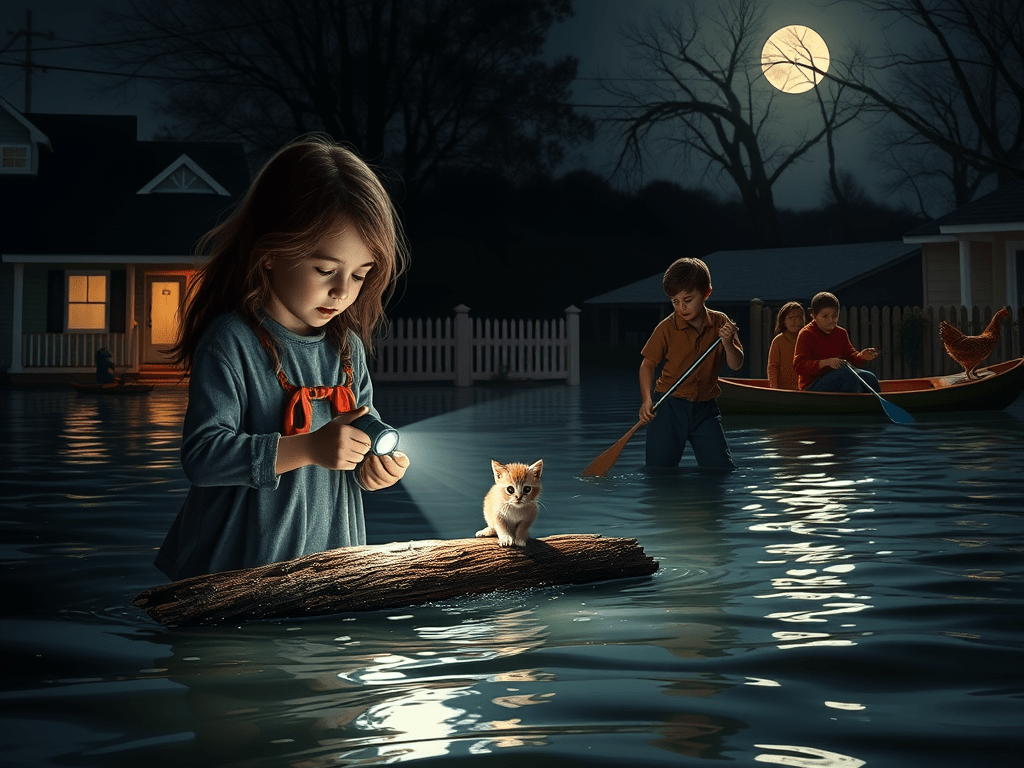
Olivia and Ethan were the first to make a rescue—a tiny kitten stranded on a piece of driftwood. Ethan waded carefully into the water while Olivia held the flashlight steady.
“Got it!” Ethan said, cradling the soaked but unharmed kitten.
Meanwhile, Jonah and Carlos used the canoe to reach the stranded dog Olivia had seen earlier. The dog wagged its tail weakly as they lifted it into the boat.
Maya and Mrs. Daniels found a coop full of chickens clinging to the top of a collapsed fence. Maya gently scooped up each bird while Mrs. Daniels checked them for injuries.
A Race Against Time
As the night wore on, the group’s teamwork paid off. They saved a horse by guiding it to higher ground, coaxed a family of ducks out of a storm drain, and even rescued a frightened raccoon stuck on a floating log.
But the most challenging rescue came just before dawn.
Ethan received a call from a neighbor who had spotted a deer trapped in the corner of a flooded pasture. The water was rising fast, and the deer couldn’t climb over the fence to safety.
The group hurried to the scene. With ropes and makeshift tools, they worked together to break open the fence and guide the panicked animal to dry land.
By the time they succeeded, the sun was beginning to rise, casting a golden glow over the town.
A Community United
In the days that followed, news of the midnight rescues spread throughout Willow Creek. The rescued animals were taken to the local shelter, where they received care and were reunited with their owners or rehomed.
The rescuers became local heroes, but they didn’t see themselves that way.
“We just did what anyone would do,” Ethan said humbly when interviewed by the local paper.
Olivia, however, felt differently. “We showed that even in the darkest times, we can come together to help those who can’t help themselves,” she said.
A New Tradition
Inspired by their success, the neighbors decided to form a permanent group called “The Midnight Rescuers.” They met regularly to train for future emergencies, ensuring that no animal—or person—would be left behind again.
And every time Olivia looked at the kitten she had adopted from that stormy night, she remembered how a simple act of courage could ripple into something extraordinary.

 Life's Adventure