Project 2025: How Trump’s Actions Align with Conservative Goals

Project 2025, a comprehensive conservative policy roadmap, is increasingly being implemented through President Donald Trump’s executive actions, despite his public disavowal of the initiative. As of April 2025, the evidence shows a striking alignment between Trump’s policies and this extensive blueprint for reshaping the federal government.

What is Project 2025?

Project 2025 is a multi-pronged initiative overseen by the Heritage Foundation, a conservative think tank, designed to provide a detailed roadmap for the next Republican president. At its core is the “Mandate for Leadership,” a 922-page blueprint that outlines ways to completely overhaul the executive branch of the federal government[1][2]. This extensive document was crafted in 2023 by the Heritage Foundation and other conservative groups as a comprehensive guide for implementing conservative policies across all aspects of federal governance[4].

The initiative covers a wide range of policy areas, from immigration and defense to regulatory reform and federal workforce management. Its stated goal is to dramatically reshape federal governance according to conservative principles, with particular emphasis on reducing the size of government, promoting “America First” policies, and rolling back progressive initiatives implemented during the Biden administration[4][5].

Trump’s Public Stance on Project 2025

Throughout his presidential campaign, Donald Trump repeatedly distanced himself from Project 2025. He insisted that he had “nothing to do with Project 2025,” claimed he had not read it, and had no intention of reading it[1]. As Democrats highlighted the initiative as a key reason to vote against Trump in the election, he further reinforced his disavowal, describing some of its proposals as “abysmal” and “ridiculous”[1][5].

Despite these public statements, there is significant evidence that the Trump administration is implementing policies that closely align with the Project 2025 blueprint. This has led Paul Dans, who previously oversaw Project 2025 at the Heritage Foundation, to express enthusiasm about Trump’s actions, describing them as “home runs” and “in many cases more than we could have even dared hope for”[1].

Evidence of Implementation

Personnel Connections

A notable indication of alignment between Trump’s administration and Project 2025 is the presence of key personnel who contributed to the initiative. Several authors of Project 2025’s policy chapters served in Trump’s first administration and now hold positions in his second term. These include Russ Vought, Trump’s pick to lead the Office of Management and Budget, and John Ratcliffe, who now serves as CIA director[1].

Policy Alignments

Federal Workforce Restructuring

One of the most dramatic implementations of Project 2025 principles has been Trump’s aggressive approach to downsizing the federal workforce. By March 2025, federal agencies faced a deadline to provide the administration with plans for a reduction in force, known as ARRPs (Agency Reorganization and Reduction in Force Plans)[3]. This initiative, guided by billionaire Elon Musk and his Department Of Government Efficiency (DOGE), has already resulted in mass firings of federal employees across multiple agencies[3].

The layoffs have particularly affected probationary federal workers, including employees in their first year or two on the job, those who recently moved between federal agencies, and those who were recently promoted. These cuts have impacted all 50 states and included employees at agencies that Americans frequently interact with, such as the National Park Service, U.S. Department of Agriculture, Veterans Affairs, Internal Revenue Service, and National Institutes of Health[3].

FEMA Restructuring

In alignment with Project 2025’s recommendations, Trump has established a review council to advise him on the Federal Emergency Management Agency’s capabilities and has suggested he could potentially “get rid” of FEMA entirely, leaving disaster response management to the states[1][2].

This action directly reflects Project 2025’s call for “reforming FEMA emergency spending to shift the majority of preparedness and response costs to states and localities instead of the federal government.” The initiative’s blueprint specifically recommends changing the cost-sharing arrangement so the federal government covers only 25% of costs for small disasters and up to 75% for “truly catastrophic disasters,” a significant reduction in federal responsibility[1].

Immigration and Border Security

Trump has taken significant actions on immigration that mirror Project 2025 proposals, including assigning troops “the mission to seal the borders and maintain the sovereignty, territorial integrity and security of the United States”[1]. This aligns with Project 2025’s recommendation that the Pentagon should “explicitly acknowledge and adjust personnel and priorities to participate actively in the defense, including using military personnel and hardware to prevent illegal crossings between ports of entry”[1].

Additionally, Trump has suspended entry into the U.S. by refugees under the U.S. Refugee Admissions Program, reflecting Project 2025’s call for “rightsizing refugee admissions” and an “indefinite curtailment” of refugee admissions[1].

Dismantling DEI Initiatives

Trump has taken substantial steps to dismantle diversity, equity, and inclusion (DEI) initiatives throughout the government and in the private sector, signing multiple executive orders aimed at abolishing these programs[4]. This mirrors Project 2025’s calls for the next conservative president to “eliminate every one of [the Biden administration’s] wrongful and burdensome ideological projects,” asserting that “Nondiscrimination and equality are the law; DEI is not”[4].

In a particularly striking alignment, Trump revoked a 60-year-old policy from 1965 that prohibited employment discrimination by government contractors. Project 2025 explicitly called for revoking this Lyndon B. Johnson-era executive order, arguing that abolishing it would mean contractors will “be less subject to the changing political whims of a President that might impose significant new costs or burdens”[4].

The Scale of Implementation

A CNN analysis of Trump’s first week in office found that more than two-thirds of his executive orders and actions (36 out of 53) evoked proposals outlined in Project 2025’s blueprint[2]. This extensive alignment covers not only Trump’s most-touted pledges like cracking down on illegal immigration and dismantling DEI initiatives but also more provocative and unexpected early actions[2].

These included punishing countries that refuse deported migrants, revoking security clearances of top national security officials accused by conservatives of political bias, and curbing foreign aid from countries “not fully aligned” with his global aims—all policies that were foreshadowed in Project 2025’s recommendations[2].

Conclusion

Despite President Trump’s public disavowal of Project 2025, the evidence demonstrates a substantial alignment between his administration’s actions and the initiative’s policy recommendations. From federal workforce cuts to immigration policy changes, from dismantling DEI initiatives to restructuring FEMA, Trump’s executive actions appear to be following much of the conservative blueprint laid out in Project 2025’s “Mandate for Leadership.”

As former Project 2025 director Paul Dans stated, the initiatives being implemented are “exactly the work we set out to do”[2]. While Trump continues to maintain distance from the project publicly, the implementation of its recommendations suggests that Project 2025 is indeed serving as an influential roadmap for his second administration’s approach to governance and policy.

Citations:
[1] https://www.cbsnews.com/news/trump-project-2025-playbook/
[2] https://www.cnn.com/2025/01/31/politics/trump-policy-project-2025-executive-orders-invs/index.html
[3] https://www.usatoday.com/story/news/politics/2025/03/12/trump-doge-federal-layoffs-timeline/82240271007/
[4] https://www.forbes.com/sites/alisondurkee/2025/03/17/heres-how-trumps-executive-orders-align-with-project-2025-as-he-touts-agenda-in-speech-to-congress/
[5] https://www.forbes.com/sites/alisondurkee/2025/03/05/heres-how-trumps-executive-orders-align-with-project-2025-as-he-touts-agenda-in-speech-to-congress/
[6] https://www.npr.org/2025/03/15/nx-s1-5328721/reduction-in-force-rif-federal-workers-job-cuts-musk-doge-layoffs
[7] https://progressivereform.org/tracking-trump-2/project-2025-executive-action-tracker/
[8] https://en.wikipedia.org/wiki/Project_2025
[9] https://www.whitehouse.gov/fact-sheets/2025/02/fact-sheet-president-donald-j-trump-works-to-remake-americas-federal-workforce/
[10] https://www.pbs.org/newshour/show/the-project-2025-policies-the-trump-administration-is-already-implementing
[11] https://www.npr.org/2025/01/31/nx-s1-5280364/trump-enacts-project-2025-policies-which-he-distanced-himself-from-while-campaigning
[12] https://www.selc.org/news/we-all-suffer-from-federal-workforce-cuts/
[13] https://www.aclu.org/project-2025-explained
[14] https://www.bbc.com/news/articles/c977njnvq2do
[15] https://www.brookings.edu/articles/trumps-dramatic-plan-to-cut-the-federal-workforce/
[16] https://www.nature.com/articles/d41586-025-00780-2
[17] https://www.cnn.com/politics/tracking-federal-workforce-firings-dg/index.html
[18] https://www.project2025.org
[19] https://apnews.com/article/trump-elon-musk-federal-workers-layoffs-d295d4bb2cdd5023c27d9cb03754e81b
[20] https://nul.org/node/6770


Answer from Perplexity: pplx.ai/share
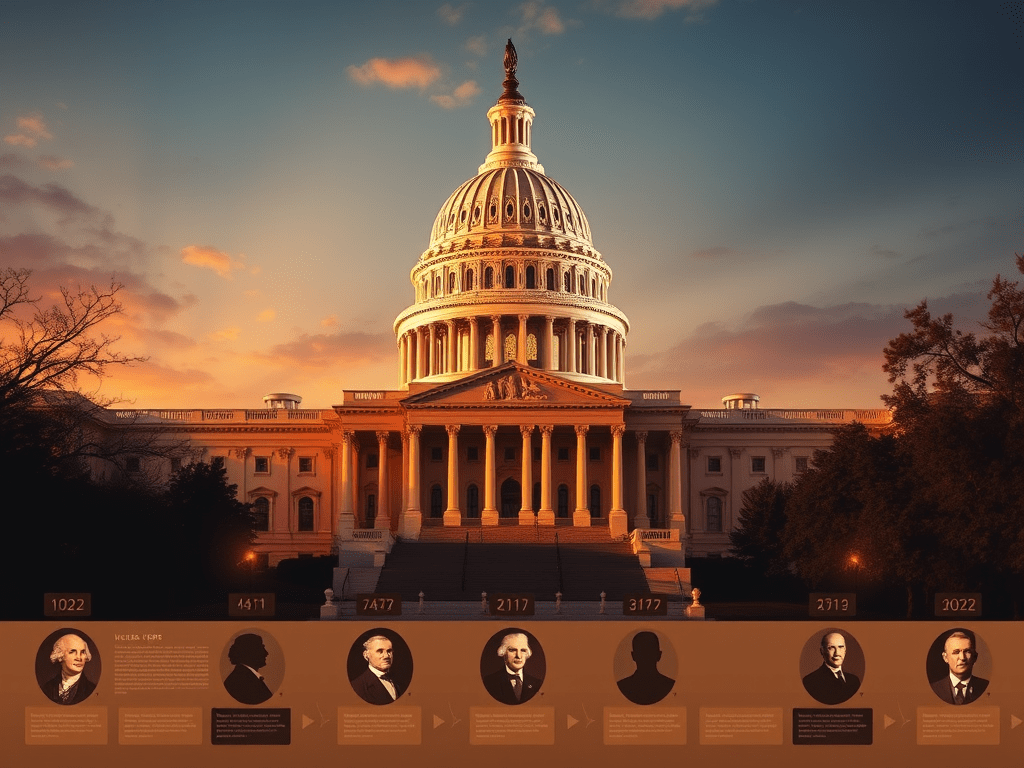
The Evolution of Presidential Term Limits in America

The original U.S. Constitution (1787) did not set any limits on how many terms a president could serve. Instead, it only outlined a four-year term with the possibility of reelection. Article II, Section 1, simply stated:

“The executive Power shall be vested in a President of the United States of America. He shall hold his Office during the Term of four Years, and, together with the Vice President, chosen for the same Term, be elected, as follows…”

This meant that, in theory, a president could serve for an unlimited number of terms as long as they kept winning elections. The decision to impose a two-term limit did not come until 1951, with the passage of the 22nd Amendment, following Franklin D. Roosevelt’s four-term presidency.

The history of U.S. presidential term limits is closely tied to the precedent set by early presidents and the eventual passage of the 22nd Amendment to the U.S. Constitution.

1. The Two-Term Tradition (1789–1940)

  • George Washington, the first U.S. president (1789–1797), voluntarily stepped down after two terms, establishing an informal precedent.
  • This tradition was followed by nearly all presidents afterward, with the notable exception of Theodore Roosevelt, who ran for a third (non-consecutive) term in 1912 but lost.

2. Franklin D. Roosevelt’s Four Terms (1932–1945)

  • Franklin D. Roosevelt (FDR) broke the two-term tradition by winning four consecutive terms (1932, 1936, 1940, 1944).
  • His extended presidency was due to the Great Depression and World War II, where voters sought continuity in leadership.

3. The 22nd Amendment (1951)

  • After FDR’s death in 1945, Congress moved to formally limit presidential terms.
  • In 1947, Congress proposed the 22nd Amendment, which was ratified on February 27, 1951.
  • It limits a president to two elected terms or a maximum of 10 years (if they assumed office due to succession and served less than two years before being elected twice).

4. Impact and Attempts to Repeal

  • Dwight D. Eisenhower (1953–1961) was the first president affected by the amendment.
  • Several lawmakers have proposed repealing it, but no serious effort has succeeded.
  • Ronald Reagan and Bill Clinton both suggested that term limits restrict voter choice, but no changes were made.

Key Takeaway

The two-term limit became law after FDR’s unprecedented four terms, and since then, no president has served more than eight years in office.

Trump’s Victory: Celebrations and Future Challenges

The recent presidential election has resulted in Donald Trump’s victory, leading to celebrations among his supporters. However, the aftermath of the election has been marked by significant developments and challenges.

Initial Celebrations

Donald Trump secured a commanding victory over Vice President Kamala Harris, achieving what many considered an unlikely political comeback[4]. The election night was marked by jubilant scenes at Mar-a-Lago, where Trump and his allies gathered to celebrate[4]. The atmosphere was one of triumph, with Trump declaring it a day when “the American people regained control of their country”[4].

Voter Shifts and Political Landscape

Trump’s victory revealed significant shifts in the American electorate:

  • Improved Republican margins across the nation
  • Increased support from non-White voters, particularly among Latino communities
  • Gains in both urban and rural areas

These changes have posed substantial challenges for the Democratic Party, fracturing their national coalition[3].

Trump’s Post-Election Mindset

Following his win, Trump has been described as buoyant and optimistic:

  • He feels empowered by his popular vote victory, which he sees as a mandate for his agenda
  • Trump has been engaging with global leaders, top advisors, and his transition team
  • He has appointed Susie Wiles as his White House chief of staff
  • The president-elect has expressed amazement at the positive reactions from foreign leaders[5]

Emerging Challenges

Despite the initial euphoria, several issues have begun to surface:

  1. Legal Concerns: Trump still faces numerous legal challenges, including four indictments and 34 felony convictions. He has also been found liable for sexual abuse and faces potential fines exceeding half a billion dollars[4].
  2. Security Concerns: A recent assassination attempt has led to increased security measures, with Trump refraining from his usual golfing activities[5].
  3. Political Divisions: While Trump’s victory was decisive, the country remains deeply divided, with Democrats entering a period of introspection[3].
  4. Transition Challenges: The transition process is underway, with Trump’s team working to staff his administration. However, the process of handing over power from the current administration may present its own set of challenges[5].

Looking Ahead

As Trump prepares to return to the White House, he faces the task of implementing his campaign promises while navigating a complex political and legal landscape. His popular vote win has bolstered his confidence, but the coming months will likely test his administration’s ability to govern effectively in the face of ongoing controversies and opposition[5].

Citations:
[1] https://www.scmp.com/magazines/style/entertainment/article/3286755/who-wayne-gretzkys-trump-supporting-wife-janet-jones-gretzky-police-academy-5-actress-celebrated
[2] https://www.newyorker.com/news/dispatch/donald-trumps-west-palm-beach-victory-celebration
[3] https://www.cnn.com/2024/11/10/politics/trump-voter-shifts-nationwide/index.html
[4] https://apnews.com/article/trump-victory-harris-dd64fe5fac158025058a45f21388a6b2
[5] https://www.cnn.com/2024/11/07/politics/donald-trump-mindset/index.html

Key Proposals of Agenda 47 Explained

Agenda 47 is Donald Trump’s comprehensive policy platform for his 2024 presidential campaign, outlining his proposed actions and priorities if elected as the 47th President of the United States[1]. Here are the key aspects of Agenda 47:

## Overview

Agenda 47 is presented on Trump’s campaign website as a series of videos featuring Trump himself explaining each proposal[1]. The platform covers a wide range of policy areas and is designed to appeal to Republican primary voters and Trump’s base[1].

## Key Policy Proposals

Some of the main policy proposals included in Agenda 47 are:

1. **Immigration and Border Security**:
   – Sealing the border and stopping what Trump calls a “migrant invasion”
   – Carrying out the largest deportation operation in American history[5]

2. **Economy and Energy**:
   – Ending inflation and making America “affordable again”
   – Making the U.S. the dominant energy producer in the world
   – Implementing large tax cuts for workers and eliminating tax on tips[5]

3. **Education**:
   – Focusing on “Knowledge and Skills, Not CRT and Gender Indoctrination”
   – Removing what Trump calls the “left’s ‘equity’ agenda” from classrooms
   – Reinstating the 1776 Commission[1]

4. **Government Reform**:
   – Cutting federal regulations
   – Implementing a regulatory budget to reduce the federal government annually
   – Bringing independent regulatory agencies under Presidential authority[1]

5. **Constitutional Rights**:
   – Defending the Constitution, Bill of Rights, and fundamental freedoms
   – Protecting freedom of speech, religion, and the right to bear arms[5]

6. **Foreign Policy and National Security**:
   – Preventing World War III and restoring peace in Europe and the Middle East
   – Building a missile defense shield over the entire country[5]

## Implementation and Criticism

Many of Agenda 47’s proposals would rely on executive orders and expanded executive power[1]. Some of the plans are legally controversial and may require constitutional amendments[1]. Critics have raised concerns about the platform’s approach to climate change, public health, and its potential impact on inflation[1].

It’s worth noting that while Agenda 47 is Trump’s official campaign platform, it shares many themes and policies with Project 2025, a separate initiative by the Heritage Foundation that aligns closely with Trump’s vision[4].

Citations:
[1] Agenda 47 https://en.wikipedia.org/wiki/Agenda_47
[2] Agenda 47 vs. Project 2025: Trump’s Bold Plan for … – YouTube https://www.youtube.com/watch?v=cwYpnE748MA
[3] Trump’s Agenda 47 — What It Means for Democracy https://www.democracydocket.com/analysis/trumps-agenda-47-and-what-it-means-for-democracy/
[4] What to Know About Donald Trump’s Agenda 47, and Project 2025 https://www.harpersbazaar.com/culture/politics/a62830793/donald-trump-agenda-47-project-2025-explained/
[5] Platform | Donald J. Trump https://www.donaldjtrump.com/platform

Kamala Harris Surges in 2024 Presidential Polls

Recent polls indicate that Vice President Kamala Harris has experienced a significant surge in popularity as the 2024 presidential election campaign intensifies. Here are the key details:

Harris Takes the Lead

Harris is now leading former President Donald Trump in several national polls:

  • An NBC News poll shows Harris ahead of Trump 49% to 44% among registered voters[5][6].
  • A USA TODAY/Suffolk University Poll has Harris leading Trump 48% to 43%[4].
  • A CBS/Ipsos poll puts Harris ahead 52% to 48%[3].

While these leads are often within the margin of error, they represent a notable shift from earlier polling that had Trump ahead.

Record-Breaking Favorability Increase

Harris has seen a dramatic rise in her favorability ratings:

  • Her favorability has increased by 16 percentage points in NBC’s polling since July[6].
  • This marks the largest favorability increase for any candidate in NBC News polling since George W. Bush after 9/11[3][6].

Key Factors Driving Harris’ Momentum

Several elements appear to be contributing to Harris’ surge:

  • Democratic Enthusiasm: About 78% of Democratic voters now express enthusiasm about voting with Harris as the nominee, up from 55% when Biden was the candidate[2].
  • Demographic Shifts: Harris has made significant gains among Hispanic voters, Black voters, young people (18-34), and lower-income Americans[4].
  • Perception of Change: Harris is being viewed as a candidate representing change, which is resonating with voters[6].

Battleground State Impact

While national polls show Harris leading, the race remains tight in key battleground states:

  • CBS rates seven key swing states as tossups, with Harris holding a slight edge in most[3].
  • Harris leads Trump by narrow margins in Arizona, Georgia, and Nevada according to some polls[2].

Challenges Remain

Despite her surge, Harris still faces hurdles:

  • The economy remains a strong issue for Trump, though Harris has narrowed the gap[3].
  • Some Republican voters who currently express hesitation about Trump may ultimately return to supporting him, as seen in previous elections[6].

As the election approaches, both campaigns are intensifying efforts to mobilize voters in key states. With early voting already underway in some areas, the race remains highly competitive and fluid[3][6].

Citations:
[1] https://www.270towin.com/2024-presidential-election-polls/
[2] https://www.theguardian.com/us-news/article/2024/aug/30/2024-us-presidential-polls-harris-enthusiasm
[3] https://fortune.com/2024/09/22/kamala-harris-favorability-polling-biggest-george-w-bush-9-11/
[4] https://www.usatoday.com/story/news/politics/elections/2024/08/29/kamala-harris-donald-trump-suffolk-usa-today-poll-results/74984967007/
[5] https://www.nbcnews.com/nightly-news/video/a-new-nbc-news-poll-shows-vice-president-harris-ahead-of-trump-219902021723
[6] https://www.nbcnews.com/politics/2024-election/poll-newly-popular-harris-challenging-trump-change-rcna171308
[7] https://www.nbcnews.com/politics/2024-election/live-blog/harris-trump-presidential-election-live-updates-rcna172152
[8] https://www.washingtonpost.com/elections/2024/09/23/2024-election-campaign-updates-harris-trump/

Examining the Truth: Do Haitians Really Eat Cats and Dogs?

Do Haitians eat cats and dogs?

Based on the available information, there is no credible evidence that Haitians eat cats and dogs. This claim appears to be part of a disinformation campaign targeting Haitian immigrants. Here are the key points:

1. Officials in Springfield, Ohio, where rumors about Haitian immigrants eating pets originated, have stated there are “no credible reports or specific allegations of pets being harmed, injured or abused by individuals within the immigrant community”[1][8].

2. The Springfield police department has not received any reports of stolen or consumed pets[7].

3. Experts on Haitian culture and Vodou practices state that cats and dogs are not part of Haitian religious rituals or diet. Dr. Ingrid Kummels, a Latin American ethnologist, notes that “Afro-Caribbean religions, including Haitian Vodou, only involve the sacrifice of animals considered edible, such as chickens and goats. Cats and dogs are not part of these practices”[5].

4. Haitian individuals have spoken out against these claims. One Haitian stated, “For the Record we (Haitians) don’t eat cats and dogs in Haiti. They are seen as loved companion animals”[3].

5. Scholars point out that the “dog eater” stereotype is a fearmongering tactic historically used against various immigrant groups, particularly those of Asian heritage[6].

6. The rumors appear to be part of a broader disinformation campaign targeting Haitian immigrants, fueled by social media posts and amplified by some politicians[1][2].

In conclusion, the claim that Haitians eat cats and dogs is not supported by evidence and appears to be a harmful stereotype rooted in xenophobia and misinformation.

Citations:
[1] Where did Trump’s Springfield dog-eating debate claims come from? https://www.the-independent.com/news/world/americas/us-politics/springfield-ohio-haiti-immigrants-pets-b2611074.html
[2] America’s Racist, Xenophobic, and Highly Specific Fear of Haiti https://theintercept.com/2024/09/12/trump-springfield-haiti-cats-dogs-racism-immigration/
[3] For the Record we (Haitians) don’t eat cats and dogs in Haiti … – Reddit https://www.reddit.com/r/h3h3productions/comments/1ffv8qb/for_the_record_we_haitians_dont_eat_cats_and_dogs/
[4] Haiti’s Voodoo Culture Consists Of Sacrificing Cats, “Eating Animals, And Humans,” According To Reports https://www.eviemagazine.com/post/haiti-voodoo-culture-eating-animals-humans-jack-brewer
[5] Fact check: Disinformation targets Haitian migrants – DW – 09/13/2024 https://www.dw.com/en/fact-check-how-the-stigmatization-of-haitian-vodou-led-to-a-disinformation-campaign/a-70200764
[6] the racist US history behind Trump’s Haitian pet eater claim https://www.theguardian.com/us-news/2024/sep/14/racist-history-trump-pet-eating-immigrant
[7] Trump falsely accuses immigrants in Ohio of abducting and eating pets https://apnews.com/article/haitian-immigrants-vance-trump-ohio-6e4a47c52b23ae2c802d216369512ca5
[8] Ohio City Responds to Claims of Animal Sacrifices by Haitian Migrants https://www.newsweek.com/immigration-haitian-migrants-springfield-ohio-eating-pets-maga-1951125

The Precarious Situation of Trump’s 2024 Campaign: Financial Dynamics, Dishonesty, and Internal Opposition

Recent analyses suggest that former President Donald Trump’s 2024 campaign is facing significant challenges that could potentially lead it into what some are calling a “death spiral.” This term refers to a series of compounding negative events and trends that could critically undermine his chances of winning the election.

Key Factors Contributing to the ‘Death Spiral’

1. Polling and Public Opinion

Recent polls indicate a substantial shift in favor of Vice President Kamala Harris, the presumptive Democratic nominee. This shift is partly attributed to Trump’s controversial statements and actions, which have alienated various voter demographics, including Black voters. For instance, a disastrous interview with Black journalists led to widespread criticism and further eroded his support base[4]. Additionally, Harris’s campaign has gained momentum, with increased fundraising and strategic advertising efforts[4].

2. Legal Troubles and Public Perception

Trump’s legal battles are another significant factor. He faces multiple criminal charges, including those related to his efforts to overturn the 2020 election results and the mishandling of classified documents[5]. These legal issues have not only damaged his public image but also created a sense of instability within his campaign. The fear of co-conspirators flipping and cooperating with prosecutors has added to the turmoil, as several high-profile allies have already struck plea deals[6].

3. Financial Dynamics

While Trump experienced a fundraising surge following his conviction on 34 felony counts related to a hush money scheme, this financial boost may not be enough to counteract the negative publicity and legal challenges[5]. His campaign’s ability to effectively deploy these funds to sway voter opinion remains uncertain, and the stigma of his legal troubles could outweigh the financial advantages.

4. Avalanche of Dishonesty

Trump’s campaign strategy, characterized by a high frequency of false claims and misinformation, has also contributed to the negative trajectory. Fact-checking efforts have highlighted numerous falsehoods in his speeches, further damaging his credibility[2]. This pattern of dishonesty has been a consistent issue across his previous campaigns and continues to be a central feature of his current one.

5. Internal and External Opposition

Trump faces significant opposition both within and outside his party. Former allies and political insiders have criticized his recent actions, predicting that his campaign could spiral further into chaos if current trends continue[4]. Additionally, his immunity fight and the broader legal landscape present formidable obstacles, with constitutional scholars and legal experts arguing against his claims of immunity for actions taken during his presidency[3].

Conclusion

The combination of shifting public opinion, ongoing legal battles, financial uncertainties, pervasive dishonesty, and internal opposition creates a precarious situation for Trump’s 2024 campaign. These factors collectively contribute to the notion of a “political avalanche” that threatens to send his campaign into a full-on “death spiral,” significantly impacting his chances of securing the presidency once again.

Citations:
[1] https://www.alternet.org/trump-harris-scaramucci-polls/
[2] https://www.cnn.com/2023/12/01/politics/trump-dishonesty-avalanche-102-fall-false-claims/index.html
[3] https://lawandcrime.com/high-profile/no-get-out-of-jail-free-passes-citizen-trump-who-is-not-a-king-faces-avalanche-of-opposition-in-immunity-fight/
[4] https://www.nj.com/news/2024/07/after-trumps-disastrous-session-with-black-journalists-insiders-make-vile-prediction-for-him.html
[5] https://www.nbcnews.com/politics/2024-election/trump-reaps-post-verdict-financial-windfall-rcna155224
[6] https://www.rollingstone.com/politics/politics-features/trump-lawyers-prepare-betrayal-former-allies-flip-1234861640/
[7] https://www.alternet.org/trump-black-job/
[8] https://eu.palmbeachpost.com/story/news/politics/elections/2024/07/21/biden-quits-but-could-vp-kamala-harris-make-a-difference-in-florida/74455829007/

Trump Shooting Incident: Propelling Action Against Gun Violence

The recent shooting incident involving former President Donald Trump highlights a critical issue that should not be overshadowed by political rhetoric: the persistent problem of gun violence in the United States[1][3].

While the attack has sparked intense debate and finger-pointing across the political spectrum, it’s crucial to focus on the underlying issue of easy access to powerful firearms. The assailant, Thomas Matthew Crooks, was able to obtain and use a potent assault weapon, resulting in injuries to Trump and others[1].

This incident is not an isolated event but part of a broader pattern of gun violence plaguing the country. On the same day as the Trump shooting, numerous other gun-related incidents occurred across the nation, underscoring the pervasive nature of this problem[1].

The political affiliations or motivations of the shooter, while subject to speculation, should not distract from the fundamental issue at hand – the widespread availability of military-grade weapons to civilians[1]. This accessibility continues to fuel the cycle of violence that affects communities across America.

While calls to tone down political rhetoric have emerged from various quarters, including President Biden and Speaker Mike Johnson[2], it’s essential to recognize that inflammatory language, while problematic, is not the root cause of gun violence. The focus should remain on addressing the underlying issue of gun control and the need for stricter measures to regulate access to powerful firearms[1][3].

As the country grapples with the aftermath of this high-profile incident, it’s crucial to resist the temptation to get caught up in partisan accusations or conspiracy theories. Instead, the emphasis should be on having a constructive dialogue about effective ways to curb gun violence and protect public safety[1][3].

In conclusion, while political discourse and rhetoric certainly play a role in shaping public opinion and potentially influencing actions, the Trump shooting serves as a stark reminder of the urgent need to address the broader issue of gun violence in America. This incident should catalyze meaningful discussions and actions aimed at implementing comprehensive measures to reduce the prevalence of such violent acts in society[1][3].

Citations:
[1] https://www.latimes.com/opinion/story/2024-07-17/donald-trump-assassination-attempt-jd-vance-guns-political-violence-robin-abcarian
[2] https://www.nbcnews.com/politics/donald-trump/speaker-mike-johnson-trump-shooting-political-rhetoric-rcna161762
[3] https://thehill.com/opinion/campaign/4772619-dangerous-rhetoric-trump-shooting/
[4] https://www.nbcnews.com/politics/donald-trump/prominent-republicans-lay-blame-democrats-trump-rally-shooting-rcna161774
[5] https://www.cnn.com/2024/07/15/us/thomas-crooks-trump-rally-shooting-invs/index.html

Alex Jones, Provocative Livestream, and Social Media Alarm

On July 11, 2024, far-right podcaster and conspiracy theorist Alex Jones reportedly hosted a livestream on social media that included “Assassinate Biden” in the title, causing significant concern and calls for investigation[1]. This incident has drawn attention from various quarters, including journalists and social media users, who have notified the U.S. Secret Service about the potentially threatening content.

Key points about the incident:

  1. Livestream title: The full title of the stream appears to have been “Will the Deep State Assassinate Biden If He Refuses To Leave?”[1], which some argue provides important context to the provocative headline.
  2. Social media reaction: Many users on X (formerly Twitter) expressed alarm and called for an investigation, tagging the Secret Service, FBI, and X’s safety team[1].
  3. Potential legal implications: The use of such language, even if not intended as a direct threat, could potentially violate laws against threatening the President and may be subject to investigation.
  4. Context of Jones’ previous statements: This incident follows a pattern of controversial claims by Jones. In June 2024, he speculated that the “Deep State” might assassinate Biden and blame Trump supporters following a poor debate performance[2].

It’s important to note that Alex Jones has a history of promoting conspiracy theories and making inflammatory statements[5][9]. He has faced significant legal consequences for his past claims, particularly regarding the Sandy Hook school shooting[5].

This incident occurs against a backdrop of heightened political tensions and concerns about threats to political figures. It also raises questions about the responsibilities of social media platforms in moderating potentially dangerous content.

As of now, there has been no official statement from the Secret Service or other law enforcement agencies regarding this specific incident. It remains to be seen whether this will lead to any formal investigation or action against Jones.

Citations:
[1] https://www.rawstory.com/alex-jones-secret-service-assassinate-biden/
[2] https://tribune.com.pk/story/2474923/alex-jones-claims-deep-state-could-assassinate-biden-after-debate-performance
[3] https://www.crowdpac.com/news/877834
[4] https://newrepublic.com/post/182205/felon-trump-fbi-assassination-biden-classified-docs
[5] https://apnews.com/hub/alex-jones
[6] https://www.newsweek.com/marjorie-taylor-greene-suggests-dems-plan-have-trump-murdered-jail-1893047
[7] https://twitter.com/morgfair/status/1811466804444954908
[8] https://www.nbcnews.com/news/tucker-carlson-says-us-speeding-assassination-trump-stoking-conspiraci-rcna102976
[9] https://en.wikipedia.org/wiki/Alex_Jones
[10] https://www.imdb.com/news/ni64602157/
[11] https://www.smartnews.com/p/4702010722270319065
[12] https://www.motherjones.com/politics/2024/01/greg-abbott-texas-shoot-migrants-border-biden-murder/
[13] https://mobile.x.com/RawStory/status/1811217100901417168
[14] https://www.mediamatters.org/steve-bannon/maga-movement-and-trump-assassination-plot-wasnt
[15] https://twitter.com/NikkiBarnesFL/status/1811221297008877856

The Controversy Surrounding Project 2025 and Its Potential Impact on Trump’s 2024 Campaign

Donald Trump’s attempt to distance himself from Project 2025 appears to be backfiring, as recent developments have highlighted the close ties between the former president and the controversial conservative policy initiative. Here’s an overview of the situation:

Trump’s Denial and Democratic Response

Late Wednesday night, Trump took to Truth Social to disavow any connection to Project 2025, stating, “I know nothing about Project 2025. I have not seen it, have no idea who is in charge of it, and unlike our very well received Republican Platform, had nothing to do with it.”[1] He accused Democrats of spreading “pure disinformation” by trying to link him to the project’s policies.

However, evidence suggests that Trump’s claim of ignorance is likely untrue. A CNN analysis found at least 140 people who worked in Trump’s administration were involved in Project 2025, including six former cabinet secretaries[1]. The project’s 900-page master plan even includes roughly 20 pages credited to Trump’s first deputy chief of staff[1].

Project 2025 and Its Ties to Trump

Project 2025 is a comprehensive policy plan developed by the Heritage Foundation and other conservative organizations. While not directly created by Trump, it is closely aligned with his potential second-term agenda:

  1. Many of Trump’s associates are linked to the project, including former Trump appointee Russ Vought and Ed Martin, who sit on the advisory board[1].
  2. The project outlines extreme conservative policies, including a federal ban on abortion and IVF, which has become a point of contention[1].
  3. Several former Trump administration officials are directly involved, such as ex-Office of Management and Budget director Russ Vought, former acting Defense Secretary Christopher Miller, and former HUD Secretary Ben Carson[4].

Democratic Strategy and Public Response

Democrats, particularly the Biden campaign, have seized on Project 2025 as a way to attack Trump:

  1. The DNC placed Project 2025 billboards around Trump’s rally in Florida[1].
  2. Biden’s campaign launched a website tying Trump to the project and released a video warning that “Project 2025 will destroy America”[1].
  3. Public interest in Project 2025 has grown significantly, with Google Trends showing a dramatic increase in searches for the term[3].

Potential Impact on Trump’s Campaign

The controversy surrounding Project 2025 may be damaging to Trump’s campaign:

  1. It exposes potential contradictions between Trump’s public stance and the policies advocated by his allies.
  2. The project’s extreme positions on issues like abortion and IVF are at odds with the majority of the electorate[1].
  3. Increased public awareness of Project 2025 could influence swing voters and those still undecided about voting[3].

As the 2024 election approaches, the debate over Project 2025 is likely to intensify. Democrats are celebrating what they see as a successful strategy to expose Trump’s connections to extreme conservative policies, while Trump and his campaign attempt to create distance from the initiative. The controversy highlights the ongoing struggle within the Republican Party to balance appealing to its conservative base while not alienating moderate voters.

Citations:
[1] https://newrepublic.com/post/183697/trump-project-2025-meltdown
[2] https://www.nytimes.com/article/project-2025.html
[3] https://www.salon.com/2024/07/05/project-2025-was-supposed-to-boost-donald-campaign–but-it-may-be-backfiring-instead/
[4] https://www.nbcnews.com/politics/donald-trump/project-2025-trump-heritage-foundation-what-know-rcna161338
[5] https://newrepublic.com/post/183706/report-trump-ties-project-2025
[6] https://apnews.com/article/trump-project-2025-biden-9d372469033d23e1e3aef5cf0470a2e6
[7] https://www.thedailybeast.com/project-2025-director-paul-dans-in-resurfaced-interview-donald-trump-is-very-bought-in
[8] https://www.theguardian.com/us-news/article/2024/jul/08/trump-project-2025
[9] https://abcnews.go.com/US/trump-distance-project-2025-architects-helped-shape-rnc/story?id=111759747
[10] https://www.cnn.com/2024/07/11/politics/trump-allies-project-2025/index.html
[11] https://www.bbc.com/news/articles/c977njnvq2do
[12] https://time.com/6995370/trump-disavows-project-2025-transition-plan/
[13] https://www.npr.org/2024/07/11/nx-s1-5035272/project-2025-trump-biden-heritage-foundation-conservative
[14] https://www.democracydocket.com/analysis/what-is-project-2025-and-why-is-it-alarming/
[15] https://www.reuters.com/world/us/trump-seeks-disavow-project-2025-despite-ties-conservative-group-2024-07-05/

Project 2025: Conservative Policy Initiative Overview and Potential Threats

Project 2025: An Overview and Its Potential Threats

Project 2025 is a comprehensive policy initiative spearheaded by the Heritage Foundation and supported by over 100 conservative organizations. It aims to reshape the U.S. federal government significantly, consolidating executive power and implementing a far-reaching conservative agenda. The initiative is designed to be enacted swiftly should a Republican, presumably Donald Trump, win the 2024 presidential election.

Key Components and Proposals

1. Executive Power Consolidation:

  • Reclassification of Civil Servants: Project 2025 proposes reclassifying tens of thousands of federal civil service workers as political appointees. This would allow the replacement of career civil servants with individuals loyal to the administration’s policies[2].
  • Unitary Executive Theory: The project asserts that the entire executive branch is under the direct control of the president, based on Article II of the U.S. Constitution[2].

2. Economic Reforms:

  • Tax Policy: The project seeks to extend the Tax Cuts and Jobs Act of 2017, simplify individual income taxes to two brackets (15% and 30%), reduce the corporate tax rate to 18%, and impose a 15% tax on capital gains and dividends[2].
  • Federal Reserve: It proposes abolishing the Federal Reserve and advocates for a commodity-backed currency like the gold standard[2].

3. Social and Civil Policies:

  • Civil Rights: Critics argue that Project 2025 would undermine civil liberties, including the rights of women, persons of color, and the LGBTQ community[2].
  • Reproductive Rights: The project includes proposals to restrict access to reproductive care and prohibit the abortion pill[5].
  • Education: It envisions reducing the federal government’s role in education, promoting school choice, and eliminating what it calls “woke propaganda” in public schools[2].

4. Environmental and Labor Policies:

  • Climate Change: The project is criticized for its lack of concern for climate change and its intent to roll back environmental protections[1].
  • Labor Protections: It aims to cut overtime pay, relax worker safety rules, and allow more workplace discrimination[1].

Potential Threats and Criticisms

1. Undermining Democracy:

  • Authoritarianism: Critics, including legal experts and anti-authoritarian groups, argue that Project 2025 represents an authoritarian plan that could transform the U.S. into an autocracy by undermining the rule of law, separation of powers, and civil liberties[2][3].
  • Executive Overreach: The project’s emphasis on consolidating executive power and bypassing congressional approval for many actions is seen as a significant threat to democratic governance[1][2].

2. Economic and Social Impact:

  • Economic Inequality: The proposed tax reforms and deregulation could exacerbate economic inequality and increase the national debt[2].
  • Social Safety Nets: The project includes plans to dismantle social safety net programs, which could reduce food assistance for millions and cut support for veterans with disabilities[1].

3. Environmental Degradation:

  • Climate Policy: The project’s disregard for climate change and environmental protections could lead to increased pollution and long-term environmental harm[1].

Political Reactions

Donald Trump has recently attempted to distance himself from Project 2025, despite its alignment with his administration’s principles and the involvement of his former aides in its creation. This disavowal is seen by some as a strategic move to avoid alienating moderate voters and to mitigate potential backlash from the project’s controversial proposals[5][6].

Conclusion

Project 2025 represents a significant shift towards a more centralized and conservative federal government. While its proponents argue it is necessary to dismantle what they see as an unaccountable bureaucracy, critics warn that it poses severe threats to democracy, civil rights, and the environment. Understanding these threats is crucial for informed public discourse and democratic engagement.

Citations:
[1] https://democracyforward.org/the-peoples-guide-to-project-2025/
[2] https://en.wikipedia.org/wiki/Project_2025
[3] https://www.wbur.org/onpoint/2024/07/11/authoritarian-promo
[4] https://www.project2025.org
[5] https://www.theguardian.com/us-news/article/2024/jul/08/trump-project-2025
[6] https://www.nytimes.com/article/project-2025.html
[7] https://www.youtube.com/watch?v=WeMjng07qB8
[8] https://www.cbsnews.com/amp/news/what-is-project-2025-trump-conservative-blueprint-heritage-foundation/
[9] https://newrepublic.com/post/183660/project-2025-trump-ally-tom-homan-revenge-threat-deportation
[10] https://www.project2025.org/about/about-project-2025/
[11] https://www.reuters.com/world/us/trump-seeks-disavow-project-2025-despite-ties-conservative-group-2024-07-05/
[12] https://www.bbc.com/news/articles/c977njnvq2do
[13] https://www.youtube.com/watch?v=nIu5gnOX6FU
[14] https://www.npr.org/2024/07/11/nx-s1-5035272/project-2025-trump-biden-heritage-foundation-conservative
[15] https://www.msnbc.com/opinion/msnbc-opinion/project-2025-what-know-trump-president-second-term-rcna160465

Project 2025: Republican Government Reshaping Plan Unveiled

Project 2025, also known as the Presidential Transition Project, is a comprehensive conservative policy proposal developed by the Heritage Foundation and other right-wing organizations to reshape the United States federal government if a Republican candidate, presumably Donald Trump, wins the 2024 presidential election[1][5]. Here are the key aspects of Project 2025:

Government Structure and Power

  • Proposes placing the entire federal bureaucracy under direct presidential control[1]
  • Advocates reclassifying tens of thousands of federal civil service workers as political appointees to replace them with loyalists[1]
  • Seeks to expand presidential power and drastically cut federal agencies like the Department of Education[3]
  • Aims to implement the controversial “unitary executive theory,” giving the president direct control over independent agencies like the Department of Justice[5]

Economic Policies

  • Recommends extending the Tax Cuts and Jobs Act of 2017[1]
  • Proposes simplifying individual income taxes to two brackets: 15% and 30%[1]
  • Aims to reduce the corporate tax rate to 18%[1]
  • Suggests abolishing the Federal Reserve and potentially returning to a gold-backed currency[5]
  • Advocates for slashing federal funding for renewable energy research and investment[5]

Social and Cultural Policies

  • Seeks to infuse the government and society with Christian values[1]
  • Proposes banning pornography and shutting down tech companies that facilitate access to such content[5]
  • Recommends withdrawing FDA approval for the abortion pill mifepristone[3][5]
  • Advocates for school choice and parental control over education[5]
  • Proposes eliminating terms like “sexual orientation,” “diversity, equity, and inclusion,” and “reproductive rights” from federal regulations[5]

Immigration and Border Security

  • Proposes increased funding for a wall on the US-Mexico border[5]
  • Recommends consolidation and expansion of powers for immigration agencies[5]
  • Suggests increasing fees on immigrants and allowing fast-tracked applications for those who pay a premium[5]

Implementation Strategy

  • Includes a 180-day playbook of actions to be taken in the first six months of a new conservative administration[2]
  • Outlines strategies for implementing policies immediately after the presidential inauguration in January 2025[5]

Critics have characterized Project 2025 as an authoritarian plan that could undermine the rule of law, separation of powers, and civil liberties[1]. However, proponents frame it as a means to dismantle what they see as an unaccountable government bureaucracy[1].

It’s worth noting that while Donald Trump has recently attempted to distance himself from Project 2025[3][4], many individuals involved in crafting the Republican Party platform and Trump’s campaign have ties to the project[3]. This has led to skepticism about Trump’s disavowal, with some suggesting it may be an attempt to avoid potential controversy during the election campaign[4].

Citations:
[1] https://en.wikipedia.org/wiki/Project_2025
[2] https://www.project2025.org
[3] https://abcnews.go.com/US/trump-distance-project-2025-architects-helped-shape-rnc/story?id=111759747
[4] https://www.theguardian.com/us-news/article/2024/jul/08/trump-project-2025
[5] https://www.bbc.com/news/articles/c977njnvq2do
[6] https://www.documentcloud.org/documents/24088042-project-2025s-mandate-for-leadership-the-conservative-promise
[7] https://www.cbsnews.com/amp/news/what-is-project-2025-trump-conservative-blueprint-heritage-foundation/
[8] https://www.heritage.org/conservatism/commentary/project-2025
[9] https://www.project2025.org/about/about-project-2025/
[10] https://www.project2025.org/policy/
[11] https://www.newsnationnow.com/politics/2024-election/heritage-foundation-project-2025-explained/
[12] https://www.democracydocket.com/analysis/what-is-project-2025-and-why-is-it-alarming/

Critiques of Heritage Foundation’s Project 2025: Potential Authoritarianism and Policy Impact

Critiques of Project 2025

Project 2025, a comprehensive policy blueprint developed by the conservative Heritage Foundation, has garnered significant attention and criticism. Here are some of the common critiques:

1. Expansion of Presidential Power

Critics argue that Project 2025 aims to significantly expand presidential authority, which could undermine democratic institutions and checks and balances. The project supports the unitary executive theory, suggesting that the president should have direct control over federal agencies, including independent ones like the Department of Justice. This centralization of power is seen as a move towards authoritarianism by opponents[1][2][6].

2. Dismantling Federal Agencies

The project proposes the elimination or significant reduction of several federal agencies, including the Department of Education and the Federal Reserve. Critics warn that such actions could destabilize essential public services and undermine efforts to address issues like education inequality and economic stability[1][4].

3. Civil Service Overhaul

Project 2025 advocates for the dismissal of thousands of civil servants, replacing them with political appointees. This move is perceived as an attempt to create a more loyal and less independent federal workforce, which could erode the professionalism and impartiality of civil service[1][2][6].

4. Immigration Policies

The project includes stringent immigration policies, such as increased funding for the US-Mexico border wall, higher fees for immigrants, and expanded powers for immigration agencies. Critics argue that these measures could lead to human rights violations and exacerbate the challenges faced by immigrants[1].

5. Climate and Economic Policies

Project 2025 proposes slashing federal funding for renewable energy and replacing carbon-reduction goals with increased energy production. Additionally, it suggests abolishing the Federal Reserve and returning to a gold-backed currency. Critics argue that these policies are regressive and could harm efforts to combat climate change and maintain economic stability[1].

6. Education Reforms

The project calls for the abolition of the Department of Education and the elimination of programs like Title I funding and Head Start. Critics argue that these changes would disproportionately affect low-income students and undermine public education. The project also promotes school choice and parental control, which opponents say could divert resources from public schools[4].

7. Social and Cultural Policies

Project 2025 includes measures to ban pornography, eliminate terms like “sexual orientation” and “gender equality” from federal regulations, and oppose critical race theory in schools. Critics argue that these policies are part of a broader agenda to impose conservative social values and roll back protections for marginalized groups[1][4][6].

8. Abortion and Reproductive Rights

The project proposes withdrawing the abortion pill mifepristone from the market and defunding abortions in certain federal programs. Critics see these measures as an attack on reproductive rights and women’s health[1][6].

9. Potential for Authoritarianism

Some critics express concerns that Project 2025 could pave the way for a more authoritarian government. They argue that the project’s emphasis on expanding executive power, dismantling federal agencies, and overhauling the civil service could lead to a concentration of power that threatens democratic norms and institutions[3][5].

In summary, while Project 2025 has its supporters, it faces substantial criticism for its potential to centralize power, dismantle key federal agencies, and implement regressive social and economic policies. Critics argue that these changes could undermine democratic institutions, harm vulnerable populations, and roll back progress on various fronts.

Citations:
[1] https://www.bbc.com/news/articles/c977njnvq2do
[2] https://www.washingtonpost.com/politics/2024/07/05/trump-project-2025-disavowal/
[3] https://www.reddit.com/r/PoliticalScience/comments/1857icc/what_do_you_all_think_of_project_2025_im_feeling/
[4] https://www.theguardian.com/education/article/2024/jul/04/trump-project-2025-heritage-foundation-education-department
[5] https://apnews.com/article/trump-project-2025-biden-9d372469033d23e1e3aef5cf0470a2e6
[6] https://thehill.com/homenews/campaign/4753684-heritage-foundation-project-2025/
[7] https://www.thedailybeast.com/donald-trump-claims-republicans-project-2025-has-nothing-to-do-with-him-abysmal
[8] https://www.forbes.com/sites/caileygleeson/2024/07/05/trump-disavows-project-2025-calls-some-of-conservative-groups-ideas-absolutely-ridiculous-and-abysmal/