Adopt a Stranger’s Wish

The Parker family’s holiday season had been running on autopilot for years. Every December, they put up the same decorations, exchanged predictable gifts, and went through the motions of the holidays without much thought. This year felt no different—until a chance encounter at the mall.

Discovering the Giving Tree

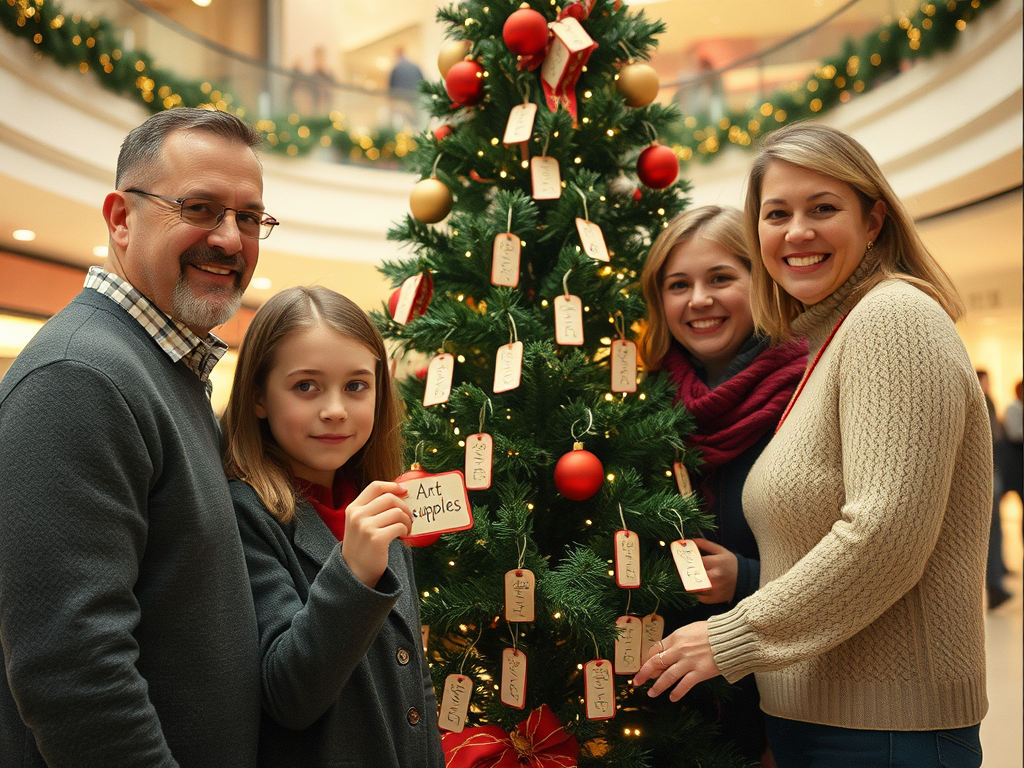
The Parkers were at the mall to buy last-minute gifts when 10-year-old Emma spotted the brightly lit “Giving Tree” in the corner of the main atrium.

“What’s that?” Emma asked, tugging on her mom’s sleeve.

“It’s a giving tree,” her dad, Greg, explained. “People write down things they need for the holidays, and others can choose to fulfill their wishes.”

Emma’s eyes widened. “Can we pick one?”

Greg hesitated. “We’re already behind on our shopping.”

But Emma was persistent. “Please, Dad? Someone might really need our help.”

Greg sighed but smiled. “Alright, let’s take a look.”

The family approached the tree, which was covered in small, handwritten tags. Each tag bore a wish—some simple, others heartbreaking:

  • “A warm coat for my daughter.”
  • “Groceries for our family.”
  • “A toy train for my son.”
  • “Shoes so I can walk to work.”

One tag caught Emma’s attention. It read: “Art supplies. I want to be an artist someday.”

“This one!” Emma said, holding up the tag.

“Let’s take a few more,” her mom, Sarah, suggested. They ended up choosing five wishes in total, each one reflecting something they could relate to or felt compelled to help with.

Fulfilling the Wishes

Back home, the Parkers got to work. Emma and her older brother, Ben, searched online for the perfect art supplies—sketchbooks, paints, and pencils. Greg went out to buy a coat for the little girl who needed one, while Sarah packed a box with non-perishable groceries.

For the boy who wanted a toy train, the family picked out a beautifully detailed set that Emma insisted was “the coolest.” And for the man who needed shoes, they bought a sturdy pair along with warm socks.

“It feels different, doesn’t it?” Sarah said that evening as they wrapped the gifts. “Doing this instead of just shopping for ourselves.”

“It feels good,” Ben admitted.

Delivering More Than Gifts

The family returned to the mall to drop off the gifts. As they placed their packages under the tree, a woman who worked with the Giving Tree program approached them.

“Thank you for doing this,” she said warmly. “You’d be amazed at how much these simple gestures mean to people.”

“Do we ever get to meet the people we’re helping?” Emma asked.

“Not usually,” the woman replied. “But sometimes, they send thank-you notes. Keep an eye on your mailbox.”

A Ripple Effect

The Parkers returned to their routine, but something had shifted. Their conversations at dinner turned from gift lists and holiday plans to wondering about the people behind the tags.

“Do you think the kid who wanted art supplies will paint something amazing someday?” Emma asked one night.

“Maybe,” Sarah said. “And maybe we’ll have helped them take the first step.”

Two weeks later, a thank-you card arrived in the mail. It was from the young artist:

“Dear strangers, thank you for the art supplies. No one has ever given me something like this before. I promise to use them to make beautiful things. Happy holidays!”

The family read the note together, their hearts swelling.

“That’s the best gift we’ve gotten this year,” Greg said.

A New Tradition

The experience stayed with the Parkers long after the holidays. The next December, they returned to the Giving Tree, but this time they did more. Greg organized a coat drive at work, Sarah baked cookies to sell for charity, and Ben got his school involved in collecting toys.

By the third year, they had inspired other families in their neighborhood to “adopt” wishes, turning a single act of kindness into a community-wide tradition.

For the Parkers, the Giving Tree became more than just a holiday activity—it was a reminder of what the season was truly about: connection, generosity, and the joy of helping others.

And in fulfilling strangers’ wishes, they found something they hadn’t even realized was missing: a deeper bond with one another and a renewed sense of purpose that carried them through every season of the year.

Sunshine Letters

In the quaint little town of Meadowbrook, nestled between rolling hills and golden fields, life moved at a slower, simpler pace. But even the picturesque charm of the town couldn’t shield it from hardship. The local factory, the heart of Meadowbrook’s economy, had recently closed, and the town was cloaked in an air of gloom.

Twelve-year-old Clara watched this change unfold from the window of her small bedroom. She noticed her once-chatty neighbors walking with heads bowed, shopkeepers with weary smiles, and even her parents whispering worriedly at the kitchen table. The warmth of the town felt like it had been snuffed out, and it weighed heavily on Clara’s heart.

One gray morning, while rummaging through a box of old belongings in the attic, Clara found a stack of letters tied together with a faded yellow ribbon. The letters were from her grandmother, who had passed away the previous year, addressed to Clara’s mother during her college years.

As Clara read through them, she felt something she hadn’t felt in weeks—a spark of hope. Each letter was filled with words of encouragement, funny anecdotes, and little doodles that made her smile. Her grandmother had called them her “Sunshine Letters” because they were meant to brighten dark days.

Clara had an idea.

That night, armed with colorful stationery and her favorite pens, she began writing her own Sunshine Letters. She crafted messages like, “You’re stronger than you think!” and “A tough day is just a stepping stone to a brighter tomorrow!” She added little drawings of flowers, sunshine, and animals to make them cheerful. She signed each one, “A friend who cares.”

The next morning, Clara slipped out of the house early and began leaving the letters in unexpected places: tucked under windshield wipers, slipped into mailboxes, and taped to shop windows.

At first, she wasn’t sure if anyone would even notice. But by the end of the week, the letters had started to work their magic.

Mrs. Benson, the florist, found a letter on her shop door and put it in her display window with a sign that read, “Whoever you are, thank you!” Mr. Grady, the retired school principal, received one in his mailbox and read it aloud at the diner, declaring it “the best surprise I’ve had in years.” People began sharing their letters with neighbors, displaying them on fridges, and even passing them along to others.

Curiosity about the mysterious writer grew. Meadowbrook’s newspaper ran a front-page story titled, “Who’s Behind the Sunshine Letters?” Townsfolk began calling them “the little rays of hope” that were bringing Meadowbrook back to life.

Clara remained anonymous, but she noticed the change. The postman smiled again. The grocer hummed while stocking shelves. Her parents’ whispers at the kitchen table became conversations filled with laughter.

One evening, Clara’s mother came home with a Sunshine Letter she had found at work. “Whoever is doing this,” she said, holding the letter to her chest, “they’ve reminded me that there’s still good in the world.”

Clara’s heart swelled with pride, but she just smiled and said, “I think they’re pretty special too.”

As weeks turned into months, the factory reopened, and the town’s economy began to recover. But the spirit of the Sunshine Letters remained. People started writing their own notes of encouragement and passing them on. Acts of kindness multiplied, turning Meadowbrook into a town not just of golden fields but golden hearts.

Clara kept her secret, content knowing she had sparked something bigger than herself. One evening, as she slipped another letter into a neighbor’s mailbox, she looked up at the stars and whispered, “Thank you, Grandma. Your Sunshine Letters worked wonders, just like you said they would.”

The Christmas Carnival

The little town of Evergreen was known for its annual Christmas Carnival—a magical event that transformed the town square into a winter wonderland. For decades, it had brought joy to generations, with its twinkling lights, carolers, and a towering Christmas tree at the center of it all. But this year was different.

A storm had swept through the town weeks before, leaving damaged buildings, fallen trees, and a spirit of despair in its wake. The town council, overwhelmed with repairs and a dwindling budget, announced that the Christmas Carnival would be canceled.

When nine-year-old Ellie heard the news, she refused to accept it. The Christmas Carnival wasn’t just an event to her—it was where her parents had met, where her grandpa always read the Christmas story to kids, and where she’d learned to ice skate. It was the heartbeat of Evergreen.

Ellie decided to take matters into her own hands. Armed with her notebook, she marched into her fifth-grade classroom the next day and declared, “We’re saving the Christmas Carnival!”

Her classmates buzzed with excitement, and soon they were brainstorming ideas. Some offered to bake cookies to sell, while others suggested using their allowance to buy decorations. Ellie’s teacher, Mrs. Grant, overheard the chatter and decided to help. She sent letters home to parents, explaining the kids’ plan, and before long, the entire school was on board.

News of Ellie’s mission spread like wildfire. Local businesses donated materials, volunteers gathered to clear debris from the square, and the high school drama club offered to put on a holiday play. The fire department even agreed to set up the Christmas tree—provided someone could find one.

Ellie had an idea. She remembered an old pine tree on her grandparents’ farm, one her grandpa had always called “the perfect Christmas tree.” She rushed to ask him if they could use it.

Her grandpa chuckled. “I planted that tree when your mom was born,” he said. “It’s been waiting for a moment like this.”

With tears in her eyes, Ellie watched as the fire department carefully cut down the tree and transported it to the town square. Once it was set up, the kids decorated it with handmade ornaments, popcorn strings, and ribbons.

Finally, the night of the carnival arrived. The square sparkled with lights, laughter echoed in the air, and the scent of hot cocoa filled the streets. Ellie’s grandpa read the Christmas story as planned, and a choir of carolers led the town in singing “Silent Night.”

When Santa arrived in his sleigh—actually the town’s fire truck decorated with tinsel—the crowd erupted in cheers. Ellie stood beside her parents, watching it all unfold. For the first time in weeks, Evergreen felt alive again.

As the night drew to a close, the mayor took the stage. “This carnival almost didn’t happen,” she said, her voice filled with emotion. “But thanks to Ellie and all of you, we’ve proven that the spirit of Christmas is stronger than any storm.”

The crowd roared with applause, and Ellie felt her cheeks flush. She didn’t do it alone, she thought. This was everyone’s Christmas Carnival.

As snow began to fall gently, Ellie looked up at the towering Christmas tree, its lights twinkling against the night sky. She whispered to herself, “This is the best Christmas ever.”