
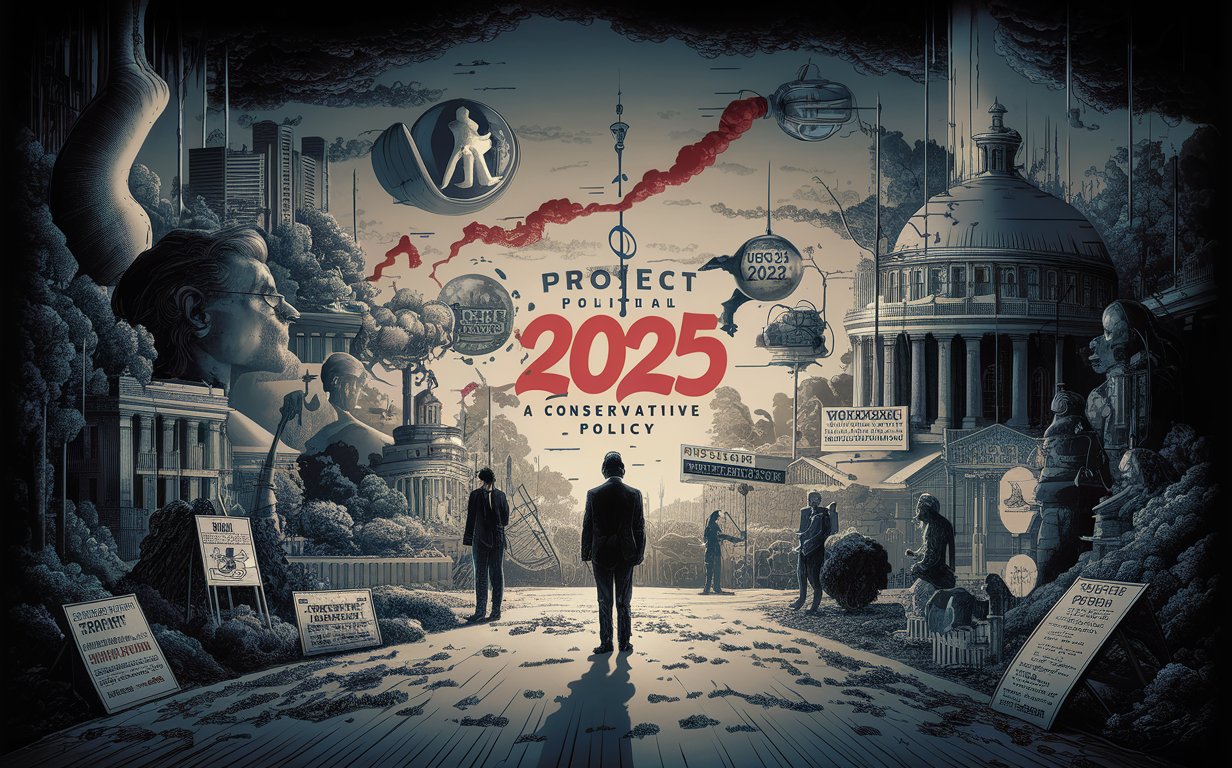
Project 2025: Conservative Policy Initiative Overview and Potential Threats

Project 2025: An Overview and Its Potential Threats

Project 2025 is a comprehensive policy initiative spearheaded by the Heritage Foundation and supported by over 100 conservative organizations. It aims to reshape the U.S. federal government significantly, consolidating executive power and implementing a far-reaching conservative agenda. The initiative is designed to be enacted swiftly should a Republican, presumably Donald Trump, win the 2024 presidential election.

Key Components and Proposals

1. Executive Power Consolidation:

  • Reclassification of Civil Servants: Project 2025 proposes reclassifying tens of thousands of federal civil service workers as political appointees. This would allow the replacement of career civil servants with individuals loyal to the administration’s policies[2].
  • Unitary Executive Theory: The project asserts that the entire executive branch is under the direct control of the president, based on Article II of the U.S. Constitution[2].

2. Economic Reforms:

  • Tax Policy: The project seeks to extend the Tax Cuts and Jobs Act of 2017, simplify individual income taxes to two brackets (15% and 30%), reduce the corporate tax rate to 18%, and impose a 15% tax on capital gains and dividends[2].
  • Federal Reserve: It proposes abolishing the Federal Reserve and advocates for a commodity-backed currency like the gold standard[2].

3. Social and Civil Policies:

  • Civil Rights: Critics argue that Project 2025 would undermine civil liberties, including the rights of women, persons of color, and the LGBTQ community[2].
  • Reproductive Rights: The project includes proposals to restrict access to reproductive care and prohibit the abortion pill[5].
  • Education: It envisions reducing the federal government’s role in education, promoting school choice, and eliminating what it calls “woke propaganda” in public schools[2].

4. Environmental and Labor Policies:

  • Climate Change: The project is criticized for its lack of concern for climate change and its intent to roll back environmental protections[1].
  • Labor Protections: It aims to cut overtime pay, relax worker safety rules, and allow more workplace discrimination[1].

Potential Threats and Criticisms

1. Undermining Democracy:

  • Authoritarianism: Critics, including legal experts and anti-authoritarian groups, argue that Project 2025 represents an authoritarian plan that could transform the U.S. into an autocracy by undermining the rule of law, separation of powers, and civil liberties[2][3].
  • Executive Overreach: The project’s emphasis on consolidating executive power and bypassing congressional approval for many actions is seen as a significant threat to democratic governance[1][2].

2. Economic and Social Impact:

  • Economic Inequality: The proposed tax reforms and deregulation could exacerbate economic inequality and increase the national debt[2].
  • Social Safety Nets: The project includes plans to dismantle social safety net programs, which could reduce food assistance for millions and cut support for veterans with disabilities[1].

3. Environmental Degradation:

  • Climate Policy: The project’s disregard for climate change and environmental protections could lead to increased pollution and long-term environmental harm[1].

Political Reactions

Donald Trump has recently attempted to distance himself from Project 2025, despite its alignment with his administration’s principles and the involvement of his former aides in its creation. This disavowal is seen by some as a strategic move to avoid alienating moderate voters and to mitigate potential backlash from the project’s controversial proposals[5][6].

Conclusion

Project 2025 represents a significant shift towards a more centralized and conservative federal government. While its proponents argue it is necessary to dismantle what they see as an unaccountable bureaucracy, critics warn that it poses severe threats to democracy, civil rights, and the environment. Understanding these threats is crucial for informed public discourse and democratic engagement.

Citations:
[1] https://democracyforward.org/the-peoples-guide-to-project-2025/
[2] https://en.wikipedia.org/wiki/Project_2025
[3] https://www.wbur.org/onpoint/2024/07/11/authoritarian-promo
[4] https://www.project2025.org
[5] https://www.theguardian.com/us-news/article/2024/jul/08/trump-project-2025
[6] https://www.nytimes.com/article/project-2025.html
[7] https://www.youtube.com/watch?v=WeMjng07qB8
[8] https://www.cbsnews.com/amp/news/what-is-project-2025-trump-conservative-blueprint-heritage-foundation/
[9] https://newrepublic.com/post/183660/project-2025-trump-ally-tom-homan-revenge-threat-deportation
[10] https://www.project2025.org/about/about-project-2025/
[11] https://www.reuters.com/world/us/trump-seeks-disavow-project-2025-despite-ties-conservative-group-2024-07-05/
[12] https://www.bbc.com/news/articles/c977njnvq2do
[13] https://www.youtube.com/watch?v=nIu5gnOX6FU
[14] https://www.npr.org/2024/07/11/nx-s1-5035272/project-2025-trump-biden-heritage-foundation-conservative
[15] https://www.msnbc.com/opinion/msnbc-opinion/project-2025-what-know-trump-president-second-term-rcna160465

Project 2025: Republican Government Reshaping Plan Unveiled

Project 2025, also known as the Presidential Transition Project, is a comprehensive conservative policy proposal developed by the Heritage Foundation and other right-wing organizations to reshape the United States federal government if a Republican candidate, presumably Donald Trump, wins the 2024 presidential election[1][5]. Here are the key aspects of Project 2025:

Government Structure and Power

  • Proposes placing the entire federal bureaucracy under direct presidential control[1]
  • Advocates reclassifying tens of thousands of federal civil service workers as political appointees to replace them with loyalists[1]
  • Seeks to expand presidential power and drastically cut federal agencies like the Department of Education[3]
  • Aims to implement the controversial “unitary executive theory,” giving the president direct control over independent agencies like the Department of Justice[5]

Economic Policies

  • Recommends extending the Tax Cuts and Jobs Act of 2017[1]
  • Proposes simplifying individual income taxes to two brackets: 15% and 30%[1]
  • Aims to reduce the corporate tax rate to 18%[1]
  • Suggests abolishing the Federal Reserve and potentially returning to a gold-backed currency[5]
  • Advocates for slashing federal funding for renewable energy research and investment[5]

Social and Cultural Policies

  • Seeks to infuse the government and society with Christian values[1]
  • Proposes banning pornography and shutting down tech companies that facilitate access to such content[5]
  • Recommends withdrawing FDA approval for the abortion pill mifepristone[3][5]
  • Advocates for school choice and parental control over education[5]
  • Proposes eliminating terms like “sexual orientation,” “diversity, equity, and inclusion,” and “reproductive rights” from federal regulations[5]

Immigration and Border Security

  • Proposes increased funding for a wall on the US-Mexico border[5]
  • Recommends consolidation and expansion of powers for immigration agencies[5]
  • Suggests increasing fees on immigrants and allowing fast-tracked applications for those who pay a premium[5]

Implementation Strategy

  • Includes a 180-day playbook of actions to be taken in the first six months of a new conservative administration[2]
  • Outlines strategies for implementing policies immediately after the presidential inauguration in January 2025[5]

Critics have characterized Project 2025 as an authoritarian plan that could undermine the rule of law, separation of powers, and civil liberties[1]. However, proponents frame it as a means to dismantle what they see as an unaccountable government bureaucracy[1].

It’s worth noting that while Donald Trump has recently attempted to distance himself from Project 2025[3][4], many individuals involved in crafting the Republican Party platform and Trump’s campaign have ties to the project[3]. This has led to skepticism about Trump’s disavowal, with some suggesting it may be an attempt to avoid potential controversy during the election campaign[4].

Citations:
[1] https://en.wikipedia.org/wiki/Project_2025
[2] https://www.project2025.org
[3] https://abcnews.go.com/US/trump-distance-project-2025-architects-helped-shape-rnc/story?id=111759747
[4] https://www.theguardian.com/us-news/article/2024/jul/08/trump-project-2025
[5] https://www.bbc.com/news/articles/c977njnvq2do
[6] https://www.documentcloud.org/documents/24088042-project-2025s-mandate-for-leadership-the-conservative-promise
[7] https://www.cbsnews.com/amp/news/what-is-project-2025-trump-conservative-blueprint-heritage-foundation/
[8] https://www.heritage.org/conservatism/commentary/project-2025
[9] https://www.project2025.org/about/about-project-2025/
[10] https://www.project2025.org/policy/
[11] https://www.newsnationnow.com/politics/2024-election/heritage-foundation-project-2025-explained/
[12] https://www.democracydocket.com/analysis/what-is-project-2025-and-why-is-it-alarming/

Critiques of Heritage Foundation’s Project 2025: Potential Authoritarianism and Policy Impact

Critiques of Project 2025

Project 2025, a comprehensive policy blueprint developed by the conservative Heritage Foundation, has garnered significant attention and criticism. Here are some of the common critiques:

1. Expansion of Presidential Power

Critics argue that Project 2025 aims to significantly expand presidential authority, which could undermine democratic institutions and checks and balances. The project supports the unitary executive theory, suggesting that the president should have direct control over federal agencies, including independent ones like the Department of Justice. This centralization of power is seen as a move towards authoritarianism by opponents[1][2][6].

2. Dismantling Federal Agencies

The project proposes the elimination or significant reduction of several federal agencies, including the Department of Education and the Federal Reserve. Critics warn that such actions could destabilize essential public services and undermine efforts to address issues like education inequality and economic stability[1][4].

3. Civil Service Overhaul

Project 2025 advocates for the dismissal of thousands of civil servants, replacing them with political appointees. This move is perceived as an attempt to create a more loyal and less independent federal workforce, which could erode the professionalism and impartiality of civil service[1][2][6].

4. Immigration Policies

The project includes stringent immigration policies, such as increased funding for the US-Mexico border wall, higher fees for immigrants, and expanded powers for immigration agencies. Critics argue that these measures could lead to human rights violations and exacerbate the challenges faced by immigrants[1].

5. Climate and Economic Policies

Project 2025 proposes slashing federal funding for renewable energy and replacing carbon-reduction goals with increased energy production. Additionally, it suggests abolishing the Federal Reserve and returning to a gold-backed currency. Critics argue that these policies are regressive and could harm efforts to combat climate change and maintain economic stability[1].

6. Education Reforms

The project calls for the abolition of the Department of Education and the elimination of programs like Title I funding and Head Start. Critics argue that these changes would disproportionately affect low-income students and undermine public education. The project also promotes school choice and parental control, which opponents say could divert resources from public schools[4].

7. Social and Cultural Policies

Project 2025 includes measures to ban pornography, eliminate terms like “sexual orientation” and “gender equality” from federal regulations, and oppose critical race theory in schools. Critics argue that these policies are part of a broader agenda to impose conservative social values and roll back protections for marginalized groups[1][4][6].

8. Abortion and Reproductive Rights

The project proposes withdrawing the abortion pill mifepristone from the market and defunding abortions in certain federal programs. Critics see these measures as an attack on reproductive rights and women’s health[1][6].

9. Potential for Authoritarianism

Some critics express concerns that Project 2025 could pave the way for a more authoritarian government. They argue that the project’s emphasis on expanding executive power, dismantling federal agencies, and overhauling the civil service could lead to a concentration of power that threatens democratic norms and institutions[3][5].

In summary, while Project 2025 has its supporters, it faces substantial criticism for its potential to centralize power, dismantle key federal agencies, and implement regressive social and economic policies. Critics argue that these changes could undermine democratic institutions, harm vulnerable populations, and roll back progress on various fronts.

Citations:
[1] https://www.bbc.com/news/articles/c977njnvq2do
[2] https://www.washingtonpost.com/politics/2024/07/05/trump-project-2025-disavowal/
[3] https://www.reddit.com/r/PoliticalScience/comments/1857icc/what_do_you_all_think_of_project_2025_im_feeling/
[4] https://www.theguardian.com/education/article/2024/jul/04/trump-project-2025-heritage-foundation-education-department
[5] https://apnews.com/article/trump-project-2025-biden-9d372469033d23e1e3aef5cf0470a2e6
[6] https://thehill.com/homenews/campaign/4753684-heritage-foundation-project-2025/
[7] https://www.thedailybeast.com/donald-trump-claims-republicans-project-2025-has-nothing-to-do-with-him-abysmal
[8] https://www.forbes.com/sites/caileygleeson/2024/07/05/trump-disavows-project-2025-calls-some-of-conservative-groups-ideas-absolutely-ridiculous-and-abysmal/

2024 Presidential Debate: Economic Issues and Policy Clash

As President Joe Biden and former President Donald Trump prepare to face off in their first presidential debate of the 2024 election cycle, the economy is expected to be a central focus of discussion. Here’s an overview of what to expect from this crucial debate on economic issues:

  1. Economic Performance and Inflation:
    Both candidates are likely to present contrasting narratives about the state of the economy. Trump may highlight the high inflation rates seen during Biden’s presidency, which peaked at around 9% in June 2022[4]. However, it’s important to note that inflation has since decreased to about 3%, though still higher than desired[4]. Biden, on the other hand, is expected to emphasize the recent improvements in inflation rates and wage growth, potentially arguing that wages have outpaced inflation over the past year[4].
  2. Tax Policies:
    The candidates have starkly different approaches to taxation. Biden has pledged not to raise taxes on Americans earning less than $400,000 annually while proposing higher taxes on corporations and wealthy individuals to fund social programs and reduce the deficit[2]. In contrast, Trump has promised to make his 2017 tax cuts permanent and further reduce the corporate tax rate to 15%[2]. The debate may highlight the potential costs and benefits of these opposing tax strategies.
  3. Job Creation and Employment:
    Both candidates are likely to present their records and plans for job creation. Biden may point to the overall job growth during his tenure, while Trump might focus on the job losses during the COVID-19 pandemic, which significantly impacted his final year in office[4].
  4. Trade and Tariffs:
    The debate may touch on international trade policies, particularly regarding China. Trump has been a strong proponent of tariffs, while Biden has advocated for a more measured approach[6]. The candidates may be pressed to explain the potential downsides of their respective trade strategies and how they plan to navigate complex international trade relationships.
  5. Housing Affordability:
    With housing affordability being a pressing concern for many voters, the candidates may be asked to present their plans for addressing this issue. Biden has proposed subsidies for homebuyers, while Trump’s strategy includes tax cuts and regulatory changes[6]. The debate could reveal more details about their approaches to tackling the housing supply shortage.
  6. Federal Reserve Reforms:
    Questions may arise about potential reforms to the Federal Reserve, given Trump’s past criticism of Fed Chair Powell and Biden’s emphasis on racial equity within the Fed[6]. The candidates might be asked to clarify their stances on the Fed’s independence and any proposed changes to its structure or mandate.
  7. Corporate Power and Antitrust Issues:
    Both candidates have taken steps to address antitrust concerns, with Trump targeting tech giants and Biden focusing on competition across various sectors[6]. The debate may explore their views on corporate power and their proposed measures to ensure fair competition in the market.
  8. Long-term Fiscal Planning:
    With the national debt being a significant concern, the candidates may be pressed to explain how they plan to balance their proposed tax policies and spending initiatives with the need for fiscal responsibility[6].

As the debate unfolds, viewers can expect a clash of economic visions and policy proposals. The candidates will likely use this platform to appeal to undecided voters, particularly in swing states, by addressing key economic concerns such as inflation, job creation, and overall economic growth[8]. The debate’s outcome could significantly influence public perception of each candidate’s economic competence and potentially shape the narrative leading up to the election.

Citations:
[1] https://www.wsj.com/livecoverage/biden-trump-first-presidential-debate-2024-election
[2] https://www.marketwatch.com/livecoverage/bidentrumpdebate62724?mod=home_editorspick
[3] https://www.theguardian.com/us-news/article/2024/jun/27/biden-trump-debate-what-to-know
[4] https://www.pbs.org/newshour/politics/prepare-for-the-biden-trump-debate-with-these-key-facts
[5] https://www.youtube.com/watch?v=8_pv9NPt4Mg
[6] https://www.politico.com/news/magazine/2024/06/27/trump-biden-debate-questions-economy-00164924
[7] https://abcnews.go.com/Politics/live-updates/Biden-Trump-first-2024-presidential-debate/politifact-is-joining-the-blog-tonight-to-help-sort-out-fact-from-fiction-111494455?id=111366511
[8] https://www.washingtonpost.com/politics/2024/06/27/debate-topics-economy-abortion-democracy-war/
[9] https://www.cnbc.com/2024/06/27/presidential-debate-between-trump-biden-live-updates.html
[10] https://www.usatoday.com/story/news/politics/elections/2024/06/27/trump-biden-economy-stances/74238280007/
[11] https://www.axios.com/2024/06/25/nobel-prize-winners-biden-economy-trump-inflation
[12] https://www.cbsnews.com/philadelphia/video/economy-could-be-key-topic-at-biden-trump-debate-experts-say/
[13] https://www.nytimes.com/2024/06/25/us/politics/trump-biden-cnn-debate-attacks.html
[14] https://www.washingtonpost.com/politics/2024/06/27/trump-biden-presidential-debate-what-to-watch/
[15] https://www.wilx.com/2024/06/27/michigan-voters-give-their-thoughts-candidates-economy-ahead-presidential-debate/
[16] https://thehill.com/homenews/campaign/4744101-biden-trump-debate-policy-issues/
[17] https://www.bbc.com/news/articles/cn0099v8ywpo
[18] https://www.forbes.com/sites/saradorn/2024/06/27/trump-biden-debate-heres-what-to-watch-for-from-the-economy-and-mental-fitness-to-immigration-and-abortion/

Uncovering Trump’s Tactics: Threats Against the Press and Litigation Strategies

While there is no direct evidence in the search results of Trump threatening to sue reporters specifically for revealing payments to witnesses, there is a clear pattern of Trump and his allies making threats against the press and using litigation as a tactic to intimidate journalists. Here are the key points:

  1. Ongoing threats against the media:
    Trump has a long history of threatening legal action against news organizations and journalists who publish unfavorable stories about him[4]. During his 2016 campaign alone, he threatened to sue multiple outlets including The Washington Post, Associated Press, and The New York Times[4]. These threats often come in response to investigative reporting or critical coverage.
  2. Recent escalation of rhetoric:
    Trump and his allies have recently intensified their hostile stance towards the press. Former Trump adviser Kash Patel explicitly stated that if Trump is re-elected, they will “come after” journalists both criminally and civilly[3]. This suggests a willingness to use legal means to target reporters who publish unfavorable stories.
  3. Potential witness payments:
    A recent ProPublica investigation revealed that at least nine witnesses in Trump’s criminal trials have received significant financial benefits from Trump’s campaign, including pay raises, severance packages, and job offers[6]. While Trump hasn’t directly threatened to sue over this reporting, it fits the pattern of stories he typically reacts against.
  4. Concerns about press freedom:
    Legal experts and press freedom advocates have expressed serious concerns about the implications of Trump’s threats on journalistic independence. Floyd Abrams, a renowned First Amendment attorney, warned of potential retaliatory measures against the press in a second Trump term[1].
  5. Legal challenges to such threats:
    Media law experts note that Trump would face significant legal hurdles in successfully suing journalists for reporting factual information. The First Amendment provides strong protections for the press, especially when reporting on public figures like Trump[5].
  6. Pattern of using lawsuits as intimidation:
    Trump has a history of using the threat of lawsuits, even when unlikely to succeed, as a means of intimidation against critics and the press[4]. This tactic aligns with strategies used by authoritarian leaders to control narratives and suppress critical reporting[1].

While there’s no specific report of Trump threatening to sue over the witness payment story, given his past behavior and recent rhetoric from his allies, it wouldn’t be surprising if such threats emerged. However, legal experts suggest that any such lawsuit would face significant constitutional challenges and would likely be viewed as an attempt to intimidate the press rather than a legitimate legal action[5].

Journalists and news organizations should remain vigilant and continue to report on matters of public interest, despite potential threats or intimidation tactics.

Citations:
[1] https://www.cnn.com/2023/12/07/media/trump-threatens-retribution-against-press/index.html
[2] https://www.hollywoodreporter.com/movies/movie-news/cannes-the-apprentice-trump-lawsuit-ali-abbasi-1235904897/
[3] https://www.nytimes.com/2023/12/05/us/politics/trump-kash-patel-journalists.html
[4] https://www.cjr.org/first_person/donald_trump_lawsuit_new_york_times.php
[5] https://www.ncronline.org/news/bishop-barrons-word-fire-again-threatens-commonweal-over-article-about-trumpism
[6] https://www.nj.com/politics/2024/06/is-donald-trump-engaging-in-witness-tampering.html
[7] https://www.newsweek.com/donald-trump-inner-circle-pay-boost-criminal-trial-probes-witnesses-report-1907378
[8] https://cardinalpine.com/2024/06/03/trump-paying-off-witnesses/
[9] https://www.pbs.org/newshour/politics/trump-can-talk-about-hush-money-witnesses-and-jurors-after-judge-alters-gag-order
[10] https://apnews.com/article/trump-hush-money-trial-defense-rests-7e2f310bc30eb5ce4287e04ba8fedeb5
[11] https://www.esquire.com/news-politics/politics/a60992228/trump-witness-financial-benefits-report/
[12] https://consent.yahoo.com/v2/collectConsent?sessionId=1_cc-session_f46ccf2c-7d6f-4fc1-97e0-dca08722729b
[13] https://abcnews.go.com/US/prosecutors-trumps-hush-money-trial-rest-case-after/story?id=110390128
[14] https://www.cnbc.com/2024/01/12/trump-ordered-to-pay-new-york-times-reporters-over-lawsuit.html
[15] https://apnews.com/article/trump-new-york-times-taxes-lawsuit-slapp-f39342501d9a2a5cfd36181f9f336215
[16] https://www.cjr.org/the_media_today/trump_libel_suit_stephanopoulos.php
[17] https://www.latimes.com/entertainment-arts/business/story/2024-03-19/trump-sues-abcs-george-stephanopoulos-for-liable
[18] https://www.cbsnews.com/news/trump-suing-abc-news-george-stephanopoulos-defamation/
[19] https://www.businessinsider.com/trump-lawyers-deposition-journalists-pulitzer-prize-lawsuit-2024-3
[20] https://www.rawstory.com/trump-sue-reporters-revealing-paying-witnesses/

The Controversy Surrounding Trump and FISA

The controversy surrounding Trump and FISA centers around his opposition to the Foreign Intelligence Surveillance Act (FISA) and his efforts to derail its renewal. Trump’s opposition was sparked by his personal grievances with the FBI and other intelligence agencies over the surveillance of his former campaign aide, Carter Page, during the 2016 election. Trump took to his social media platform, Truth Social, to urge Congress to “KILL FISA,” stating, “IT WAS ILLEGALLY USED AGAINST ME, AND MANY OTHERS. THEY SPIED ON MY CAMPAIGN!!!”. His opposition led to the defeat of a procedural motion to bring a compromise FISA reauthorization bill to the floor, which was blocked by 19 House Republicans who heeded Trump’s call to reject the legislation[1][2].

The impact of Trump’s opposition to FISA is significant, as the bill’s expiration on April 19 raises concerns about the potential consequences for national security. Senate Republicans, including Susan Collins (R-Maine) and Marco Rubio (R-Fla), both members of the Senate Intelligence Committee, expressed their concerns about the potential consequences of failing to pass the bill. Collins emphasized the importance of FISA, stating, “It is an essential tool. It may need to be amended but it is absolutely essential.” Rubio warned that the absence of the bill would cripple the nation’s intelligence gathering, stating, “If we can’t spy on foreign terrorists and foreign spies overseas, we’re out of the intelligence business.” John Cornyn (R-Texas), another Intelligence Committee member, highlighted the significance of FISA in providing national security intelligence to President Biden, explaining, “So I think we need to reform it, not end it.”[1].

The timeline of events related to Trump’s opposition to FISA began in December 2023 when Speaker Mike Johnson (R-La.) and his allies were forced to come up with a Plan B to reauthorize the program before the April 19 deadline[1]. The situation is ongoing, with the House set to pass a revised surveillance bill imminently, potentially as early as Friday, following the failure of an earlier iteration to progress due to opposition from conservative House members[4]. The legislation, which reauthorizes the Foreign Intelligence Surveillance Act, also needs to pass the Senate ahead of the April 19 deadline[4].

Key players in this controversy include former President Donald Trump, Speaker Mike Johnson (R-La.), and various members of the Senate Intelligence Committee, such as Susan Collins (R-Maine) and Marco Rubio (R-Fla)[1].

Citations:
[1] https://thehill.com/homenews/senate/4589449-senate-republicans-furious-over-trump-derailing-fisa-bill/
[2] https://www.dailynews.com/2024/04/11/trump-and-fisa-a-fact-check/
[3] https://www.cnn.com/2024/04/10/politics/trump-fisa-speaker-johnson-house-republicans/index.html
[4] https://www.cnn.com/2024/04/12/politics/house-vote-fisa-reauthorization/index.html
[5] https://www.axios.com/2024/04/12/fisa-rule-vote-surveillance-house-republicans
[6] https://www.washingtonpost.com/politics/2024/04/12/donald-trump-congress-republicans-mike-johnson-fisa-ukraine-abortion/
[7] https://www.nytimes.com/2024/04/10/us/politics/fisa-trump-johnson-house.html
[8] https://www.grassley.senate.gov/imo/media/doc/CFH%20Timeline%20w%20Updates%2020201203%20%28FINAL%29.pdf
[9] https://abcnews.go.com/Politics/what-is-fisa-surveillance-law-in-spotlight/story?id=109138345
[10] https://abc7chicago.com/fisa-vote-house-passes-reauthorization-bill-through-2026-after-previous-gop-setback-donald-trump-said-to-kill-program/14652369/
[11] https://www.forbes.com/sites/saradorn/2024/04/12/house-passes-hotly-debated-foreign-surveillance-act-despite-trumps-plea-to-kill-it/?sh=6f64268637a2
[12] https://apnews.com/article/fisa-donald-trump-surveillance-congress-johnson-6798869fa141a13329c24245c64fd14f
[13] https://www.hindustantimes.com/world-news/us-news/what-is-fisa-us-house-passes-controversial-surveillance-bill-despite-donald-trumps-plea-to-kill-it-101712957739743.html
[14] https://www.nbcnews.com/politics/congress/house-republicans-are-chaos-fighting-key-surveillance-tool-rcna147175
[15] https://oig.justice.gov/node/16547
[16] https://www.nytimes.com/2024/04/12/us/politics/trump-intelligence-agencies.html
[17] https://thehill.com/homenews/house/4590833-fisa-warrant-mandate-republicans-retaliation/
[18] https://apnews.com/article/trump-documents-investigation-timeline-087f0c9a8368bb983a16b67dd31dcd4c
[19] https://www.washingtonpost.com/politics/2024/04/12/fisa-surveillance-house-republicans/
[20] https://www.politico.com/trump-russia-ties-scandal-guide/timeline-of-events

The Foreign Intelligence Surveillance Act (FISA)

The Foreign Intelligence Surveillance Act (FISA) is a United States federal law enacted on October 25, 1978, which establishes the legal framework for surveillance and collection of foreign intelligence information between foreign powers and agents of foreign powers suspected of espionage or terrorism. The Act is codified at 50 U.S.C. ch. 36[1].

FISA was created in response to revelations of domestic spying abuses by the U.S. government, including the Watergate scandal and surveillance against U.S. dissidents. It was intended to provide oversight and to protect U.S. persons’ privacy rights while allowing the government to collect vital foreign intelligence[3][4].

Under FISA, “U.S. persons” are defined as citizens of the U.S., aliens lawfully admitted for permanent residence, and other specified categories of individuals[3]. The Act outlines procedures for electronic surveillance and physical searches specifically targeting foreign powers and their agents operating within the United States. It also established the Foreign Intelligence Surveillance Court (FISC), a special federal court that reviews and approves surveillance applications[3][8].

FISA has been amended several times, notably by the FISA Amendments Act of 2008, which included Section 702. This section allows for the collection of foreign intelligence information concerning non-U.S. persons located outside the United States without a warrant. However, it has raised concerns due to incidental collection of U.S. persons’ data when they communicate with foreign targets[5][6][7].

The Act has been subject to debate and criticism, particularly regarding the balance between national security interests and civil liberties. Civil liberties groups, such as the ACLU, have advocated for reforms to increase oversight and protect privacy rights[4]. The reauthorization and potential reform of FISA, including Section 702, have been points of contention in Congress, with recent debates focusing on the necessity of the program for counterterrorism efforts versus the need for privacy protections[6].

Citations:
[1] https://law.gwu.libguides.com/FISA
[2] https://www.fletc.gov/audio/foreign-intelligence-surveillance-act-fisa-part-1-mp3
[3] https://www.fletc.gov/sites/default/files/imported_files/training/programs/legal-division/downloads-articles-and-faqs/research-by-subject/miscellaneous/ForeignIntelligenceSurveillanceAct.pdf
[4] https://www.aclu.org/documents/foreign-intelligence-surveillance-act-news-and-resources
[5] https://bja.ojp.gov/program/it/privacy-civil-liberties/authorities/statutes/1286
[6] https://abcnews.go.com/Politics/what-is-fisa-surveillance-law-in-spotlight/story?id=109138345
[7] https://www.fbi.gov/investigate/how-we-investigate/intelligence/foreign-intelligence-surveillance-act-fisa-and-section-702
[8] https://en.wikipedia.org/wiki/United_States_Foreign_Intelligence_Surveillance_Court
[9] https://www.justice.gov/archive/ll/paa-dispelling-myths.html
[10] https://www.fisc.uscourts.gov/about-foreign-intelligence-surveillance-court
[11] https://en.wikipedia.org/wiki/Foreign_Intelligence_Surveillance_Act
[12] https://www.law.cornell.edu/uscode/text/50/1801
[13] https://www.dni.gov/files/icotr/Section702-Basics-Infographic.pdf
[14] https://www.intel.gov/foreign-intelligence-surveillance-act/1238-the-foreign-intelligence-surveillance-court
[15] https://www.intel.gov/foreign-intelligence-surveillance-act/1234-categories-of-fisa
[16] https://www.nsa.gov/Signals-Intelligence/FISA/
[17] https://crsreports.congress.gov/product/pdf/R/R40138

Trump and Haley Gear Up for Heated 2024 GOP Primary Debate

WASHINGTON, D.C. – As the 2024 Republican primaries heat up, all eyes are on the upcoming debate between former president Donald Trump and former UN ambassador Nikki Haley. The two GOP heavyweights are expected to spar over key policy issues and their visions for the future of the Republican Party.

“I’m looking forward to a vigorous policy debate with Nikki,” said Trump. “We may have our differences, but at the end of the day we’re both committed to advancing the conservative cause.”

Haley, who announced her candidacy earlier this month, has positioned herself as a reform-minded Republican who can modernize the party. She is expected to challenge Trump on both his policies and leadership style.

“Voters deserve to see the clear contrast between my positive, inclusive vision for America’s future and the former president’s erratic, ego-driven approach,” Haley told supporters at a rally in South Carolina.

The debate stage will be set for a dramatic confrontation between the former president known for his brash persona and the former governor presenting a polished, policy-focused message.

“I’m not going to let anyone bully me – not even the president,” Haley said in an interview.

Trump, however, remains the frontrunner for the nomination and has dismissed Haley’s candidacy.

“She’s weak on crime and immigration,” Trump said at a recent rally. “No one’s going to vote for her.”

With less than a year until primaries begin, the debate will serve as a high-stakes proving ground for both candidates. The fireworks are sure to fly as Trump and Haley fight for the soul of the Republican Party.

Florida Governor Ron DeSantis Revealed As High-Ranking Scientologist

Tallahassee, FL – A shocking exposé published today has revealed that Florida Governor Ron DeSantis is actually a top-ranking member of the Church of Scientology who has managed to keep his involvement completely secret until now.

The extensive report includes photographs of DeSantis participating in high-level Scientology ceremonies at the church’s Flag Building in Clearwater, as well as leaked church documents listing him as a “Operating Thetan Level VIII” – the highest spiritual ranking in Scientology.

“Ron has been a devout Scientologist for years, but has used his political power to scrub any mention of it from the public record,” said former church spokesman Rex Pendleton. “He’s donated millions to grow Scientology, and has even convinced several legislators to sign up for Auditing sessions.”

DeSantis reportedly uses coded language in his speeches to signal to fellow Scientologists, praising founder L. Ron Hubbard and emphasizing key concepts like “going clear.” And while pushing his conservative policies publicly, DeSantis apparently works internally to advance top-secret Scientology goals like taking over Florida’s education system.

The Governor’s mansion in Tallahassee has also been revealed as a lavish Scientology center, with movie theaters for watching church propaganda and a fleet of Sea Org volunteers catering to DeSantis’ every need.

“I always found it odd how Ron would talk about unleashing ‘massive SP [suppressive person] ethics programs’ against protesters and political enemies,” said a former aide. “Now it all makes sense – he’s been talking about Scientology methods this whole time.”

At press time, DeSantis had responded to the exposé by calling it “religious bigotry” and cut off all public access in preparation for an assumed elevation to the church’s mythic Operating Thetan Level IX.

How Courts Are Holding Donald Trump Accountable Amid Political Turmoil

Former president Donald Trump faces a wave of legal challenges that could profoundly impact his business, political future, and even personal freedom. As Trump navigates this period of unprecedented political turmoil, the court system has become a pivotal force in ensuring he is held legally accountable.

Upcoming Trials Could Alter Trump’s Trajectory

In the next 12 months alone, Trump faces up to four criminal trials, a multimillion-dollar defamation case, and a major civil verdict. The outcomes of these trials could significantly restrict Trump’s capacity to run for office again, threaten the viability of his company, and potentially lead to jail time. Legal experts state that no former president has ever faced this level of simultaneous legal jeopardy.

Trump Escalates Attacks on the Judiciary

As his legal troubles mount, Trump has amplified his rhetoric against judges and the judicial system. He has accused courts of political bias and labeled specific rulings he disagrees with as “horrible,” “ridiculous,” and a “witch hunt.” Legal scholars warn that his attacks undermine public confidence in the courts and could weaken the independence of the legal process.

Supreme Court May Shape Trump’s Legal Fate

The Supreme Court may soon decide whether to hear Trump’s appeal in several cases charged with political sensitivity. The court’s rulings could have major implications for Trump’s ongoing legal battles and prospects for accountability. With issues of executive power and immunity at stake, the outcomes may hinge on whether the conservative-majority court views Trump as above the law.

Civil Fraud Ruling Restricts Trump’s Business

In a landmark civil case, a New York judge ordered Trump to pay over $350 million for engaging in years of fraudulent business practices. The judge also banned Trump from serving as an officer or director at any New York corporation for five years – dealing a blow to his capacity to run his company. This ruling demonstrated that no individual, even a former president, is above facing consequences for financial misconduct.

Conclusion

With trials and lawsuits unfolding over months and years, the legal landscape surrounding Trump remains complex and ever-changing. But as courts continue to hold the former president legally accountable for alleged misconduct, their rulings promise to profoundly impact his political and economic future. Trump’s destiny now lies largely in the hands of the justice system he has so often denigrated and defied.