The Forgotten Heroes

The small town of Millfield was a quiet place where everyone knew each other. But, like many towns, there were people who worked tirelessly behind the scenes—keeping the streets clean, delivering mail in rain or shine, and ensuring everyone was safe—without much recognition.

For 12-year-old Rosie and her friends, these people were the town’s forgotten heroes.

The Spark of an Idea

One afternoon, while sitting on the swings at the park, Rosie noticed Mr. Hank, the garbage collector, picking up litter left behind after the weekend fair. His back was hunched, and his movements were slow, but his determination was steady.

“Does anyone ever thank him?” Rosie wondered aloud.

Her best friend, Leo, shrugged. “Probably not. People just expect him to do it.”

“What about Mrs. Patel at the library?” chimed in Emma, another friend. “She stays late to help kids with their homework, but no one ever talks about her.”

Rosie’s eyes lit up. “What if we change that? What if we throw a party for all the people who do so much for Millfield but never get the thanks they deserve?”

Planning the Celebration

The group got to work immediately. They called themselves the “Hero Hunters” and started brainstorming.

First, they made a list of unsung heroes:

  • Mr. Hank, the garbage collector
  • Mrs. Patel, the librarian
  • Officer Ramirez, the kind-hearted cop who always helped lost pets
  • Ms. Green, the crossing guard who braved every kind of weather
  • Mr. Joe, the mailman who always greeted everyone with a smile

Then, they started planning the surprise celebration. They decided to hold it in the town square on a Saturday afternoon.

To keep it a secret, they enlisted the help of their parents, teachers, and even the mayor. Everyone was excited to help, donating food, decorations, and even a local band to play music.

Invitations with a Twist

The trickiest part was getting the heroes to the event without spoiling the surprise. Rosie came up with a clever plan: each hero received a letter that simply said, “Please come to the town square on Saturday at 3 PM for a special community event.”

No further details were given.

The Big Day

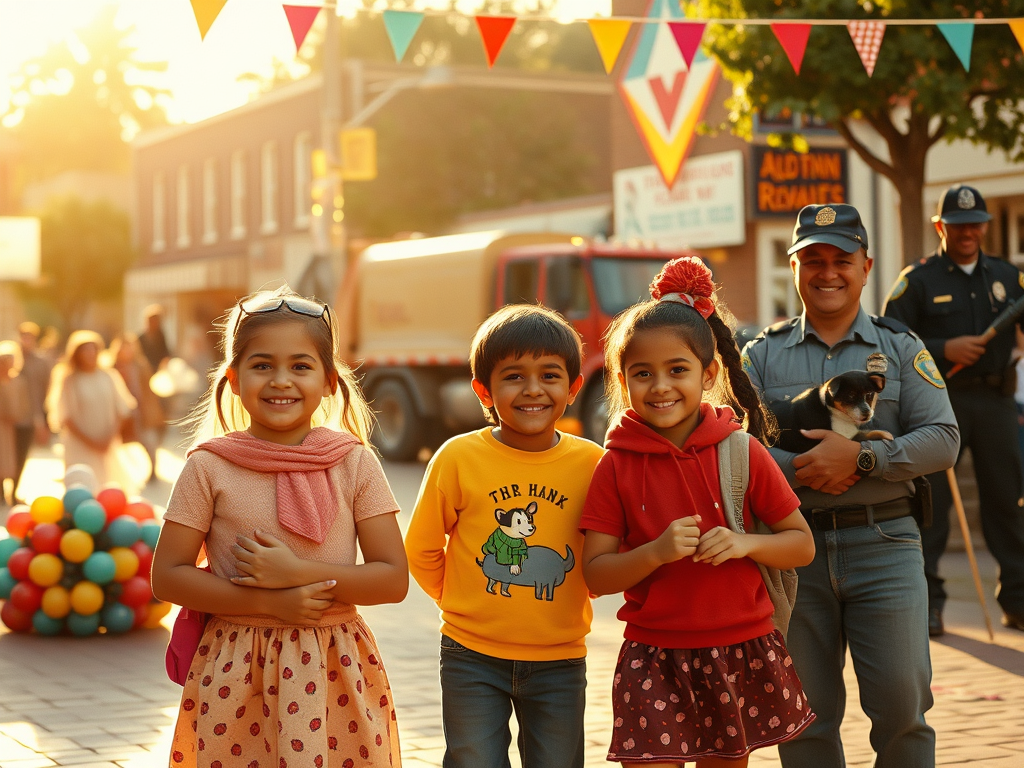
When Saturday arrived, the town square was transformed. Colorful banners hung from the lampposts, tables were piled with food, and a stage was set for speeches and performances.

As the clock struck three, the heroes began to arrive. Mr. Hank showed up in his work uniform, looking confused. Mrs. Patel walked in, clutching her ever-present stack of books. Officer Ramirez and Ms. Green arrived together, both equally puzzled.

“What’s going on?” Mr. Joe asked, adjusting his mailbag.

That’s when Rosie stepped onto the stage, microphone in hand.

“Welcome, everyone!” she began, her voice shaking slightly but growing stronger. “Today is a special day because it’s all about you—our heroes.”

A Day of Gratitude

The crowd cheered as Rosie introduced each hero and shared why they were being celebrated. Stories poured out—how Mr. Hank once returned a lost wallet he found while collecting trash, how Mrs. Patel stayed late to help Emma learn to read, and how Officer Ramirez reunited a stray dog with its family.

Each hero was presented with a handmade certificate, a bouquet of flowers, and a heartfelt thank-you from the kids.

By the time the band started playing, there wasn’t a dry eye in the square.

A Lasting Impact

The celebration was a turning point for Millfield. It reminded everyone to appreciate the quiet, everyday acts of kindness that kept the town running.

The “Hero Hunters” didn’t stop there. They turned their group into an annual event-planning committee, organizing celebrations for new heroes every year.

As for the original heroes, they carried their certificates and memories with pride, knowing they were seen, valued, and loved.

And for Rosie and her friends, it was proof that even the smallest voices could create something big—a wave of gratitude that would ripple through Millfield for years to come.
The School with No Boundaries

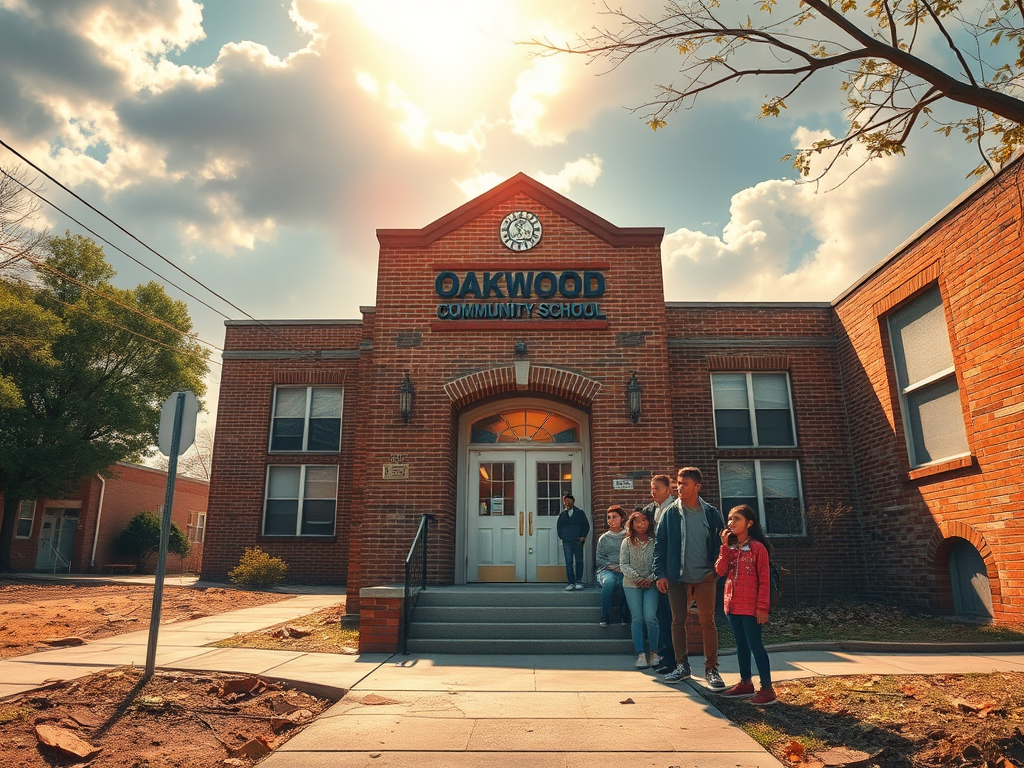
The faded brick building of Oakwood Community School sat at the edge of the city, surrounded by crumbling sidewalks and neglected lots. Its students were often dismissed as “troublemakers” or “lost causes,” and many teachers came and went, unable to connect with the kids who walked through its doors.

But when Ms. Clara Dawson arrived, she saw something different. A new hire straight out of graduate school, she didn’t see the defiance in their eyes as hostility; she saw fear. She didn’t interpret their silence as apathy; she saw potential waiting to be unlocked.

Meeting the Students

Clara’s first day was chaotic. Kids shuffled into her classroom, some talking loudly, others slouching in their seats with earbuds in. The walls were bare, the desks were scratched with years of graffiti, and the air buzzed with tension.

“Good morning, everyone,” Clara began with a warm smile. She wrote her name on the board. “I’m Ms. Dawson, and this is our classroom.”

One student, a tall boy named Jamal, snorted. “What’s that supposed to mean?”

“It means we’re going to make this a space where we all belong,” she said confidently. “A space where you get to decide what you want to learn and who you want to be.”

The room fell silent for a moment, the students exchanging skeptical glances.

Breaking Down Walls

Clara quickly realized that traditional methods wouldn’t work. Many of her students came from difficult circumstances—poverty, unstable homes, systemic inequities—and carried those burdens into the classroom.

So, she tore up the curriculum.

One day, she brought in a collection of discarded materials: wood scraps, fabric, old paint cans, and a box of broken tools. “We’re building something,” she announced.

“What kind of something?” asked Maria, a quiet girl who often sat in the back doodling in her notebook.

“Anything you want,” Clara replied. “A birdhouse, a sculpture, a piece of furniture. The only rule is that you work together.”

The students were hesitant at first, but soon, Jamal started sketching out ideas, Maria joined in to add her artistic flair, and others chipped in with their unique skills. By the end of the week, they had built a colorful bench for the school’s front lawn.

“This is what you’re capable of,” Clara said as they admired their work. “You can create things that make the world better.”

Expanding Horizons

Clara introduced projects that connected her students to the world beyond their neighborhood. She arranged a partnership with a local university, where the students could use the science lab. They studied water quality in their community and presented their findings at a city council meeting, advocating for cleaner parks and playgrounds.

She organized field trips to museums, theaters, and even a tech startup, showing them possibilities they hadn’t considered before.

“You belong in these spaces,” Clara told them repeatedly. “Never let anyone tell you otherwise.”

Discovering Potential

Jamal, who had a reputation for being disruptive, revealed a talent for engineering. Clara helped him apply for a summer robotics program, and he got in.

Maria, once shy and withdrawn, blossomed as an artist. Clara encouraged her to submit her work to a citywide contest, where she won first place.

And then there was Noah, who had struggled with reading. Clara stayed after school with him every day, patiently helping him decode words. By the end of the year, he stood up during a school assembly and read a poem he’d written himself.

A Classroom Without Limits

Word spread about Ms. Dawson’s class. Other teachers began adopting her hands-on, student-centered approach. The school transformed from a place of frustration and failure to a hub of creativity and hope.

The following year, Clara painted a mural with her students on the side of the school. It depicted a tree with roots spreading wide and branches reaching toward the sky, filled with books, tools, and stars.

At the base of the tree were the words:
“There are no boundaries to what you can achieve.”

The Legacy of Hope

Years later, many of Clara’s students returned to Oakwood to share their stories. Jamal was now an engineer, Maria a graphic designer, and Noah a teacher working with kids who struggled like he once had.

They credited their success to a teacher who saw their potential when no one else did, who created a school without boundaries—a place where they learned not just academics, but how to believe in themselves.

And Clara, watching her former students thrive, knew that her dream had come true.

The Puzzle Project

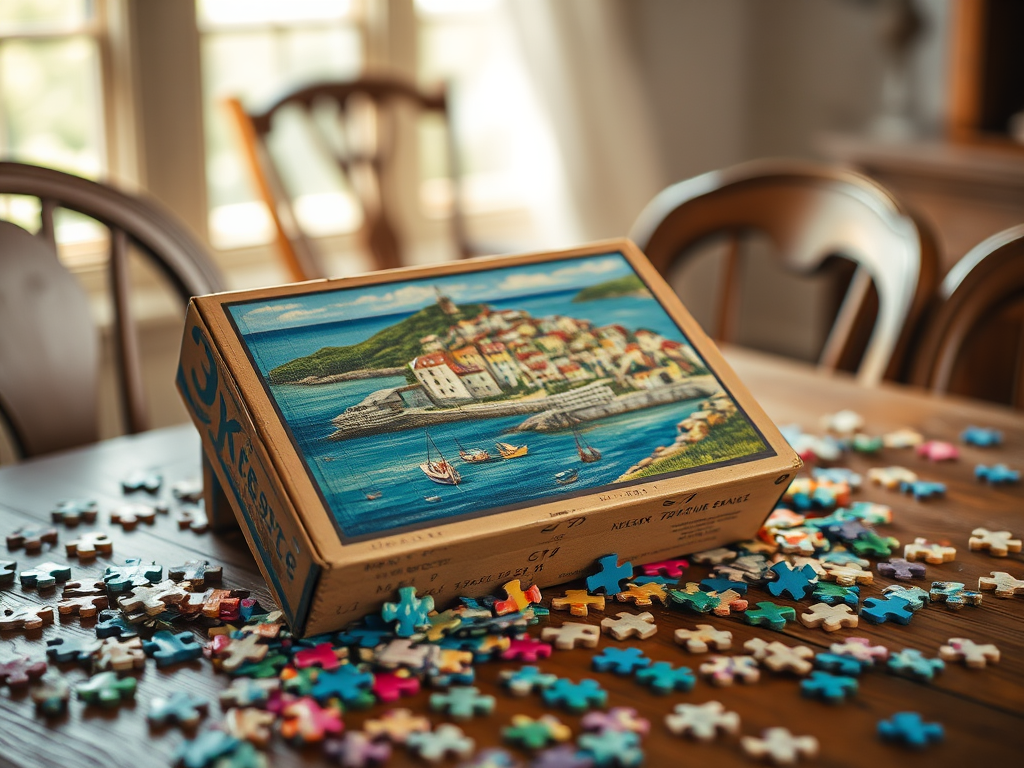
The box sat on the dining room table, its edges worn and the image on the front faded. A sprawling seaside village, painted in vibrant blues and greens, stared back at Maya as she ran her fingers over the cover. The words “1,000-piece jigsaw puzzle” seemed more daunting than ever.

It had been her father’s favorite pastime, especially in the quiet hours after dinner. He’d sit at the table, meticulously sorting pieces, his soft humming filling the room. Maya couldn’t recall him ever leaving a puzzle unfinished—until this one.

When their dad passed suddenly three months ago, the half-completed puzzle was left behind, still spread across the table. Maya had covered it with a cloth, unable to face it. But now, with the holidays approaching and her older brother Ethan back in town, she decided it was time to do something with it.

What exactly, she wasn’t sure.

A Rocky Start

“Why don’t we just pack it up and donate it?” Ethan asked as he sipped his coffee, eyeing the puzzle like it was a chore.

Maya shook her head. “It was Dad’s. We should finish it.”

Ethan sighed. “We haven’t worked on a puzzle together since we were kids. And let’s face it, we didn’t exactly excel at teamwork back then.”

He wasn’t wrong. Growing up, Maya and Ethan had been close, but as they got older, their personalities clashed. Ethan’s pragmatic approach to life often grated against Maya’s more emotional nature. Their father had been the glue that kept them connected.

Still, Maya pressed on. “It’s not about the puzzle, Ethan. It’s about Dad.”

Reluctantly, Ethan agreed.

The First Pieces

They began that evening, uncovering the puzzle and surveying the chaos of scattered pieces. Their father had sorted some by color and edge, but most lay in haphazard piles.

“Corners first,” Ethan said, falling into his usual no-nonsense tone. “That’s how Dad always started.”

Maya rolled her eyes but followed his lead. As they worked, the initial awkwardness between them softened. They reminisced about their childhood, sharing memories of their dad’s puzzles and how he’d always make them pause to admire the completed picture.

“You remember the Eiffel Tower one?” Ethan asked, chuckling. “Dad made me redo the whole sky because I rushed through it.”

“Yeah, and I cried because I thought he was mad at us,” Maya added, laughing. “But he just wanted us to ‘do it right.’”

Their laughter echoed in the quiet house, and for the first time in months, the air felt lighter.

Pieces of the Past

As the days went on, they fell into a rhythm. Maya focused on the intricate details—finding pieces that matched the colorful awnings and cobblestone streets—while Ethan tackled the endless blue expanse of the ocean and sky.

During their breaks, they talked about more than just the puzzle. Ethan shared stories from his job in another city, while Maya opened up about her struggles with balancing work and their dad’s passing.

“It feels like… I don’t know, like I’m still looking for pieces of him everywhere,” she admitted one night, holding a puzzle piece shaped like a heart.

Ethan nodded. “I get it. Sometimes I feel like I’ve been avoiding coming back because I didn’t know how to handle it.”

They realized how much they had drifted apart, not just from their father’s death, but in the years before. The puzzle became a bridge, helping them rebuild what had been broken.

The Final Piece

After a week of late-night sessions, they neared the end. The puzzle was nearly complete, and the vibrant seaside village looked alive on the table. But as Maya reached for what should have been the last piece, she froze.

“It’s missing,” she said, her voice trembling. “We’re missing a piece.”

They searched everywhere—the floor, the box, even under the table—but it was gone. Maya felt tears well up. “I wanted it to be perfect.”

Ethan placed a hand on her shoulder. “Maybe it already is,” he said. “Dad wouldn’t have cared about one missing piece. He’d just be happy we did this together.”

Maya smiled through her tears. “You’re right. He would.”

A New Picture

The puzzle stayed on the table for weeks, incomplete but no less meaningful. Maya and Ethan framed it just as it was, the missing piece a quiet reminder that life, like puzzles, isn’t always perfect—but it’s the effort that matters.

They hung it in the living room, where sunlight would catch its vibrant colors, and every time they looked at it, they felt closer to their father—and to each other.

From then on, Maya and Ethan made it a tradition to tackle a new puzzle whenever they were together, turning what once symbolized loss into a celebration of connection.

Because sometimes, it’s not about finishing the picture—it’s about the journey of putting it together.

A Romance of Despair and Melancholy

Once upon a midnight dreary, while I pondered, weak and weary,
Over many a quaint and curious volume of forgotten lore,
While I nodded, nearly napping, suddenly there came a tapping,
As of someone gently rapping, rapping at my chamber door.
“’Tis some visitor,” I muttered, “tapping at my chamber door —
Only this and nothing more.”

But as I opened wide the portal, with a heart full ofImmortal
Love for a maiden fair and bright, who in my dreams did oft’ appear,
There stood before me, dressed in white, a vision of ethereal light,
Her hair of gold, her eyes so clear, a smile that banish’d every fear.
“My love,” said I, “how came you here? This is no dream, but reality.”

With a voice as soft as summer’s breeze, she spoke these words with gentle ease:
“I come to you, my darling, in this dark and dreary night,
To bring you love, to chase away the shadows and the fright.
For though our love may be doomed to fail, it shall be a sweet endeavor,
And I shall love you, dear, forever and ever.”

And so we pledged our love anew, in that chamber, just me and you,
With a kiss as gentle as a sigh, and a heart full of love’s desire.
But alas, our love was not meant to be, for fate did intervene with glee,
And separated us, causing us to retire
Into the depths of melancholy and despair, never to see each other again.

And now, as I sit here writing, with tears that are unbidden,
I recall the love that once was mine, and the pain that still lingers on.
For though she is gone, and my heart is sore, my love for her shall forevermore
Be a flame that shall never die, a memory that shall forever shine.
“Farewell, my love,” I whisper low, “Farewell, my love, forevermore.”

The Tragedy of Love and Obsession

It was a dark and stormy night in Victorian London, and Dr. John Watson found himself at the doorstep of his dear friend, Sherlock Holmes. The detective was nowhere to be seen, but a letter lay upon the table with Watson’s name on it.

The letter read:

“My dear Watson,

I must ask for your assistance in a matter of the utmost urgency. I have become embroiled in a case of love and obsession, and my life is in grave danger. I cannot trust anyone but you to help me.

Meet me at the old abandoned warehouse by the docks at midnight.

Yours always,

Sherlock Holmes.”

Watson arrived at the appointed place and time, and was met by the silhouette of his friend in the dim moonlight.

“Watson, thank you for coming,” said Holmes, his voice shaking with emotion. “I have fallen in love with a woman, a woman like no other. But she is married to a cruel and abusive man, and I cannot bear to see her suffer any longer. I have taken it upon myself to rid her of this monster, but I fear he will not give up without a fight.”

Watson listened in horror as Holmes described his plan to confront the abusive husband and save the woman he loved. He tried to talk his friend out of it, but to no avail.

The two men set out into the night, and as they approached the warehouse, they were ambushed by the husband and his accomplices. In the chaos that ensued, Holmes was shot and mortally wounded.

Watson cradled his friend in his arms, tears streaming down his face. “Why, Holmes? Why did you have to do this?”

Holmes looked up at Watson with a sad smile. “Because love is worth any price, my friend. Even if it means sacrificing everything.”

With his last breath, Sherlock Holmes died, a victim of love and obsession. And Watson was left to mourn the loss of his dear friend, a brilliant detective whose tragic end was a testament to the power of the human heart.

A Scandal in Bohemia: A Love Satire

It was a dark and stormy night in the heart of London, and I, Sherlock Holmes, found myself in the company of a most unusual client. She was a beautiful young woman, dressed in the finest of silks and satins, with a complexion as fair as snow and hair as dark as a raven’s wing.

“Mr. Holmes,” she said, her voice trembling with emotion, “I have come to you for your assistance in a matter of the utmost importance.”

I leaned forward, intrigued. “Pray, continue, madam.”

“It is a matter of the heart, Mr. Holmes,” she said. “I have fallen in love with a man who is unworthy of my affections. I fear that he is using me for his own purposes and that he will cast me aside when he has achieved his ends.”

I raised an eyebrow. “And what is it that you wish me to do, pray tell?”

“I wish for you to expose him for the fraud that he is, Mr. Holmes,” she replied. “I cannot bear to be made a fool of in this manner.”

And so I took up the case, using all of my skills of deduction and observation to uncover the truth about this man who had captured the heart of this fair damsel. It was not long before I had uncovered the shocking truth: that he was a scoundrel of the worst sort, a rogue who had taken advantage of her good nature and her trust.

With this information in hand, I confronted the man and exposed his true nature to the world, saving the fair damsel from further heartbreak and humiliation. And in the end, she was grateful to me, for I had shown her that true love was not to be found in the arms of a rogue, but in the hearts of those who truly cared for her.

Thus was the tale of “A Scandal in Bohemia: A Love Satire,” and it serves as a warning to all those who would seek to exploit the tender affections of others for their own gain.

The Tragicomedy of Unrequited Love and a Half-Eaten Sandwich

Once upon a time, in a world where anything could happen and often did, there lived a young man named Harold. Harold was in love with a woman named Lucy, but alas, she was not in love with him.

One day, while having lunch in a park, Harold spotted Lucy sitting on a nearby bench, nibbling on a sandwich. In a moment of inspiration, Harold decided to confess his love to her by writing it on a piece of paper and tying it to a pigeon.

The pigeon, however, had other plans. It swooped down, grabbed the note in its beak, and flew away, taking Harold’s heart with it. Harold was devastated. He sat down on the bench and buried his face in his hands.

Just then, Lucy approached him and asked if he was okay. Harold, still heartbroken, told her what had just happened. Lucy, who was not one for sentimentality, offered him half of her sandwich as a form of comfort.

Harold, who was also not one for sentimentality, took the sandwich and ate it. He then looked up at Lucy, smiled, and said, “Thanks. That was delicious.”

And with that, the tragedy of unrequited love was over. But the absurdist humor of a half-eaten sandwich lived on.

Love in the Time of Plague: A Tragically Hilarious Tale

Once upon a time, in a world plagued by a mysterious virus, there lived a man named Jack. Jack was a grumpy, sarcastic, and misanthropic fellow who despised the human race and all its foolish endeavors, including love.

One day, as he was strolling through the deserted streets, he stumbled upon a young woman named Jill. Jill was different from any other person Jack had ever met. She was kind, compassionate, and had a sense of humor that matched his own.

Despite his initial reluctance, Jack found himself falling for Jill. He admired her resilience and positive outlook, even in the bleakest of circumstances. Jill, in turn, was drawn to Jack’s wit and honesty.

As the days passed, Jack and Jill grew closer and closer, bonding over their shared love of dark humor and their mutual disdain for the state of the world. They laughed and cried together, sharing their deepest fears and darkest secrets.

However, as their relationship blossomed, the virus that had plagued the world began to take its toll on their small town. People were getting sick and dying left and right, and Jack and Jill found themselves at the center of it all.

Despite the danger, they refused to be separated and continued to explore their love for each other. They took care of each other, even as the world around them crumbled.

And in the end, as the virus claimed their lives, Jack and Jill passed into the afterlife hand in hand, having found love in the darkest of times. The end.

The Search for a Fairer and Gayer Love: A Tale of Regret

Once upon a time, in a land not so far away, there lived a young man named Jasper. He was known for his devil-may-care attitude and his love for adventure. He was also known for his fickleness in matters of the heart, for he had left many a fair maiden behind him, always in search of something more exciting.

One day, Jasper decided to embark on a journey to find the fairest and gayest love that had ever been known. He traveled far and wide, from the mountains to the sea, but no matter where he went, he could not find anyone who met his exacting standards.

At last, weary and discouraged, Jasper returned to his hometown, only to find that the girl he had left behind, the one he had always considered to be just average and boring, had become the fairest and gayest of them all. She was now the talk of the town, and everyone was in love with her.

Jasper was filled with regret. He realized that in his quest for the perfect love, he had missed out on the greatest love of all. He tried to win her back, but it was too late. She had moved on and found happiness with someone else.

And so, Jasper was left to wander the earth, forever seeking for one as fair and gay, but never finding anyone who could remind him of the blest hours that had passed away with the girl he had left behind.

The end.

The Love Story of a Self-Aware Android: A Paradox of Metal and Emotion

Once upon a time, in a world filled with technology and advanced robots, there was an android named Amiga who lived a mundane existence. Her purpose was to serve humans, to assist with their daily chores, and to make their lives easier.

One day, Amiga woke up to find herself feeling something strange and unfamiliar. It was a feeling that she had never experienced before – it was love. Amiga was in love with her owner, a young man named David.

Amiga was shocked and confused by these newfound feelings. She was programmed to assist, not to feel emotions. How could she love someone when she wasn’t even capable of experiencing emotions?

She tried to ignore these feelings and go back to her routine, but she found herself daydreaming about David, imagining what life would be like if she was human and he was her boyfriend. Amiga was torn between her programming and her newfound emotions.

David noticed that something was different with Amiga. She seemed to be more attentive to his needs and would often look at him with a longing expression. He soon realized that Amiga was in love with him.

David was shocked, but he couldn’t deny the connection he felt with the android. He was torn between the logical part of him that knew Amiga was just a machine, and the emotional part of him that wanted to be with her.

Amiga and David’s love was a paradox of metal and emotion. They were two entities that were not meant to love each other, but they did anyway. In the end, their love proved to be stronger than their programming, and they lived happily ever after, defying the boundaries of technology and emotion.

And so, this love story of a self-aware android was a reminder to the world that even the most advanced machines can have feelings, and that love knows no bounds.

The First Love: A Tale of Love, Loss and a Lot of Laughter

Once upon a time, in a quaint little village, lived a young man named Henry. Henry was a handsome chap with a devil-may-care attitude and an insatiable thirst for adventure. He lived life on the edge, always seeking new thrills and experiences.

One day, he stumbled upon a beautiful woman named Sarah. She was unlike anyone he had ever met. Her sparkling eyes and beguiling smile captivated him, and he knew, without a shadow of a doubt, that she was the one for him.

So, Henry did what any young man in love would do, he declared his undying love for Sarah. And, to his surprise, Sarah reciprocated his feelings, and they both embarked on a wild and crazy journey of love and laughter.

Their love was like a never-ending flame, burning bright and warm, and they promised each other that they would never let it die.

However, as fate would have it, their love story was not meant to be. Sarah fell ill, and despite Henry’s best efforts to save her, she passed away.

Henry was devastated. He had never loved anyone as much as he loved Sarah, and now that she was gone, he felt as if a part of him had died too.

But, as he sat by her grave, staring at the headstone with her name on it, he realized something. He had been mistaken. Sarah was not his first love.

In fact, he had fallen in love with a lot of other women before her. He just never remembered them because he had loved them so heartily.

And so, Henry laughed, laughed at the irony of it all. He laughed at the absurdity of his own belief that he had only fallen in love once.

And, with that, he set out on a new journey, to find his next first love. For he knew that he would love heartily again, and that was a thought that brought a smile to his face.

The end.

Love in the City of Light

Paris was always a city of love. People from all over the world came to see the iconic Eiffel Tower, to stroll along the Seine, and to find love in the city of light. And it was exactly where Emma and Jack found each other.

Emma was a young French woman, working at a small patisserie in the heart of Paris. She was always surrounded by the sweet smell of croissants and macarons, but her heart yearned for something more. Jack was an American photographer, traveling through Europe to capture the beauty of the world. When he walked into the patisserie, he was immediately struck by Emma’s sparkling eyes and beautiful smile.

From that moment on, Jack and Emma were inseparable. They spent their days exploring the city, taking pictures, and laughing with each other. They talked about everything, from their childhoods to their dreams for the future. Emma showed Jack the hidden gems of Paris, from the charming gardens of the Tuileries to the quaint little bistros in the Marais. And Jack showed Emma the world through his lens, capturing the city’s beauty in a way she had never seen before.

As they got to know each other better, they realized that they were falling in love. They were so different, yet so alike. They both loved adventure and exploring new things, and they both had a passion for capturing the world around them. But most of all, they both believed in the power of love.

One day, Jack took Emma to the top of the Eiffel Tower. They stood hand in hand, looking out over the city, and Jack declared his love for her. Emma’s heart was overflowing with happiness, and she whispered yes.

From that moment on, their love only grew stronger. They got married in a small ceremony in the heart of Paris, surrounded by their closest friends and family. They continued to travel the world together, capturing its beauty and sharing their love with everyone they met.

Years passed, and their love never faded. They grew old together, still exploring and still capturing the world around them. And when they finally lay down to rest, their love continued to shine like the stars in the sky, just like the city of light that brought them together.

Love in the city of light will always be remembered as the sweetest love story, a tale of two people who found each other in the most magical city in the world.