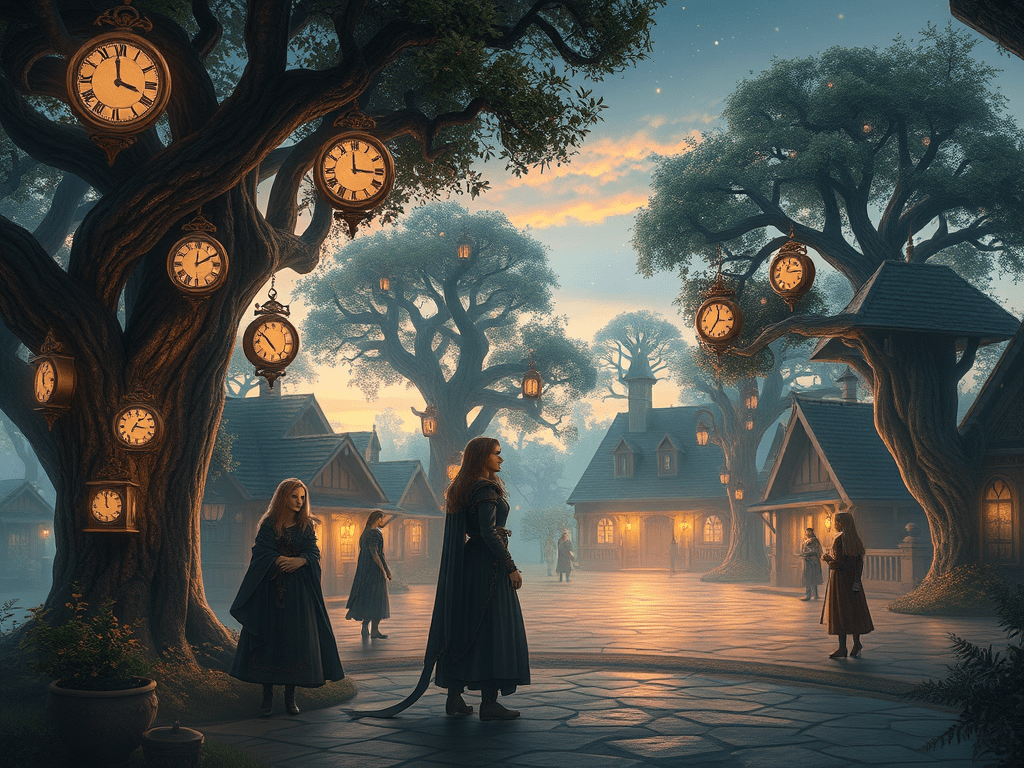
In the quaint village of Arborhollow, time itself seemed to dance to a rhythm few could understand. People spoke of an enigma lurking in their midst, a mysterious force that feasted on moments unguarded. When the sun dipped behind the verdant hills, Lorelei, the village seamstress, found her afternoons swallowed by a peculiar fog. As she threaded her needle one evening, she felt a warm drowsiness creep over her, and suddenly, the dusk was replaced by the starlit night. The clock on the mantle chimed slowly, mockingly echoing the hollow loss.
Lorelei wasn’t alone. The village baker, Thoran, often stirred his bread dough in half-lucidity under the morning sun, only to later discover his hands kneading flour under the glow of the moon instead. And Agnes, the local teacher, would blink away dreams to find entire hours of her lessons vanished with the setting or rising sun.
The villagers suspected their anticipation and fears were being siphoned. Lorelei fretted about wedding dresses, Thoran perspired over perfect batches, and Agnes pondered curriculum changes – each trapped in cycles of worry or expectation.
Determined to confront this spectral thief, Lorelei, Thoran, and Agnes allied in the village square. Here, Lorelei spoke of an ancient tale told by her grandmother – a specter named Chrono, the Wellspring Keeper, nourished by hidden moments within human hearts.
Compelled to reclaim their seized hours, they resolved to meet Chrono. With blossoms plucked from the vernal heart of Arborhollow, they laid a trail leading to the glen the invisibles often whispered about. As twilight descended, it wrapped around them like a muslin cloak, guiding them to a grove fluttering with countless clocks hanging from the boughs of ageless trees.
Chrono awaited, not as a villain, but a being caught in the perpetual swing of an ethereal pendulum. “Time is no enemy,” said Chrono, his voice like the rustling leaves. “You give it willingly through expectations and reticence.”
Lorelei stepped forward, heart emboldened. “How can we stop it?” she asked.
“Live completely in moments,” replied Chrono. “Cease to divide your dreams between fear and hope.”
Nodding, they each surrendered a trinket – Lorelei her thimble, Thoran a wooden spoon, and Agnes a chalk nub. In return, Chrono opened his hands, and the sky above rained down a kaleidoscope of glimpses lost and dreams untethered.
Returning to Arborhollow, they practiced new rituals: the pliancy of mind in the dawn chorus for Agnes, the tactile meditation in Thoran’s dough, and the tactile composition of satin in Lorelei’s fingers. They embraced the symphony of the present, each stolen hour returning to the tapestry of their lives as a thread woven in harmonious vibrancy.
The village thrived as whispers of lost time melted into myth, a folktale sung around autumn bonfires by descendants who had long since forgotten fear of time’s theft.
Tag: Short Story
The Midnight Rescuers
The storm that swept through Willow Creek was the worst anyone had seen in decades. Fierce winds howled through the night, tearing off roofs and uprooting trees. By morning, the small town lay in shambles, and the swollen river had flooded its banks, leaving homes submerged and roads impassable.
As the townspeople began assessing the damage, 14-year-old Olivia Taylor peered out her bedroom window at the rising water. Her heart sank when she spotted a shivering dog stranded on the roof of a shed half-submerged in the flood.
“We have to help it,” Olivia said to her father, who was busy boarding up broken windows.
“It’s too dangerous right now,” he replied, shaking his head. “We’ll call the shelter later.”
But Olivia couldn’t wait. She grabbed her raincoat and ran outside to get a better look.
A Call for Help
By the time Olivia reached the end of her street, she had seen more animals in trouble—cats perched in trees, chickens clinging to a fence, and even a horse stuck in a muddy field.
Determined to help, Olivia ran to her neighbor Ethan, a high school senior known for his calm demeanor and love of animals. “Ethan, there are animals everywhere that need saving,” she said breathlessly.
Ethan frowned but nodded. “You’re right. Let’s see who else we can get to help.”
The two of them knocked on doors, recruiting neighbors who were willing to brave the stormy aftermath. By the time the sun began to set, they had assembled a group of six:
- Mrs. Daniels, a retired veterinarian
- Jonah, a college student home on break
- Maya and Carlos, siblings who volunteered at the local animal shelter
- And, of course, Olivia and Ethan
The Midnight Plan
The group gathered in Ethan’s garage to make a plan. Mrs. Daniels sketched a map of the area, marking the locations where animals had been reported stranded.
“We need to act quickly,” she said. “But safety comes first. Stick together, and don’t go near the river—it’s too dangerous.”
Ethan divided the group into pairs and assigned each team a section of the neighborhood to search. Jonah brought his canoe, and Maya grabbed the shelter’s supply of animal carriers.
By nightfall, they were ready.
Rescues Under the Stars
Armed with flashlights, the neighbors ventured into the flooded streets. The sound of rushing water filled the air, but the rescuers pressed on.
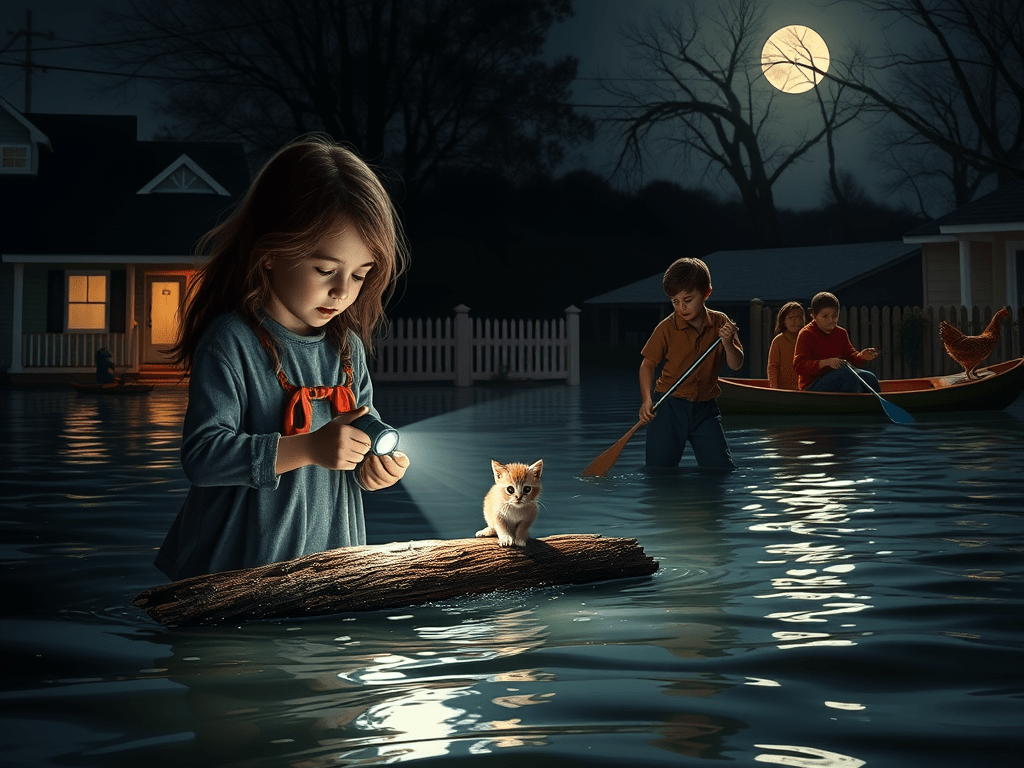
Olivia and Ethan were the first to make a rescue—a tiny kitten stranded on a piece of driftwood. Ethan waded carefully into the water while Olivia held the flashlight steady.
“Got it!” Ethan said, cradling the soaked but unharmed kitten.
Meanwhile, Jonah and Carlos used the canoe to reach the stranded dog Olivia had seen earlier. The dog wagged its tail weakly as they lifted it into the boat.
Maya and Mrs. Daniels found a coop full of chickens clinging to the top of a collapsed fence. Maya gently scooped up each bird while Mrs. Daniels checked them for injuries.
A Race Against Time
As the night wore on, the group’s teamwork paid off. They saved a horse by guiding it to higher ground, coaxed a family of ducks out of a storm drain, and even rescued a frightened raccoon stuck on a floating log.
But the most challenging rescue came just before dawn.
Ethan received a call from a neighbor who had spotted a deer trapped in the corner of a flooded pasture. The water was rising fast, and the deer couldn’t climb over the fence to safety.
The group hurried to the scene. With ropes and makeshift tools, they worked together to break open the fence and guide the panicked animal to dry land.
By the time they succeeded, the sun was beginning to rise, casting a golden glow over the town.
A Community United
In the days that followed, news of the midnight rescues spread throughout Willow Creek. The rescued animals were taken to the local shelter, where they received care and were reunited with their owners or rehomed.
The rescuers became local heroes, but they didn’t see themselves that way.
“We just did what anyone would do,” Ethan said humbly when interviewed by the local paper.
Olivia, however, felt differently. “We showed that even in the darkest times, we can come together to help those who can’t help themselves,” she said.
A New Tradition
Inspired by their success, the neighbors decided to form a permanent group called “The Midnight Rescuers.” They met regularly to train for future emergencies, ensuring that no animal—or person—would be left behind again.
And every time Olivia looked at the kitten she had adopted from that stormy night, she remembered how a simple act of courage could ripple into something extraordinary.
Shoes That Travel
Fifteen-year-old Maya Perez had a habit of noticing things other people overlooked. Walking home from school one chilly afternoon, she saw a boy about her age sitting on the curb outside a bus stop. His jacket was worn, but what caught her attention were his shoes—tattered sneakers with holes so big she could see his socks poking through.
“Are you okay?” she asked, hesitating a few steps away.
The boy looked up, startled. He nodded but didn’t say anything. Maya glanced at his shoes again.
“I—uh—have an extra pair of sneakers at home,” she said awkwardly. “If you want them, I could bring them tomorrow?”
The boy’s face softened, and he gave a small smile. “That’d be cool. Thanks.”
The Start of an Idea
That night, Maya rummaged through her closet and found the sneakers she had outgrown last year. They were still in good shape—practically new.
As she packed them into a bag, a thought struck her. If she had shoes she didn’t need, others probably did too. And there had to be more kids like the boy at the bus stop who could use them.
By the time she fell asleep, Maya had a plan.
Collecting Shoes
The next day at school, Maya stood in the cafeteria holding a poster she had hastily made the night before. It read:
“Shoes That Travel: Donate Your Gently Used Shoes to Someone in Need!”
“Are you starting a shoe store or something?” joked her friend Liam as he walked by.
“No,” Maya said, grinning. “I’m starting a shoe movement.”
She explained her idea: to collect shoes from the community and distribute them to people who needed them. Liam was intrigued. “I’ve got a couple of pairs at home I can bring in. Want help spreading the word?”
With Liam’s help, Maya’s project took off. They set up donation boxes at school, the local library, and the community center. Over the next few weeks, the boxes filled with sneakers, boots, sandals, and even some shiny dress shoes.
Finding the Right Homes
Collecting the shoes was the easy part. The challenge was figuring out where they should go. Maya reached out to local shelters, youth centers, and even an organization that supported refugees. Each group welcomed her donations with open arms.
But Maya wanted to do more than just drop off the shoes. She wanted to know their stories—where they went and how they helped.
Following the Shoes
Maya included a small card with each pair of shoes, inviting the recipients to share their journey if they wanted to.
One card came back from a single mom named Clara, who had picked out a sturdy pair of boots for her son, Alex. “These boots mean Alex can walk to school comfortably in the winter,” Clara wrote. “Thank you for helping us keep going.”
Another card came from Lina, a refugee from Syria who had fled to the U.S. with her family. She wrote, “The shoes remind me of my old life, where I worked in a shoe factory. They also remind me of hope—for a new beginning.”
Even the shiny dress shoes found a purpose. A teenager named Marcus wore them to a job interview. “I got the job,” he wrote. “First step toward my dreams.”
Growing the Movement
Encouraged by these stories, Maya shared them on social media. Her posts caught the attention of a local news station, which aired a segment about “Shoes That Travel.” Donations poured in from neighboring towns, and Maya had to recruit more friends to sort and distribute the shoes.
The project grew beyond anything she had imagined. A nearby shipping company offered to help transport shoes to distant communities, and a local nonprofit partnered with Maya to expand her reach.
One Pair at a Time
Maya never forgot the boy at the bus stop who started it all. She saw him again a few months later, wearing the sneakers she had given him.
“Hey,” she called out, waving.
He grinned. “Hey! Thanks again for these. They’re awesome.”
Maya smiled. “They look great on you.”
As she walked away, her heart swelled with pride. She realized that each pair of shoes wasn’t just about covering feet—it was about giving people the confidence and comfort to take their next step.
And step by step, the shoes kept traveling, connecting lives and stories, proving that even something as simple as an old pair of sneakers could change the world.
The Forgotten Heroes
The small town of Millfield was a quiet place where everyone knew each other. But, like many towns, there were people who worked tirelessly behind the scenes—keeping the streets clean, delivering mail in rain or shine, and ensuring everyone was safe—without much recognition.
For 12-year-old Rosie and her friends, these people were the town’s forgotten heroes.
The Spark of an Idea
One afternoon, while sitting on the swings at the park, Rosie noticed Mr. Hank, the garbage collector, picking up litter left behind after the weekend fair. His back was hunched, and his movements were slow, but his determination was steady.
“Does anyone ever thank him?” Rosie wondered aloud.
Her best friend, Leo, shrugged. “Probably not. People just expect him to do it.”
“What about Mrs. Patel at the library?” chimed in Emma, another friend. “She stays late to help kids with their homework, but no one ever talks about her.”
Rosie’s eyes lit up. “What if we change that? What if we throw a party for all the people who do so much for Millfield but never get the thanks they deserve?”
Planning the Celebration
The group got to work immediately. They called themselves the “Hero Hunters” and started brainstorming.
First, they made a list of unsung heroes:
- Mr. Hank, the garbage collector
- Mrs. Patel, the librarian
- Officer Ramirez, the kind-hearted cop who always helped lost pets
- Ms. Green, the crossing guard who braved every kind of weather
- Mr. Joe, the mailman who always greeted everyone with a smile
Then, they started planning the surprise celebration. They decided to hold it in the town square on a Saturday afternoon.
To keep it a secret, they enlisted the help of their parents, teachers, and even the mayor. Everyone was excited to help, donating food, decorations, and even a local band to play music.
Invitations with a Twist
The trickiest part was getting the heroes to the event without spoiling the surprise. Rosie came up with a clever plan: each hero received a letter that simply said, “Please come to the town square on Saturday at 3 PM for a special community event.”
No further details were given.
The Big Day
When Saturday arrived, the town square was transformed. Colorful banners hung from the lampposts, tables were piled with food, and a stage was set for speeches and performances.
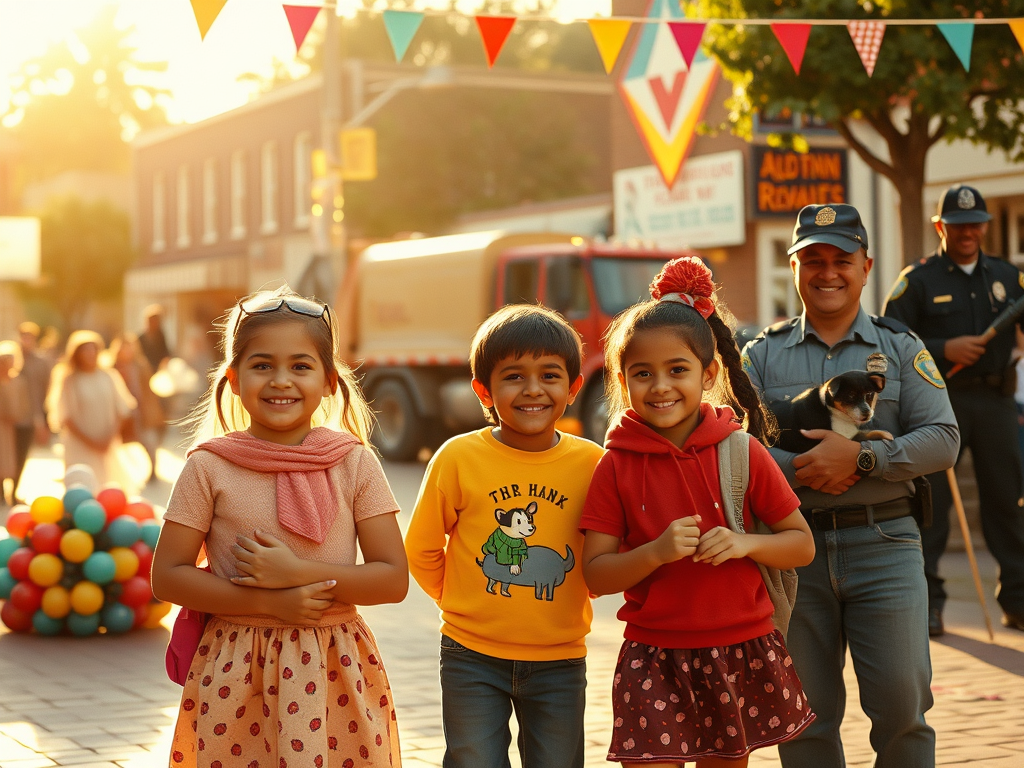
As the clock struck three, the heroes began to arrive. Mr. Hank showed up in his work uniform, looking confused. Mrs. Patel walked in, clutching her ever-present stack of books. Officer Ramirez and Ms. Green arrived together, both equally puzzled.
“What’s going on?” Mr. Joe asked, adjusting his mailbag.
That’s when Rosie stepped onto the stage, microphone in hand.
“Welcome, everyone!” she began, her voice shaking slightly but growing stronger. “Today is a special day because it’s all about you—our heroes.”
A Day of Gratitude
The crowd cheered as Rosie introduced each hero and shared why they were being celebrated. Stories poured out—how Mr. Hank once returned a lost wallet he found while collecting trash, how Mrs. Patel stayed late to help Emma learn to read, and how Officer Ramirez reunited a stray dog with its family.
Each hero was presented with a handmade certificate, a bouquet of flowers, and a heartfelt thank-you from the kids.
By the time the band started playing, there wasn’t a dry eye in the square.
A Lasting Impact
The celebration was a turning point for Millfield. It reminded everyone to appreciate the quiet, everyday acts of kindness that kept the town running.
The “Hero Hunters” didn’t stop there. They turned their group into an annual event-planning committee, organizing celebrations for new heroes every year.
As for the original heroes, they carried their certificates and memories with pride, knowing they were seen, valued, and loved.
And for Rosie and her friends, it was proof that even the smallest voices could create something big—a wave of gratitude that would ripple through Millfield for years to come.
The Butterfly Garden
The Johnson family’s backyard had always been a patch of uneven grass and wild weeds. But to nine-year-old Sophie, it was her kingdom. She’d sit for hours imagining castles, magical creatures, and secret adventures.
One spring morning, Sophie was sitting by the window, watching a lone butterfly flutter among the dandelions. Her mother, Laura, walked in with a cup of tea and a weary smile. Sophie’s illness had taken a toll on the whole family, but her daughter’s spirit remained unbroken.
“Mom,” Sophie said, her voice filled with quiet wonder, “what if we turned the yard into a garden? A garden just for butterflies.”
Laura hesitated, unsure of how much energy Sophie had for such a big project. But Sophie’s eyes sparkled with excitement. “A garden where everyone could feel happy, just like I do when I see butterflies.”
Laura nodded, her heart full. “Let’s do it.”
Planting Hope
The next weekend, Sophie and her parents began transforming the yard. Sophie picked out colorful flowers—milkweed, zinnias, and marigolds—that would attract butterflies. Her dad, Eric, dug up the weeds while Sophie directed him like a foreman, giggling whenever he dramatically wiped his brow.
Neighbors noticed the activity and stopped by to help. Mrs. Bennett from next door brought over a bag of soil, and Mr. Patel offered wooden planks for raised flower beds. Soon, it wasn’t just Sophie’s family working on the garden—it was the whole community.
As the garden grew, Sophie spent her days painting small signs with names like “Butterfly Bistro” and “Puddle Paradise.” Her favorite spot was a small bench beneath a willow tree, where she could sit and watch the butterflies dance.
The First Visitor
By mid-summer, the garden was alive with color. Butterflies of all shapes and sizes flitted between the flowers, and Sophie’s giggles echoed through the yard.
One afternoon, a boy named Ben visited with his mom. Ben had recently moved to the neighborhood and was painfully shy. Sophie, sitting on her bench, waved him over.
“Do you like butterflies?” she asked.
Ben nodded but didn’t say much. Sophie handed him a tiny painted rock shaped like a butterfly. “This is your ticket to the garden,” she said with a grin.
For the first time, Ben smiled. He began visiting the garden daily, helping Sophie water the plants and even painting rocks for other visitors.
A Garden of Connection
As word spread, more people came to see the garden. Some came to admire its beauty; others came seeking solace.
One day, Mrs. Thompson, who had recently lost her husband, sat on Sophie’s bench. “This place feels magical,” she said, her voice trembling.
Sophie, now frailer but just as spirited, smiled warmly. “Butterflies always bring good things. Maybe they’ll bring you something happy, too.”
Mrs. Thompson nodded, tears glistening in her eyes.
Sophie’s Legacy
As summer turned to autumn, Sophie grew weaker. She could no longer spend as much time in the garden, but her parents would wheel her out to the bench whenever the weather allowed. One crisp October morning, Sophie sat quietly, watching a monarch butterfly land on her hand.
“They’re so free,” she whispered. “That’s what I want this garden to be—a place where people can feel free, happy, and loved.”
Those were her last words in the garden.
Sophie passed away peacefully a few days later, surrounded by her family.
Blooming Hope
In the weeks following Sophie’s passing, the community came together to honor her memory. They added a plaque near her bench that read:
“The Butterfly Garden: A place of hope, joy, and love, created by Sophie Johnson, who believed in the magic of butterflies and the beauty of life.”
The garden didn’t wither in her absence. It flourished. Visitors continued to come—not just for the flowers and butterflies, but for the peace the garden seemed to offer.
Children painted rocks, families planted new flowers, and people from all walks of life found comfort on Sophie’s bench. Ben, now one of the garden’s young caretakers, often told visitors about Sophie’s dream.
“She wanted everyone to feel happy here,” he’d say, his voice filled with pride. “And they do.”
The Garden That Grew Hearts
Years later, the garden remained a vibrant sanctuary. Sophie’s story inspired others to create similar gardens in nearby towns. What began as one child’s dream became a ripple of kindness and connection that reached far beyond her backyard.
And on quiet days, when the sun was just right, visitors to the garden could see butterflies soaring high, as if carrying Sophie’s spirit with them, spreading joy wherever they went.
The Quilt of Stories
The Taylor family’s living room was quieter than usual. Grandpa Henry had recently passed away, leaving an emptiness that no words could fill. His chair sat by the window, its cushions slightly worn, a reminder of the many evenings he spent there telling stories from his colorful life.
In the weeks that followed, the family struggled to find their way back to normal. Laughter felt distant, and shared meals were marked by long silences. One rainy Saturday, as the family gathered for what should have been their usual movie night, Grandma Rose stood up with a determined glint in her eye.
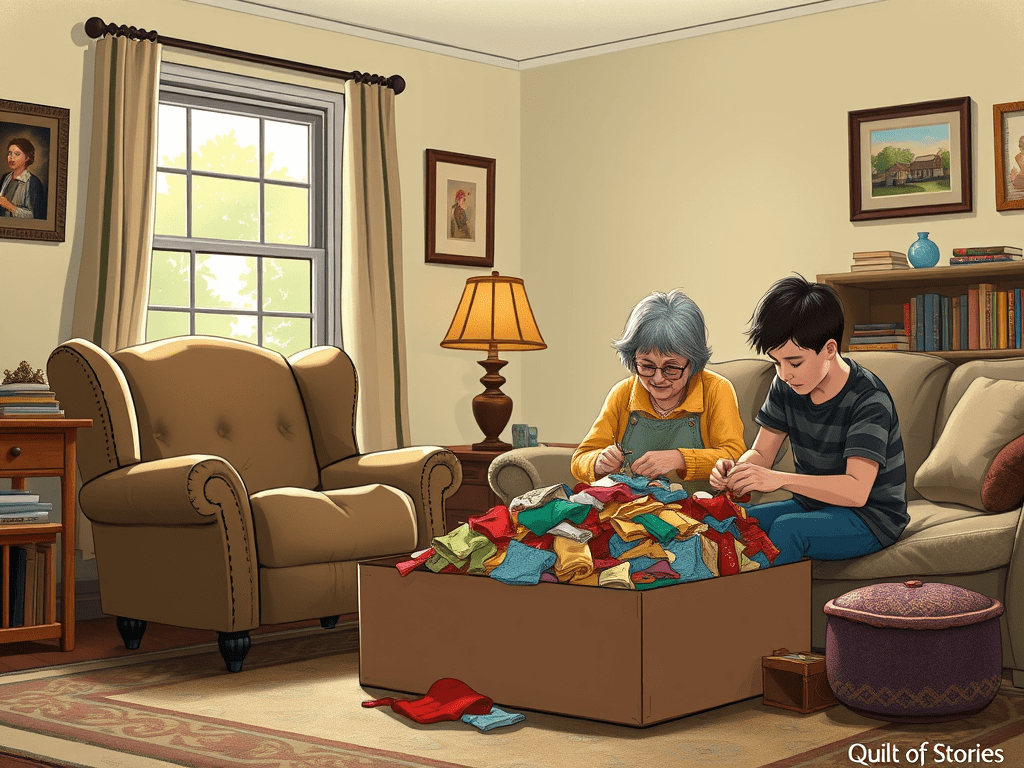
“We’re going to make something together,” she announced, pulling a large box out from the hallway closet. Inside were scraps of fabric in all colors and patterns—some faded with age, others still vibrant.
“What is all this?” asked Lily, the youngest of the Taylor clan.
“Memories,” Grandma said, holding up a piece of fabric. “This was part of your grandpa’s favorite shirt. And this one,” she said, pulling out a floral scrap, “came from the dress I wore the day we moved into this house. I’ve been saving these for years. We’re going to make a quilt.”
Stitching the Past
At first, the idea seemed daunting. None of them were quilters, and the sheer volume of fabric was overwhelming. But Grandma explained that this wasn’t just about sewing; it was about sharing stories.
Each person would choose pieces of fabric and sew a square that represented a special memory. When all the squares were finished, they’d stitch them together to make a family quilt.
“It’ll be like Grandpa’s stories,” Grandma said. “Only in fabric.”
Reluctantly, the family agreed.
Pieces of Love
As they began sorting through the fabric, memories started to surface. Lily picked a bright yellow piece from an old apron. “Grandpa and I used to bake cookies together,” she said, smiling for the first time in days. “This can be my square.”
Her older brother Ben found a plaid shirt fabric. “This was from the flannel Grandpa wore when he taught me how to fish. I’ll use this.”
Their dad, Mark, chose a small, checkered fabric. “This is from the blanket we used to bring to picnics. Remember when Grandpa slipped on the grass and blamed the ants for tripping him?” The room filled with laughter at the memory.
Even Grandma found herself lost in nostalgia as she selected pieces of her wedding dress and curtains from their first home.
Learning Together
The sewing process was not without its challenges. Ben pricked his finger repeatedly, and Lily’s stitches were uneven at first. But Grandma guided them patiently, her hands steady and experienced.
As they worked, they shared stories about Grandpa—how he always knew the right moment to tell a joke, the way he danced in the kitchen with Grandma, and his habit of giving everyone silly nicknames.
“We should add a square for Grandpa’s storytelling,” Lily suggested. She found a piece of fabric covered in tiny books and stitched it into a square.
“That’s perfect,” Grandma said, her voice soft with emotion.
Coming Together
Over the course of several weeks, the quilt began to take shape. Each square was a vivid snapshot of the family’s life: fishing trips, holiday dinners, rainy afternoons playing board games, and quiet moments spent listening to Grandpa’s tales.
As they worked, the family grew closer. The quilt became more than just a project—it was a way of healing, of remembering not just Grandpa but the love and joy he had brought into their lives.
The Final Stitch
One chilly autumn evening, the quilt was finally complete. It was a patchwork of colors and textures, each square telling its own story yet blending beautifully with the others.
Grandma spread it over Grandpa’s chair, where it seemed to belong. “Now, whenever we feel sad or miss him, we can look at this quilt,” she said. “It’s like having him here with us.”
The family gathered around, their hearts full. Ben pulled the quilt over his lap and started telling one of Grandpa’s favorite stories, complete with dramatic gestures and voices. By the end, they were all laughing, just as they had so many times before.
A Legacy of Love
The quilt remained in the Taylor family for years, passed down through generations. Each new family member added their own square, ensuring that the stories—and the love—continued to grow.
Whenever someone felt lost or alone, they’d wrap themselves in the quilt, finding comfort in the memories stitched into its fabric. It wasn’t just a quilt; it was a legacy of love, resilience, and the unbreakable bond of family.
And in the Taylor household, Grandpa Henry’s stories never truly ended—they were simply retold, one square at a time.
The Family Legacy Treehouse
The old oak tree stood at the edge of the Taylor family’s backyard, its branches reaching out like arms ready to embrace the sky. Nestled within its sturdy limbs was the treehouse that Grandpa Henry had built decades ago. Though time had weathered its wooden planks and the paint had long faded, it still held the magic of countless childhood adventures.
“It’s not safe to climb anymore,” Dad said one day as he glanced up at the sagging structure. “I’m surprised it’s still standing.”
“That’s because Grandpa built it,” 12-year-old Emma declared proudly. “He always said it was made to last.”
Her older brother, Nate, rolled his eyes. “Yeah, but even Grandpa didn’t expect it to last forever. It’s falling apart.”
Emma frowned, but an idea was already forming in her mind. She tugged on Nate’s sleeve. “What if we fix it? You and me.”
Nate hesitated. “That thing’s a lost cause, Emma.”
But their dad, overhearing the conversation, chimed in. “Maybe it’s not such a bad idea. We could make it a family project.”
Emma’s eyes lit up. “Let’s do it!”
Dusting Off the Memories
The next weekend, the entire family gathered under the oak tree. Armed with gloves, flashlights, and a ladder, they climbed up to survey the damage. The floorboards creaked ominously, and one corner of the roof was missing. But the frame—the bones of the treehouse—was as sturdy as the day Grandpa Henry had built it.
In the back of the garage, they found Grandpa’s old toolbox, still covered in sawdust. Inside were some of the tools he’d used to build the treehouse, along with a yellowed notebook filled with sketches and handwritten notes.
“Look at this,” Dad said, holding up the notebook. “It’s like a blueprint for the treehouse. Grandpa planned everything.”
Emma traced her fingers over the faded pages. “It’s like he’s helping us from the past.”
Building Together
Restoring the treehouse became a weekend ritual. Nate and Dad focused on the structural repairs, replacing rotting wood and reinforcing the beams. Emma and Mom painted the walls, choosing a bright green to match the leaves of the oak tree.
At first, it wasn’t easy. Nate and Emma bickered over everything—from the choice of paint color to who got to hammer the nails. But as the weeks passed, the work brought them closer. Nate taught Emma how to use a power drill, and Emma teased Nate about his shaky painting skills.
One day, while sanding down the railings, Nate found something carved into the wood: “H.T. 1965.”
“It’s Grandpa’s initials,” Nate said. “He must’ve carved them when he finished the treehouse.”
Emma smiled. “Let’s add ours when we’re done.”
Discovering Grandpa’s Legacy
As they worked, they discovered pieces of Grandpa Henry’s life tucked away in the treehouse. A rusted tin box under the floorboards held faded photos of him as a young man, grinning with tools in hand. There was a postcard from Grandma, sent before they were married, and a small wooden figurine Grandpa had carved.
“Grandpa put so much of himself into this treehouse,” Mom said, holding the figurine. “It wasn’t just a place to play. It was a gift of love.”
Emma thought about all the stories Grandpa had told her about the treehouse—how he’d built it for her dad and uncles, how it was the setting for pirate adventures and campouts under the stars. Restoring it felt like keeping those stories alive.
A New Beginning
After weeks of hard work, the treehouse was transformed. The bright green paint glowed against the backdrop of the oak leaves. Inside, they’d added a new carpet, shelves for books and toys, and even fairy lights that twinkled like stars at night.
On the final day, the family gathered around to celebrate. Emma handed Nate a pocketknife. “It’s time to add our initials,” she said.
Together, they carved “E.T. & N.T. 2024” next to Grandpa’s initials. Dad added his own, along with Mom’s. When they stepped back, the wood was filled with generations of Taylor family marks, each one telling a story.
As the sun set, Emma and Nate climbed into the treehouse and looked out over the backyard. “This was a good idea,” Nate admitted.
Emma grinned. “Told you so.”
Carrying the Legacy Forward
The restored treehouse became more than just a place to play. It was a reminder of Grandpa Henry’s love, the importance of family, and the power of working together.
Emma started a journal she kept in the treehouse, encouraging everyone to write down their memories. By the end of the summer, it was filled with stories—of quiet moments, silly games, and dreams for the future.
Years later, the treehouse remained a cherished part of the Taylor home. And when Emma’s own children climbed its sturdy ladder for the first time, she smiled, knowing they were stepping into a legacy of love that would never fade.
The Puzzle Project
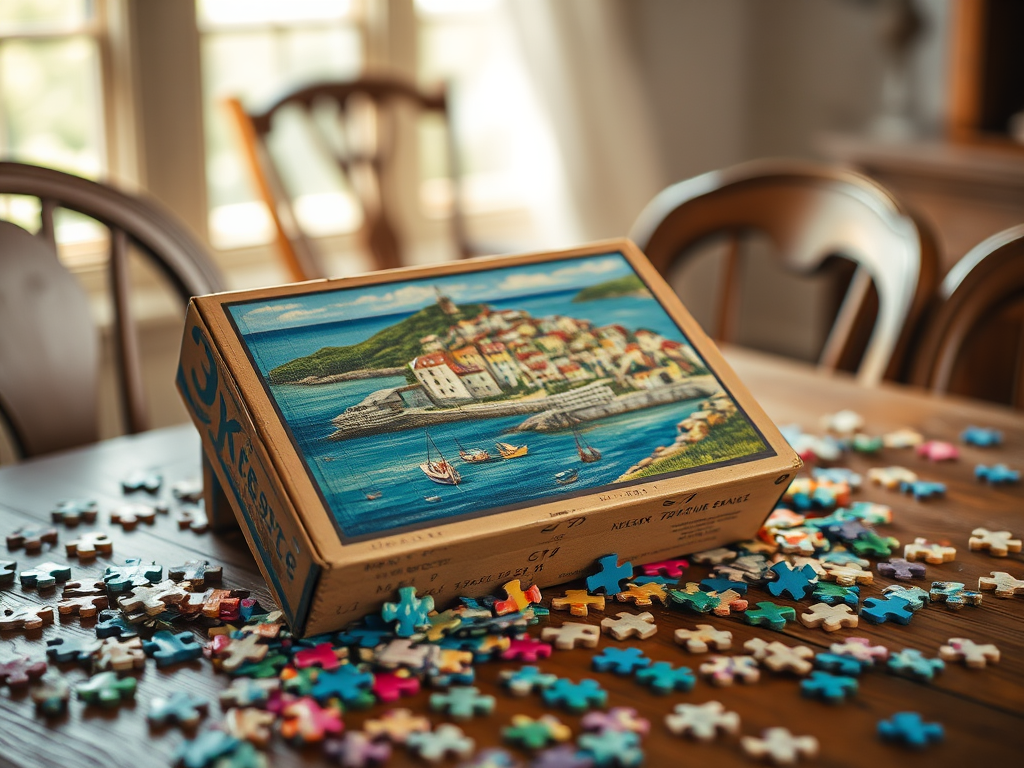
The box sat on the dining room table, its edges worn and the image on the front faded. A sprawling seaside village, painted in vibrant blues and greens, stared back at Maya as she ran her fingers over the cover. The words “1,000-piece jigsaw puzzle” seemed more daunting than ever.
It had been her father’s favorite pastime, especially in the quiet hours after dinner. He’d sit at the table, meticulously sorting pieces, his soft humming filling the room. Maya couldn’t recall him ever leaving a puzzle unfinished—until this one.
When their dad passed suddenly three months ago, the half-completed puzzle was left behind, still spread across the table. Maya had covered it with a cloth, unable to face it. But now, with the holidays approaching and her older brother Ethan back in town, she decided it was time to do something with it.
What exactly, she wasn’t sure.
A Rocky Start
“Why don’t we just pack it up and donate it?” Ethan asked as he sipped his coffee, eyeing the puzzle like it was a chore.
Maya shook her head. “It was Dad’s. We should finish it.”
Ethan sighed. “We haven’t worked on a puzzle together since we were kids. And let’s face it, we didn’t exactly excel at teamwork back then.”
He wasn’t wrong. Growing up, Maya and Ethan had been close, but as they got older, their personalities clashed. Ethan’s pragmatic approach to life often grated against Maya’s more emotional nature. Their father had been the glue that kept them connected.
Still, Maya pressed on. “It’s not about the puzzle, Ethan. It’s about Dad.”
Reluctantly, Ethan agreed.
The First Pieces
They began that evening, uncovering the puzzle and surveying the chaos of scattered pieces. Their father had sorted some by color and edge, but most lay in haphazard piles.
“Corners first,” Ethan said, falling into his usual no-nonsense tone. “That’s how Dad always started.”
Maya rolled her eyes but followed his lead. As they worked, the initial awkwardness between them softened. They reminisced about their childhood, sharing memories of their dad’s puzzles and how he’d always make them pause to admire the completed picture.
“You remember the Eiffel Tower one?” Ethan asked, chuckling. “Dad made me redo the whole sky because I rushed through it.”
“Yeah, and I cried because I thought he was mad at us,” Maya added, laughing. “But he just wanted us to ‘do it right.’”
Their laughter echoed in the quiet house, and for the first time in months, the air felt lighter.
Pieces of the Past
As the days went on, they fell into a rhythm. Maya focused on the intricate details—finding pieces that matched the colorful awnings and cobblestone streets—while Ethan tackled the endless blue expanse of the ocean and sky.
During their breaks, they talked about more than just the puzzle. Ethan shared stories from his job in another city, while Maya opened up about her struggles with balancing work and their dad’s passing.
“It feels like… I don’t know, like I’m still looking for pieces of him everywhere,” she admitted one night, holding a puzzle piece shaped like a heart.
Ethan nodded. “I get it. Sometimes I feel like I’ve been avoiding coming back because I didn’t know how to handle it.”
They realized how much they had drifted apart, not just from their father’s death, but in the years before. The puzzle became a bridge, helping them rebuild what had been broken.
The Final Piece
After a week of late-night sessions, they neared the end. The puzzle was nearly complete, and the vibrant seaside village looked alive on the table. But as Maya reached for what should have been the last piece, she froze.
“It’s missing,” she said, her voice trembling. “We’re missing a piece.”
They searched everywhere—the floor, the box, even under the table—but it was gone. Maya felt tears well up. “I wanted it to be perfect.”
Ethan placed a hand on her shoulder. “Maybe it already is,” he said. “Dad wouldn’t have cared about one missing piece. He’d just be happy we did this together.”
Maya smiled through her tears. “You’re right. He would.”
A New Picture
The puzzle stayed on the table for weeks, incomplete but no less meaningful. Maya and Ethan framed it just as it was, the missing piece a quiet reminder that life, like puzzles, isn’t always perfect—but it’s the effort that matters.
They hung it in the living room, where sunlight would catch its vibrant colors, and every time they looked at it, they felt closer to their father—and to each other.
From then on, Maya and Ethan made it a tradition to tackle a new puzzle whenever they were together, turning what once symbolized loss into a celebration of connection.
Because sometimes, it’s not about finishing the picture—it’s about the journey of putting it together.
The Great Reunion Recipe Book
The Johnson family had always been close, but life had a way of scattering them like seeds in the wind. Over the years, jobs, schools, and new adventures took them to different corners of the country. There were phone calls and video chats, but it wasn’t the same as gathering around Grandma Ruby’s big oak dining table for a family meal.
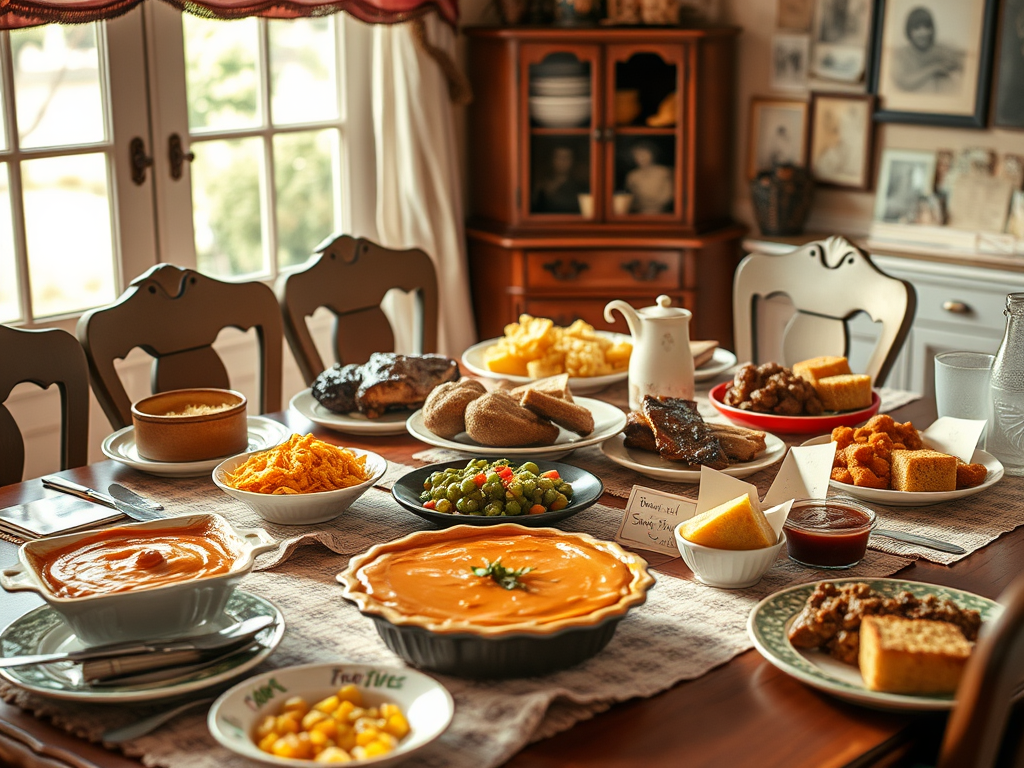
One rainy afternoon, Sarah, the youngest of the Johnson siblings, was flipping through her grandmother’s old recipe box. The familiar handwriting on the yellowed cards brought back memories of Sunday dinners and holiday feasts. She smiled as she pulled out a card labeled “Ruby’s Famous Sweet Potato Pie.”
“This pie could bring people together,” Sarah said to herself, an idea sparking in her mind.
She grabbed her phone and called her older brother, Marcus, who lived three states away. “What if we made a family recipe book?” she suggested. “We could each contribute our favorite dishes and memories. It’d be like bringing us all back to the table.”
Marcus loved the idea. “Let’s do it,” he said. “But only if I get to write about Dad’s barbecue ribs. No one else is allowed to claim that one.”
Collecting the Recipes
Sarah sent an email to the entire family, explaining her idea. The responses came in quickly.
“Aunt Lila here! Count me in—I’ll send my secret gumbo recipe.”
“Don’t forget Grandpa’s cornbread!” replied Uncle Joe.
Even the younger cousins, who were just learning to cook, wanted to contribute. “I’ll share my chocolate chip cookie recipe!” wrote Emma, a teenager with a budding passion for baking.
Sarah created a shared folder online where everyone could upload their recipes and photos of their dishes. But as the recipes came in, something unexpected happened: the family started sharing stories too. Each recipe was accompanied by memories—funny, heartfelt, or nostalgic.
Aunt Lila’s gumbo came with a story about how it saved a rainy family camping trip. Grandpa’s cornbread brought back tales of him singing old folk songs while cooking. Sarah laughed as Marcus described the “Great Rib War” of 1998, when their dad and Uncle Joe had a heated debate over the best barbecue sauce.
Bringing the Book to Life
As the recipes and stories piled up, Sarah realized the project was about more than food. It was about reconnecting. Late-night phone calls turned into brainstorming sessions about the layout. Cousins who hadn’t spoken in years bonded over shared memories of favorite dishes.
The family decided to call the book “The Great Reunion Recipe Book” and added a special subtitle: “Recipes and Memories from the Johnson Table.”
They worked together to design the book, with each family member assigned a role. Emma, the teenage baker, took charge of the cover design, creating a vibrant collage of family photos and handwritten recipe snippets. Uncle Joe, who had a knack for storytelling, wrote the introduction:
“Our family may be spread across the map, but our hearts have always been connected by the meals we’ve shared. This book is a celebration of those moments and a promise that no matter how far we roam, we’ll always have a place at the table.”
A Virtual Feast
When the book was finally complete, Sarah organized a virtual family reunion to unveil it. Everyone cooked a dish from the book and shared it on the video call. Laptops and phones around the country showed steaming plates of gumbo, golden cornbread, ribs dripping with sauce, and pies with perfectly crimped edges.
Laughter filled the call as family members tasted each other’s creations and reminisced. Aunt Lila teased Uncle Joe about still not knowing how to properly peel shrimp. Marcus held up a forkful of ribs and declared them the “true winner” of the Great Rib War. Even Grandma Ruby, now in her nineties, joined the call, wiping away tears as she saw her family united once again.
A Lasting Legacy
The cookbook wasn’t just a one-time project. It became a living document, updated with new recipes and stories as the family grew. Copies of the book were printed and sent to every household, becoming a cherished keepsake.
The Johnsons even made it a tradition to hold an annual “Recipe Day,” where they’d cook together—virtually or in person—and add new dishes to the collection. It wasn’t the same as sitting around Grandma Ruby’s table, but it was close.
Years later, when Sarah looked at the well-worn pages of her copy of The Great Reunion Recipe Book, she felt a deep sense of pride and love. Through food and stories, her family had found a way to stay connected, no matter the miles between them.
And every time she made sweet potato pie, she could almost hear Grandma Ruby’s laugh and feel the warmth of her family around her, proving that some bonds are unbreakable—even by distance.
Free Haircuts for Hope
Elliot “Eli” Carter loved being a barber. For years, his small shop on the corner of Main and Elm had been a sanctuary for people from all walks of life. He wasn’t just cutting hair—he was listening, laughing, and connecting. But recently, Eli noticed fewer familiar faces.
The neighborhood was struggling. Layoffs at the factory had left many without steady income, and the rising cost of living made it hard for people to afford even the basics, let alone a haircut.
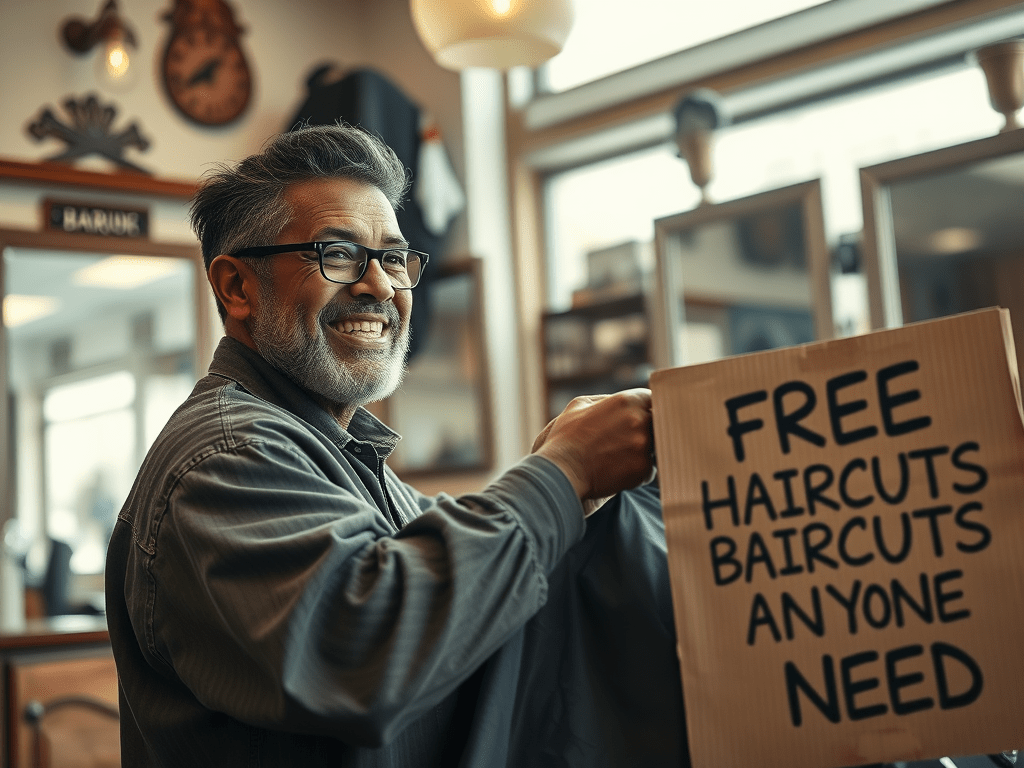
One rainy Tuesday, Eli looked out the window of his empty shop and made a decision. He grabbed a piece of cardboard, scribbled a message with a marker, and propped it up in his shop window:
“Free Haircuts for Anyone in Need. No Questions Asked.”
A Simple Start
The next morning, Eli wasn’t sure what to expect. At first, no one came. But just as he was about to sweep the floor, a man hesitantly walked in. His clothes were worn, and he avoided eye contact.
“Are you really offering free haircuts?” the man asked.
Eli smiled. “You bet. Have a seat.”
As he worked, the man relaxed and started talking. His name was Dave, and he’d been out of work for months. “I have a job interview tomorrow,” he said quietly. “Figured a haircut might help me look the part.”
Eli handed him a mirror when he was done. “You’ve got this,” he said, clapping Dave on the shoulder.
Word spread quickly. By the end of the week, Eli’s shop was buzzing with people. Parents brought their kids before school. A young woman who was couch-surfing came in for her first trim in over a year. A man with a scruffy beard joked that Eli had shaved off a decade of his life.
Eli didn’t just give haircuts—he gave dignity. Each person walked out a little taller, their burdens a little lighter.
The Ripple Effect
One afternoon, a local reporter stopped by after hearing about Eli’s free haircuts. The story aired on the evening news, and soon, Eli’s small act of kindness became the talk of the town. People began dropping by the shop—not for haircuts, but to leave tips, supplies, and even food for those in need.
Inspired by Eli’s example, other barbers and stylists in the city started offering free haircut days. A salon downtown organized a “Cuts for Confidence” event, while a barber school began teaching students the importance of giving back.
Eli’s idea even spread beyond barbershops. A nearby bakery started giving out free bread to families. A mechanic offered discounted repairs for single parents. Acts of kindness multiplied, creating a wave of hope that touched the entire city.
The Day That Changed Everything
One day, as Eli was finishing up a haircut for a young boy, a familiar face walked into the shop—it was Dave, the man who’d come in that first day. This time, he was wearing a suit and holding a bouquet of flowers.
“I got the job,” Dave said, grinning. “And it’s all thanks to you.”
Eli laughed, shaking his head. “Nah, you did that yourself.”
Dave insisted on handing Eli the flowers. “You didn’t just cut my hair. You gave me a chance to see myself differently. That made all the difference.”
A Legacy of Kindness
As the years went by, Eli’s shop remained a cornerstone of the community. Though he never charged for the free haircuts, the generosity of others always kept the lights on and the scissors sharp.
Eli often said that the best part of the experience wasn’t the haircuts—it was seeing how one small act could inspire so many.
“You never know who needs a little hope,” he’d tell new barbers who came to learn from him. “And sometimes, all it takes is a haircut.”
The city eventually declared September 15th “Hope Day” in honor of Eli’s contribution, encouraging residents to perform acts of kindness. But for Eli, every day was a chance to give.
And so, with clippers in hand and a heart full of compassion, Eli continued his mission: to remind everyone that hope could start small but grow into something beautiful.
The Unexpected Dancer
Evergreen Middle School’s annual talent show was the biggest event of the year. Students spent weeks practicing their acts—singing, playing instruments, performing skits, and showing off everything from juggling to magic tricks. The auditorium was always packed with students, parents, and teachers, ready to cheer on their peers.
This year’s show was no different. The air buzzed with excitement as performers took the stage. Backstage, the student emcees huddled over the program schedule, making last-minute adjustments. One of them, Emma, frowned.
“There’s a gap in the program,” she said. “Five minutes with no one scheduled.”
Her co-host, Ryan, shrugged. “We’ll just tell a joke or two.”
Before they could decide, Mr. Ramirez, the school janitor, approached them. He was dressed in his usual blue uniform, pushing a mop bucket. “I can fill in, if you’d like,” he said casually.
The students exchanged skeptical looks. Mr. Ramirez had always been friendly but quiet, and no one knew much about him. “You want to perform?” Emma asked, surprised.
Mr. Ramirez nodded with a small smile. “If you’ll let me.”
Ryan shrugged. “Why not? Go for it.”
When the time came, the emcees announced him with amused grins. “Ladies and gentlemen, please welcome… our janitor, Mr. Ramirez!”
Polite applause filled the room as Mr. Ramirez walked onto the stage, mop in hand. He set the mop aside, adjusted his cap, and took a deep breath. Then, to everyone’s astonishment, he struck a dramatic pose. Music filled the auditorium—a lively salsa tune—and Mr. Ramirez began to dance.
And what a dance it was.
He moved with an elegance and energy no one expected, spinning, sliding, and stepping in perfect rhythm. His feet tapped the stage with lightning speed, and his arms moved fluidly as if painting pictures in the air. The audience erupted into cheers and claps, their jaws dropping at the sight.
The students backstage peeked out, whispering in awe. “Where did he learn to dance like that?” Emma asked, wide-eyed.
Parents and teachers joined the applause, many of them standing as Mr. Ramirez twirled across the stage, ending his routine with a powerful spin and a graceful bow. The auditorium erupted into a standing ovation.
Mr. Ramirez smiled humbly and waved as he left the stage, his face flushed with excitement.
The Story Behind the Dance
Later, as students and parents mingled in the lobby, many approached Mr. Ramirez to congratulate him. “I had no idea you could dance like that!” said Mrs. Thompson, the music teacher.
Mr. Ramirez chuckled. “Dancing was my first love,” he explained. “I grew up in Puerto Rico, where dancing is a way of life. I even competed in a few contests when I was younger. But life happened, and I had to set it aside.”
“But why now?” a curious student asked.
Mr. Ramirez looked around at the excited faces. “I’ve seen so many of you walking through the halls, afraid to show who you really are, hiding your talents because you’re scared of what others might think. I figured, if I could dance, maybe it would inspire you to be brave, too.”
The students were silent for a moment, taking in his words. Then Emma stepped forward. “It worked,” she said with a grin. “You just became the coolest person at school.”
A Ripple Effect
The next day, the energy in the school was different. Inspired by Mr. Ramirez, students started talking openly about their hidden talents. A shy girl in the library brought her sketchbook to art class for the first time. A boy who loved poetry volunteered to read his work during lunch. Even the teachers began sharing stories about their hobbies and passions.
Mr. Ramirez became a beloved figure, not just as the janitor but as the man who reminded everyone that talent is everywhere, even where you least expect it.
By the time the next talent show rolled around, participation had doubled. And when Mr. Ramirez was invited to perform again, he smiled and said, “Only if you all promise to shine as bright as you can.”
That year, Evergreen Middle School wasn’t just a place where students learned math and history—it became a place where they learned to embrace their unique gifts, all thanks to the unexpected dancer who showed them how.
The Music Box
The Patterson family home had been in disarray ever since Grandma Eleanor passed away. The once warm and bustling house had grown silent, with family members speaking only when necessary and often at odds when they did. It wasn’t just grief dividing them—it was disagreements over what to do with the old house, the belongings, and the memories tied to them.
One dreary Saturday afternoon, twelve-year-old Sophie found herself alone in the attic. Her parents had tasked her with sorting through boxes to “help with the cleanup.” She wasn’t thrilled, but anything was better than listening to another argument downstairs.
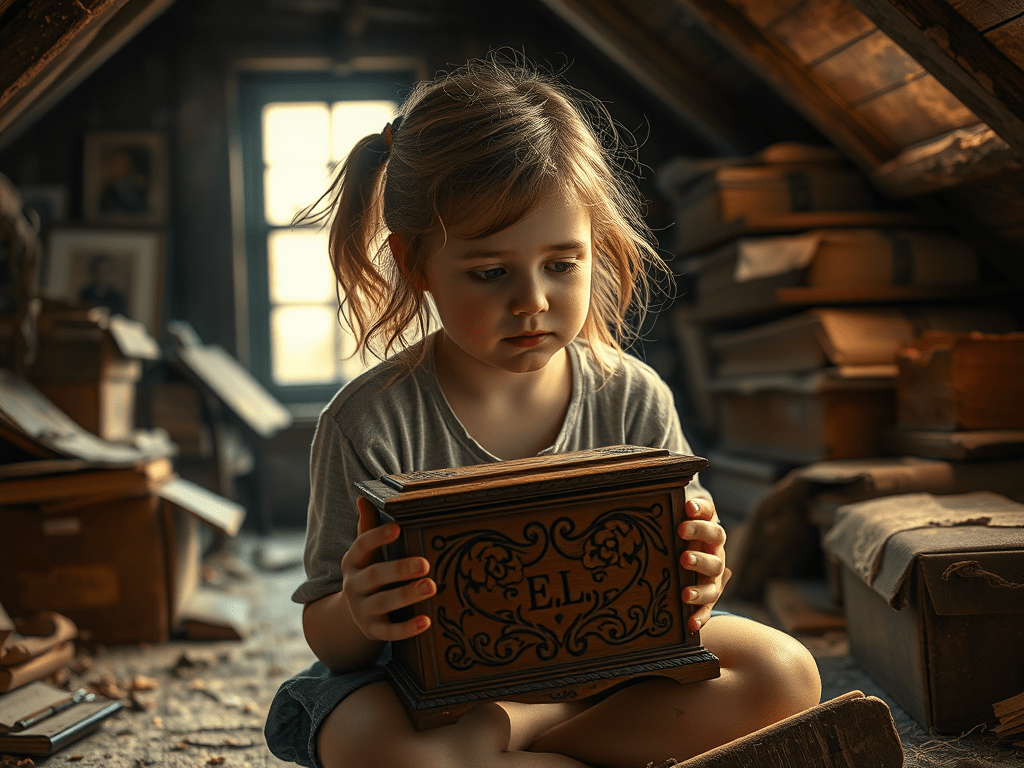
The attic was dusty and dimly lit, its air thick with the smell of aged wood and mothballs. As Sophie sifted through boxes of old photographs and yellowed books, she stumbled upon a small, ornately carved wooden box tucked beneath a pile of blankets. Curious, she pulled it out and brushed off the dust.
It was a music box, intricately decorated with floral patterns and tiny, engraved initials: E.L. Sophie’s fingers traced the letters as she wondered what they stood for. She turned the tiny crank on the side, and a soft, melodic tune began to play.
The sound was mesmerizing, delicate yet powerful, and it carried through the house. Before Sophie knew it, her father appeared at the attic door. “What’s that?” he asked, his tone softer than usual.
“I found it up here,” Sophie replied. “It plays this beautiful song.”
Her father stepped closer, his eyes widening as he recognized the music. “That’s… that’s the tune Grandma used to hum when she was baking cookies.” His voice cracked slightly, and for a moment, the tension between them seemed to dissolve.
Soon, Sophie’s mother and older brother appeared, drawn by the melody. “I haven’t heard that song in years,” her mother said, her eyes misty. “Eleanor used to play it every Christmas when we decorated the tree.”
The family gathered around Sophie as she wound the crank again. The music filled the room, bringing a bittersweet comfort that none of them had felt since Eleanor’s passing. They sat down together, the music box resting between them like a tiny beacon of light.
“I wonder where this came from,” Sophie mused aloud.
Her father smiled faintly. “Let’s find out.”
Uncovering the History
The next few days were spent piecing together the story of the music box. Old photo albums revealed pictures of Grandma Eleanor as a young woman, often with the box by her side. In one photo, she was holding it on her wedding day. Another showed her playing it for her children, including Sophie’s dad.
A letter tucked into an old diary revealed that the music box had been a gift from Eleanor’s mother, passed down through generations. The initials E.L. stood for Eleanor’s maiden name, Eleanor Larkins.
As the family delved into the history, they discovered more about Eleanor’s life—her dreams, her struggles, and her love for music. They learned that she had once dreamed of becoming a pianist but gave it up to raise her family. The music box had been her way of keeping music alive in her heart.
A New Tradition
Inspired by their discovery, the Pattersons decided to honor Grandma Eleanor’s memory by sharing her music. That Christmas, they played the music box as they decorated the tree, just as Eleanor had done. They laughed, reminisced, and, for the first time in months, felt like a family again.
The music box became a symbol of unity and healing. It reminded them that despite their differences, they were bound by shared memories and the love Eleanor had instilled in them. They even started a new tradition: every family gathering began with someone winding the music box and playing its tune.
Years later, when Sophie was grown with children of her own, the music box found a place in her home. She would wind it for her kids, telling them stories of their great-grandma Eleanor and the way a forgotten treasure had brought their family back together.
The melody of the music box continued to play, echoing through generations, a testament to the power of love, memory, and the little things that bind us all.
A Birthday for Everyone
Nine-year-old Mia loved birthdays. The balloons, the cake, the streamers—it was all magical to her. So, she was shocked one day when her elderly neighbor, Mr. Horace, mentioned he had never celebrated a birthday.
“Not even once?” Mia asked, her big brown eyes wide with disbelief.
Mr. Horace chuckled softly, leaning on his cane. “Nope. Growing up, my family didn’t have much. And as I got older, well… life got busy. Birthdays just weren’t a priority.”
Mia couldn’t imagine such a thing. To her, birthdays were a celebration of life, a way to remind people how special they were. The thought of someone going their whole life without that kind of joy made her heart ache.
That evening, Mia decided to fix things. She was going to throw Mr. Horace his very first birthday party—whether it was his actual birthday or not.
The Plan
The next morning, Mia recruited her best friend, Liam, to help. Together, they brainstormed ideas in Mia’s treehouse.
“We’ll need balloons, streamers, and a big cake!” Mia declared, scribbling on her notepad.
“And a gift!” Liam added. “Something he’ll really like.”
Mia nodded. They didn’t have much money, but she was sure they could figure it out. She started by asking her mom for help with the cake. “We can bake it together,” her mom said, smiling at Mia’s enthusiasm.
Next, Mia and Liam visited their neighbors, explaining the plan. Everyone was eager to help. Mrs. Carter offered to bring chairs, the Ramirez twins promised to make decorations, and Mr. Patel volunteered to bring his ukulele for music.
The Surprise
On the day of the party, Mia and her crew worked tirelessly in Mr. Horace’s backyard while he was at his weekly bingo game. They hung colorful streamers, set up tables with bright tablecloths, and placed a stack of presents on a makeshift gift table.
The centerpiece was the cake Mia and her mom had baked—a towering chocolate cake with “Happy Birthday, Mr. Horace!” written in bright blue frosting.
When everything was ready, Mia and Liam ran to the bingo hall to bring Mr. Horace home. “You need to come with us!” Mia said, tugging his hand. “It’s important!”
Mr. Horace raised an eyebrow, clearly confused, but let himself be guided back to his house. As they rounded the corner to his backyard, the crowd of neighbors shouted, “Surprise!”
Mr. Horace froze, his eyes wide as he took in the decorations, the cake, and the beaming faces of his neighbors. “What… what is all this?”
“It’s your birthday party!” Mia said, practically bouncing with excitement. “Your first one ever!”
Tears glistened in Mr. Horace’s eyes as he looked at the crowd. “But it’s not my birthday.”
Mia grinned. “It doesn’t matter! Everyone deserves to have a birthday party.”
A Birthday to Remember
The party was a huge success. Mr. Horace laughed harder than he had in years as he opened gifts, including a hand-knitted scarf from Mrs. Carter and a scrapbook filled with photos of his garden from Mia and Liam.
When it was time to cut the cake, the neighbors sang “Happy Birthday” so loudly that it echoed down the street. Mr. Horace blew out the candles, his hands shaking with emotion. “I don’t know what to say,” he whispered. “This is the kindest thing anyone has ever done for me.”
As the sun set and the party wound down, Mr. Horace pulled Mia aside. “You’re a special girl, you know that? You didn’t just give me a birthday. You reminded me that I’m surrounded by people who care.”
Mia hugged him tightly. “You deserve it, Mr. Horace. Everyone does.”
That night, as Mia lay in bed, she thought about how one simple idea had brought so much joy. Birthdays, she realized, weren’t just about balloons and cake—they were about making people feel loved.
From that day on, Mr. Horace became a regular at every birthday party in the neighborhood, always bringing his famous apple pie and his bright, heartfelt smile. And every year, on a random summer day, the neighbors would throw another “birthday” for him, because, as Mia always said, “A birthday isn’t about the date—it’s about the love.”