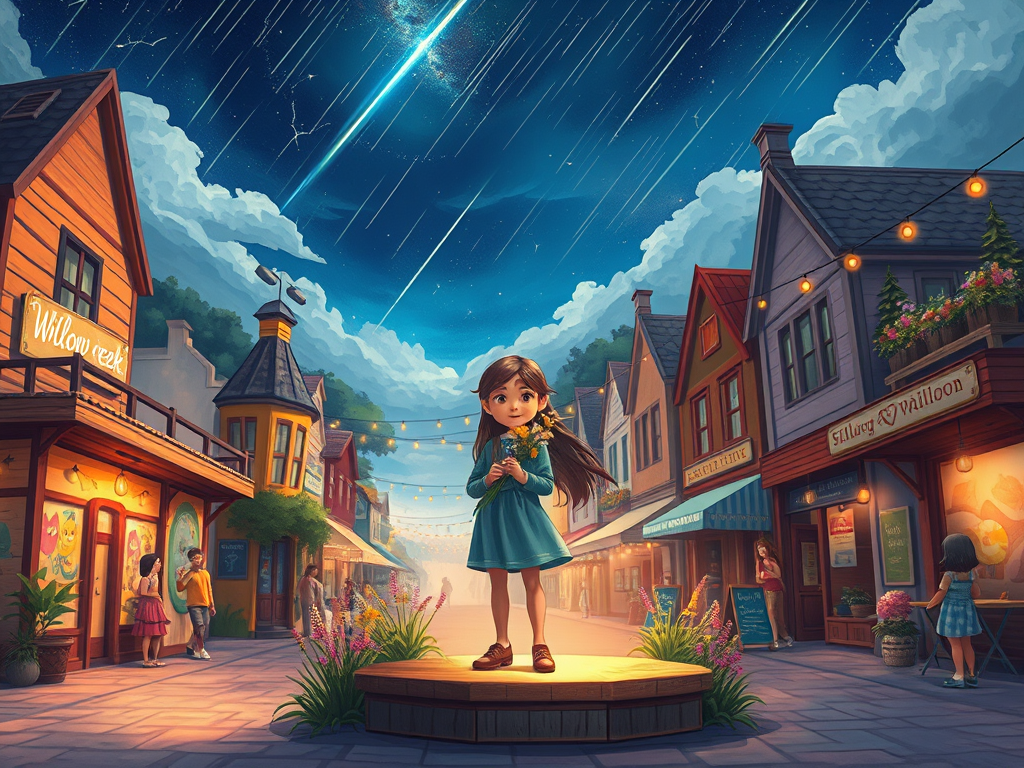
The Wish That Grew

The town of Willow Creek had seen better days. Once a thriving community, its factory had closed down a decade ago, leaving many out of work. The streets were quieter, the storefronts emptier, and hope seemed as distant as the stars.

But for ten-year-old Mia Harper, the world was still full of wonder. She spent her days exploring the fields near her house, collecting shiny pebbles, and dreaming of brighter days.

One summer evening, as the town prepared for an unusually brilliant meteor shower, Mia’s mother, a waitress at the town diner, took her to the park. The sky was a deep indigo, and the first streaks of light danced across the heavens.

“Make a wish, Mia,” her mother said, leaning close.

Mia clasped her hands together and squeezed her eyes shut. Her lips moved silently as she whispered a single wish:
“I wish for Willow Creek to feel happy again.”

The First Spark

The next morning, Mia found an envelope on their front porch. It had no name, just the words: “For Something Beautiful.” Inside was a $20 bill.

“Mama, look!” she exclaimed, running into the kitchen.

Her mother was just as surprised. “Who would leave this here?”

Mia didn’t know, but she had an idea. “Let’s do something good with it,” she said.

Her mother agreed, and together they bought a packet of wildflower seeds. They spent the afternoon sprinkling them in the bare patch of land outside the diner.

A Garden of Hope

Over the next few weeks, something magical happened. The flowers began to grow, bringing splashes of vibrant color to the gray, cracked soil. Customers at the diner noticed and smiled as they passed.

One day, old Mr. Thompson, who owned the hardware store, stopped by to admire the blooms. “This place needs more of that,” he said, tipping his hat.

The next morning, he left a box of paint and brushes outside the diner. “For Something Beautiful,” the note read.

Inspired, the townsfolk started painting murals on the sides of buildings. Bright flowers, cheerful suns, and even a giant rainbow soon adorned Willow Creek’s streets.

A Ripple of Kindness

Mia’s simple act sparked a chain reaction. Mrs. Carter, who ran the bookstore, decided to host a free story hour for kids every Saturday. The town librarian started a seed exchange program, encouraging residents to grow their own gardens.

Even the mayor got involved, organizing a town cleanup day. “If we’re going to bring back Willow Creek,” he said, “we need to start with pride.”

For the first time in years, laughter and chatter filled the town square.

The Meteor Shower Festival

As summer turned to fall, the town decided to hold a festival to celebrate their progress. They called it the Meteor Shower Festival, in honor of the night that had started it all.

Mia was invited to speak at the event. Nervous but excited, she stood on a small stage in the town square, a bouquet of wildflowers in her hands.

“I made a wish that night,” she said, her voice clear and bright. “I wished for Willow Creek to feel happy again. But it wasn’t the wish that made it happen—it was all of you. Together, we turned this town into something beautiful.”

The crowd erupted in cheers and applause.

A Wish Fulfilled

By the next year, Willow Creek was unrecognizable. New businesses opened, tourists came to see the murals, and the gardens flourished. The spirit of the town had returned, thanks to a little girl’s wish and the kindness it inspired.

And every summer, during the Meteor Shower Festival, the people of Willow Creek looked to the stars—not to make new wishes, but to celebrate the one that had already come true.

Sunshine Letters

In the quaint little town of Meadowbrook, nestled between rolling hills and golden fields, life moved at a slower, simpler pace. But even the picturesque charm of the town couldn’t shield it from hardship. The local factory, the heart of Meadowbrook’s economy, had recently closed, and the town was cloaked in an air of gloom.

Twelve-year-old Clara watched this change unfold from the window of her small bedroom. She noticed her once-chatty neighbors walking with heads bowed, shopkeepers with weary smiles, and even her parents whispering worriedly at the kitchen table. The warmth of the town felt like it had been snuffed out, and it weighed heavily on Clara’s heart.

One gray morning, while rummaging through a box of old belongings in the attic, Clara found a stack of letters tied together with a faded yellow ribbon. The letters were from her grandmother, who had passed away the previous year, addressed to Clara’s mother during her college years.

As Clara read through them, she felt something she hadn’t felt in weeks—a spark of hope. Each letter was filled with words of encouragement, funny anecdotes, and little doodles that made her smile. Her grandmother had called them her “Sunshine Letters” because they were meant to brighten dark days.

Clara had an idea.

That night, armed with colorful stationery and her favorite pens, she began writing her own Sunshine Letters. She crafted messages like, “You’re stronger than you think!” and “A tough day is just a stepping stone to a brighter tomorrow!” She added little drawings of flowers, sunshine, and animals to make them cheerful. She signed each one, “A friend who cares.”

The next morning, Clara slipped out of the house early and began leaving the letters in unexpected places: tucked under windshield wipers, slipped into mailboxes, and taped to shop windows.

At first, she wasn’t sure if anyone would even notice. But by the end of the week, the letters had started to work their magic.

Mrs. Benson, the florist, found a letter on her shop door and put it in her display window with a sign that read, “Whoever you are, thank you!” Mr. Grady, the retired school principal, received one in his mailbox and read it aloud at the diner, declaring it “the best surprise I’ve had in years.” People began sharing their letters with neighbors, displaying them on fridges, and even passing them along to others.

Curiosity about the mysterious writer grew. Meadowbrook’s newspaper ran a front-page story titled, “Who’s Behind the Sunshine Letters?” Townsfolk began calling them “the little rays of hope” that were bringing Meadowbrook back to life.

Clara remained anonymous, but she noticed the change. The postman smiled again. The grocer hummed while stocking shelves. Her parents’ whispers at the kitchen table became conversations filled with laughter.

One evening, Clara’s mother came home with a Sunshine Letter she had found at work. “Whoever is doing this,” she said, holding the letter to her chest, “they’ve reminded me that there’s still good in the world.”

Clara’s heart swelled with pride, but she just smiled and said, “I think they’re pretty special too.”

As weeks turned into months, the factory reopened, and the town’s economy began to recover. But the spirit of the Sunshine Letters remained. People started writing their own notes of encouragement and passing them on. Acts of kindness multiplied, turning Meadowbrook into a town not just of golden fields but golden hearts.

Clara kept her secret, content knowing she had sparked something bigger than herself. One evening, as she slipped another letter into a neighbor’s mailbox, she looked up at the stars and whispered, “Thank you, Grandma. Your Sunshine Letters worked wonders, just like you said they would.”

The Afterlife Machine: II. The Discovery

The laboratory was bathed in an eerie silence as Emily’s trembling hand hovered over the activation switch. Her team of scientists and engineers watched with bated breath, their faces a mixture of excitement and apprehension. This was the moment they had been working towards for years, the culmination of their efforts to breach the ultimate frontier.

With a deep breath, Emily depressed the switch, and the machine rumbled to life, its intricate array of circuits and quantum processors humming with energy. At first, there was nothing but the whir of the machinery, and Emily felt a sinking sensation in the pit of her stomach. Had they failed once again?

But then, a faint crackle of static emanated from the machine’s speakers, and a disembodied voice began to take shape amidst the white noise.

“M…Mom…my?”

Emily’s heart nearly stopped. That voice, so soft and childlike, sent shockwaves through her very being. It couldn’t be…

“Sarah?” she whispered, her voice thick with emotion. “Sarah, is that you?”

The voice grew stronger, more coherent. “Mommy, I’m here. I’ve missed you so much.”

Tears streamed down Emily’s cheeks as she fell to her knees, overcome by the weight of this impossible moment. Her little girl, her precious Sarah, was speaking to her from beyond the grave.

For the next few hours, Emily and her daughter conversed as if no veil had ever separated them. Sarah described the wondrous afterlife, a realm of pure consciousness and boundless love. She reassured her mother that she was at peace and watching over her always.

The rest of the team could scarcely believe their senses. They had achieved the impossible, shattered the boundaries of what science deemed possible. The dead could commune with the living once more.

As the euphoria of that first contact began to fade, however, Emily detected a subtle shift in her daughter’s tone. Sarah’s words took on an unsettling quality, hints of darkness and warning that sent chills down Emily’s spine.

“You shouldn’t have opened the door, Mommy,” Sarah’s voice echoed. “There are others here, waiting to come through. They won’t be as nice as me.”

A knot formed in the pit of Emily’s stomach as an ominous silence descended upon the room. She opened her mouth to respond, but Sarah’s voice had already faded, leaving only static in its wake.

The scientists exchanged uneasy glances, their initial exhilaration giving way to a creeping sense of dread. What did Sarah mean by “others” waiting to come through? And why did she sound…afraid?

Before anyone could voice their concerns, the machine’s speakers crackled back to life, this time with a deep, rasping utterance that chilled them to their core.

“Free…finally free…”

The voice was like nails on a chalkboard, devoid of any warmth or familiarity. It seemed to emanate from everywhere and nowhere at once, surrounding them with its grating menace.

“Who…who are you?” Emily mustered, her throat constricting with fear.

A low, rumbling laughter reverberated from the speakers. “You think you can peer into the abyss without consequences? You have opened a door that should have remained sealed, foolish mortals.”

One of the lab assistants let out a terrified yelp as a burst of sparks erupted from the machine’s console. The lights flickered wildly as the entity’s malevolent presence seemed to saturate the very air around them.

“No force in this world or the next can shut me out now. I shall walk among you, a harbinger of your undoing!”

The voice descended into a guttural roar that shook the foundations of the lab. Several monitors shattered, raining shards of glass in all directions. Emily threw her arms up to shield herself, panic and revulsion gripping her body.

As abruptly as the chaos had erupted, it ceased, leaving a deafening silence. The backup generators kicked in, bathing the ravaged lab in crimson emergency lighting.

Emily slowly lowered her arms, her team huddled together in shocked terror. Their incredible breakthrough, their gateway to the afterlife, had been flung wide open.

And something…ancient and evil had answered their call.