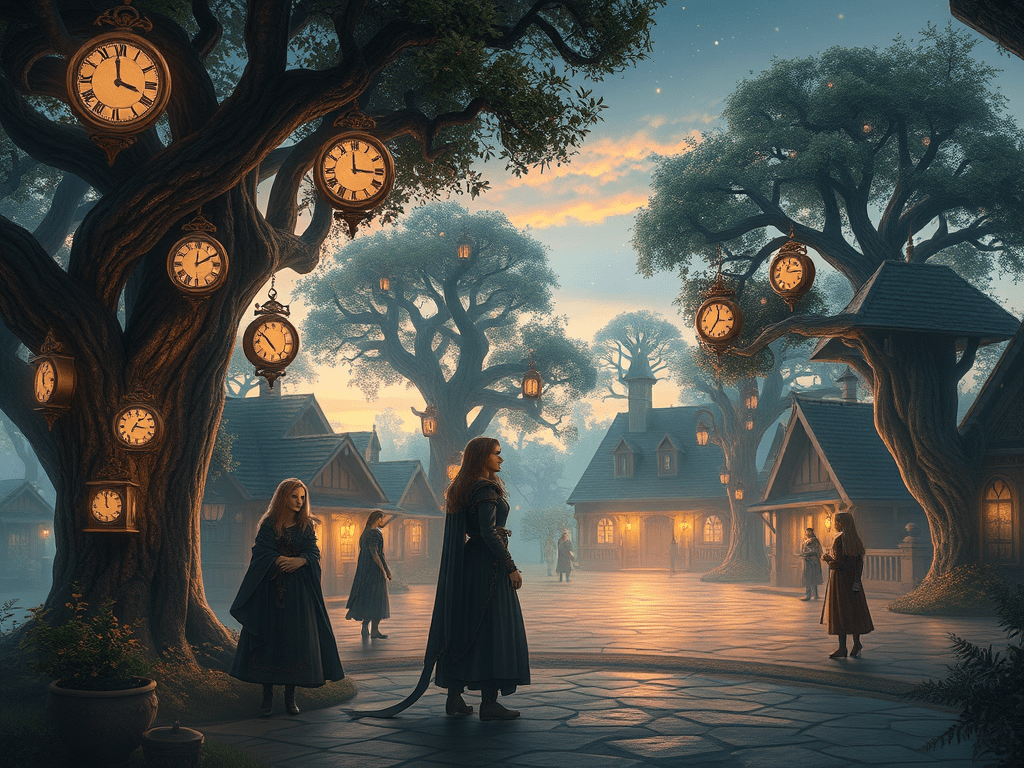
In the quaint village of Arborhollow, time itself seemed to dance to a rhythm few could understand. People spoke of an enigma lurking in their midst, a mysterious force that feasted on moments unguarded. When the sun dipped behind the verdant hills, Lorelei, the village seamstress, found her afternoons swallowed by a peculiar fog. As she threaded her needle one evening, she felt a warm drowsiness creep over her, and suddenly, the dusk was replaced by the starlit night. The clock on the mantle chimed slowly, mockingly echoing the hollow loss.
Lorelei wasn’t alone. The village baker, Thoran, often stirred his bread dough in half-lucidity under the morning sun, only to later discover his hands kneading flour under the glow of the moon instead. And Agnes, the local teacher, would blink away dreams to find entire hours of her lessons vanished with the setting or rising sun.
The villagers suspected their anticipation and fears were being siphoned. Lorelei fretted about wedding dresses, Thoran perspired over perfect batches, and Agnes pondered curriculum changes – each trapped in cycles of worry or expectation.
Determined to confront this spectral thief, Lorelei, Thoran, and Agnes allied in the village square. Here, Lorelei spoke of an ancient tale told by her grandmother – a specter named Chrono, the Wellspring Keeper, nourished by hidden moments within human hearts.
Compelled to reclaim their seized hours, they resolved to meet Chrono. With blossoms plucked from the vernal heart of Arborhollow, they laid a trail leading to the glen the invisibles often whispered about. As twilight descended, it wrapped around them like a muslin cloak, guiding them to a grove fluttering with countless clocks hanging from the boughs of ageless trees.
Chrono awaited, not as a villain, but a being caught in the perpetual swing of an ethereal pendulum. “Time is no enemy,” said Chrono, his voice like the rustling leaves. “You give it willingly through expectations and reticence.”
Lorelei stepped forward, heart emboldened. “How can we stop it?” she asked.
“Live completely in moments,” replied Chrono. “Cease to divide your dreams between fear and hope.”
Nodding, they each surrendered a trinket – Lorelei her thimble, Thoran a wooden spoon, and Agnes a chalk nub. In return, Chrono opened his hands, and the sky above rained down a kaleidoscope of glimpses lost and dreams untethered.
Returning to Arborhollow, they practiced new rituals: the pliancy of mind in the dawn chorus for Agnes, the tactile meditation in Thoran’s dough, and the tactile composition of satin in Lorelei’s fingers. They embraced the symphony of the present, each stolen hour returning to the tapestry of their lives as a thread woven in harmonious vibrancy.
The village thrived as whispers of lost time melted into myth, a folktale sung around autumn bonfires by descendants who had long since forgotten fear of time’s theft.
Tag: writing
Letters Across Generations
In the corner of the attic, behind stacks of old photo albums and dusty boxes, ten-year-old Lily stumbled upon a treasure she never expected: a wooden chest with a faded brass latch. It wasn’t particularly large or ornate, but it radiated a quiet sense of importance.
“What’s this?” Lily asked aloud, brushing cobwebs from the lid.
Her mother, who had been sorting through old blankets nearby, glanced over and smiled. “Oh, that’s Grandma and Grandpa’s letter box. I haven’t seen it in years.”
“Letter box?” Lily repeated, her curiosity piqued.
“Your grandparents used to write letters to each other all the time. They kept them in that box.”
Lily carefully opened the chest, the creak of the hinges adding to the mystery. Inside were bundles of letters, tied with ribbons of varying colors—some pink, some blue, and some golden yellow. The air seemed to hum with the stories tucked inside each envelope.
“Can I read them?” she asked hesitantly.
Her mother paused before nodding. “Just be gentle. There’s a lot of history in those letters.”
The First Letter
Lily picked a pink ribbon bundle and untied it, revealing delicate handwriting on cream-colored paper. The first letter was from Grandma, written decades ago when she and Grandpa were still dating.
“Dear John,
The garden is in full bloom today, and I thought of you when I saw the daisies. I can’t wait until you come home next month. It feels like forever since I’ve heard your laugh in person. Until then, I’ll keep writing and dreaming of the adventures we’ll share…”
Lily read the letter aloud, her voice soft with wonder. “Grandpa loved daisies?”
Her mom smiled. “He did. Grandma used to plant them every spring because they were his favorite flower.”
The letters weren’t just words on a page—they were windows into her grandparents’ lives, filled with hopes, challenges, and the small joys of everyday love.
A Story Unfolds
Over the next few weeks, Lily became captivated by the letters. She learned about her grandparents’ long-distance relationship while Grandpa was serving in the military, the way they supported each other through tough times, and their shared dreams of building a family together.
Some letters were lighthearted, filled with jokes and silly doodles. Others were deeply emotional, like the one Grandma wrote after her first miscarriage, expressing her grief and hope for the future.
Lily felt like she was meeting her grandparents in a whole new way—not just as “Grandma and Grandpa,” but as young people with dreams, fears, and an unshakable bond.
The Letter That Changed Everything
One evening, Lily came across a letter with a golden ribbon. The handwriting was shaky but familiar—it was from Grandpa, written shortly before he passed away.
“My dearest Rose,
As I sit here, the sun setting outside our window, I can’t help but think about all the sunsets we’ve watched together. I’ve lived a good life because you were in it. I hope one day our grandchildren will know how much love we shared, and how important it is to keep that love alive—through words, actions, and memories…”
Tears welled in Lily’s eyes as she finished the letter. She understood now why her grandparents had saved these letters. They were more than just pieces of paper; they were a legacy of love and communication that spanned decades.
A New Tradition
Inspired, Lily decided to start writing letters of her own. She wrote to her mom, thanking her for always being there. She wrote to her older brother, who was away at college, telling him she missed their silly games. She even wrote a letter to herself, promising to always value the people in her life.
Her mom noticed the change. “You’ve been writing a lot lately,” she said with a smile.
Lily nodded. “Grandma and Grandpa showed me how important it is to tell people how you feel. I think it’s something we should all do.”
Her mom hugged her tightly. “I think they’d be proud of you, Lily.”
Carrying the Legacy Forward
The letter box was moved to a special place in the living room, where it became a centerpiece of family gatherings. On holidays, Lily’s family would read one or two letters aloud, sharing laughter and tears as they connected with the past.
Years later, when Lily had children of her own, she showed them the letter box and told them about the love story that had shaped their family. She encouraged them to write their own letters, passing down not just the tradition but the lesson that words—thoughtful, heartfelt words—can bridge generations and keep love alive.
And somewhere, Lily imagined, Grandma and Grandpa were smiling, knowing their legacy lived on in every carefully chosen word.
The Family Legacy Treehouse
The old oak tree stood at the edge of the Taylor family’s backyard, its branches reaching out like arms ready to embrace the sky. Nestled within its sturdy limbs was the treehouse that Grandpa Henry had built decades ago. Though time had weathered its wooden planks and the paint had long faded, it still held the magic of countless childhood adventures.
“It’s not safe to climb anymore,” Dad said one day as he glanced up at the sagging structure. “I’m surprised it’s still standing.”
“That’s because Grandpa built it,” 12-year-old Emma declared proudly. “He always said it was made to last.”
Her older brother, Nate, rolled his eyes. “Yeah, but even Grandpa didn’t expect it to last forever. It’s falling apart.”
Emma frowned, but an idea was already forming in her mind. She tugged on Nate’s sleeve. “What if we fix it? You and me.”
Nate hesitated. “That thing’s a lost cause, Emma.”
But their dad, overhearing the conversation, chimed in. “Maybe it’s not such a bad idea. We could make it a family project.”
Emma’s eyes lit up. “Let’s do it!”
Dusting Off the Memories
The next weekend, the entire family gathered under the oak tree. Armed with gloves, flashlights, and a ladder, they climbed up to survey the damage. The floorboards creaked ominously, and one corner of the roof was missing. But the frame—the bones of the treehouse—was as sturdy as the day Grandpa Henry had built it.
In the back of the garage, they found Grandpa’s old toolbox, still covered in sawdust. Inside were some of the tools he’d used to build the treehouse, along with a yellowed notebook filled with sketches and handwritten notes.
“Look at this,” Dad said, holding up the notebook. “It’s like a blueprint for the treehouse. Grandpa planned everything.”
Emma traced her fingers over the faded pages. “It’s like he’s helping us from the past.”
Building Together
Restoring the treehouse became a weekend ritual. Nate and Dad focused on the structural repairs, replacing rotting wood and reinforcing the beams. Emma and Mom painted the walls, choosing a bright green to match the leaves of the oak tree.
At first, it wasn’t easy. Nate and Emma bickered over everything—from the choice of paint color to who got to hammer the nails. But as the weeks passed, the work brought them closer. Nate taught Emma how to use a power drill, and Emma teased Nate about his shaky painting skills.
One day, while sanding down the railings, Nate found something carved into the wood: “H.T. 1965.”
“It’s Grandpa’s initials,” Nate said. “He must’ve carved them when he finished the treehouse.”
Emma smiled. “Let’s add ours when we’re done.”
Discovering Grandpa’s Legacy
As they worked, they discovered pieces of Grandpa Henry’s life tucked away in the treehouse. A rusted tin box under the floorboards held faded photos of him as a young man, grinning with tools in hand. There was a postcard from Grandma, sent before they were married, and a small wooden figurine Grandpa had carved.
“Grandpa put so much of himself into this treehouse,” Mom said, holding the figurine. “It wasn’t just a place to play. It was a gift of love.”
Emma thought about all the stories Grandpa had told her about the treehouse—how he’d built it for her dad and uncles, how it was the setting for pirate adventures and campouts under the stars. Restoring it felt like keeping those stories alive.
A New Beginning
After weeks of hard work, the treehouse was transformed. The bright green paint glowed against the backdrop of the oak leaves. Inside, they’d added a new carpet, shelves for books and toys, and even fairy lights that twinkled like stars at night.
On the final day, the family gathered around to celebrate. Emma handed Nate a pocketknife. “It’s time to add our initials,” she said.
Together, they carved “E.T. & N.T. 2024” next to Grandpa’s initials. Dad added his own, along with Mom’s. When they stepped back, the wood was filled with generations of Taylor family marks, each one telling a story.
As the sun set, Emma and Nate climbed into the treehouse and looked out over the backyard. “This was a good idea,” Nate admitted.
Emma grinned. “Told you so.”
Carrying the Legacy Forward
The restored treehouse became more than just a place to play. It was a reminder of Grandpa Henry’s love, the importance of family, and the power of working together.
Emma started a journal she kept in the treehouse, encouraging everyone to write down their memories. By the end of the summer, it was filled with stories—of quiet moments, silly games, and dreams for the future.
Years later, the treehouse remained a cherished part of the Taylor home. And when Emma’s own children climbed its sturdy ladder for the first time, she smiled, knowing they were stepping into a legacy of love that would never fade.
The Restaurant That Gave Back
The Cozy Plate had always been a staple of the small town of Meadowbrook. It wasn’t fancy, but it was known for hearty meals, warm smiles, and the best apple pie for miles. But times were tough, and business had slowed.
Samantha “Sam” Rivers, who inherited the diner from her mother, sat in the empty dining room one evening, staring at the stack of unpaid bills on the counter. She sighed, her heart heavy. She couldn’t bear the thought of closing the diner—it wasn’t just a business; it was a piece of the town’s soul.
As she sat there, lost in thought, the jingling of the bell above the door pulled her from her worries. A man walked in, his clothes worn and his face weathered. “Sorry, ma’am,” he said hesitantly. “I don’t have much, but I’m real hungry. Could I maybe work for a meal?”
Sam blinked, her mother’s words echoing in her mind: “No one should ever leave this place hungry.” She stood up, a determined smile forming on her face. “You don’t have to work. Sit down, and I’ll get you something.”
The man’s gratitude was written all over his face as he devoured the warm bowl of chili and cornbread she placed before him. Watching him, Sam had an idea.
A New Way Forward
The next morning, Sam made a sign and hung it in the front window:
“Pay What You Can. No One Goes Hungry.”
Her employees were skeptical. “Are you sure about this, Sam?” asked Maria, the cook. “We’re already struggling to make ends meet.”
Sam nodded. “We’ve been struggling anyway. This way, at least we’re helping people.”
Word spread quickly. At first, a few hesitant customers trickled in—families down on their luck, college students on tight budgets, and senior citizens living on fixed incomes. Each was met with kindness and a meal, no questions asked.
But something surprising happened. Customers who could pay started leaving extra. A man ordered a cup of coffee and left a $50 bill, saying, “Pay for the next few meals.” A local bakery donated fresh bread. Farmers brought in surplus produce. Even the town’s small grocery store pitched in with a monthly donation of ingredients.
The Heart of the Town
Soon, The Cozy Plate wasn’t just a diner—it was a community hub. People came not just to eat but to connect. Regulars helped serve meals. Children drew “thank you” pictures to hang on the walls. Musicians played in the evenings for free, adding to the welcoming atmosphere.
One day, Sam received a letter in the mail. It was from a woman who had visited months earlier with her two children. Enclosed was a check for $500. The letter read:
“When I came to your diner, I had nothing. Your kindness gave me hope. Now that I’m back on my feet, I want to give back. Thank you for believing in people.”
Sam wiped tears from her eyes, her resolve stronger than ever.
A Ripple Effect
The Cozy Plate’s success caught the attention of a local newspaper, which wrote a feature story about the “pay-what-you-can” diner. Donations and support poured in from neighboring towns. Inspired by Sam’s model, other restaurants began adopting similar practices.
Sam often marveled at how the diner had changed. It wasn’t just about food anymore—it was about dignity, hope, and the power of community. The Cozy Plate was thriving, not in wealth but in purpose.
A Legacy of Kindness
Years later, when Sam handed the keys to the diner to her daughter, she shared the same advice her mother had given her: “No one should ever leave this place hungry.”
The Cozy Plate remained a beacon of compassion, proving that a simple meal served with love could transform not just lives but an entire town.
The Music Box
The Patterson family home had been in disarray ever since Grandma Eleanor passed away. The once warm and bustling house had grown silent, with family members speaking only when necessary and often at odds when they did. It wasn’t just grief dividing them—it was disagreements over what to do with the old house, the belongings, and the memories tied to them.
One dreary Saturday afternoon, twelve-year-old Sophie found herself alone in the attic. Her parents had tasked her with sorting through boxes to “help with the cleanup.” She wasn’t thrilled, but anything was better than listening to another argument downstairs.
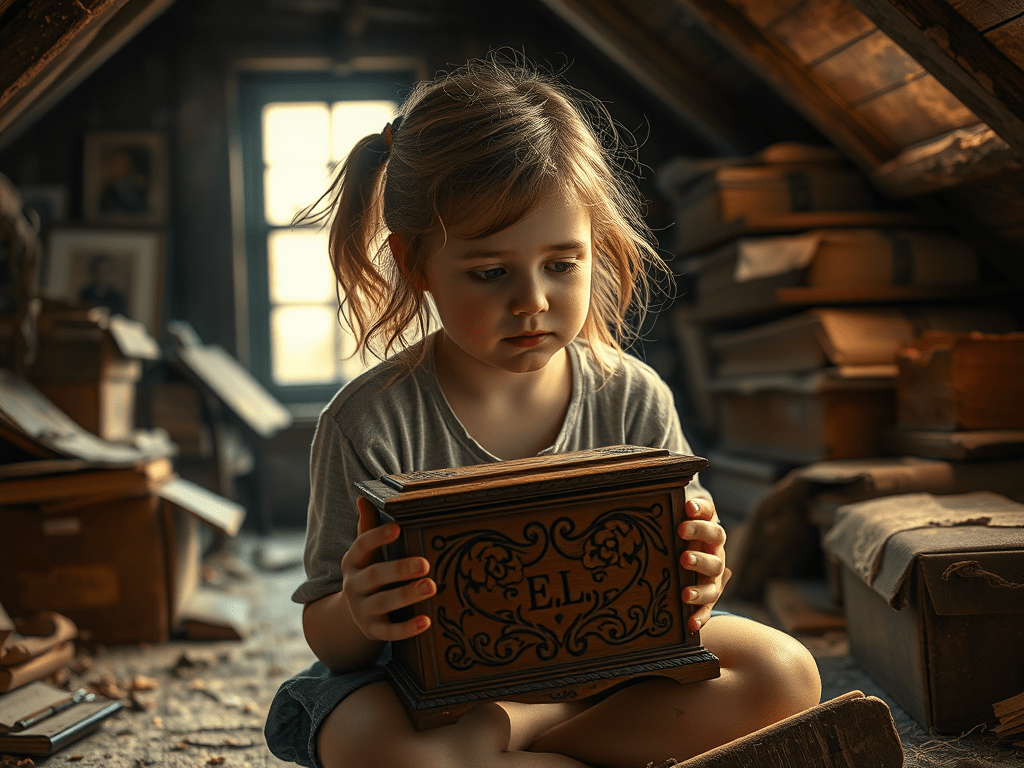
The attic was dusty and dimly lit, its air thick with the smell of aged wood and mothballs. As Sophie sifted through boxes of old photographs and yellowed books, she stumbled upon a small, ornately carved wooden box tucked beneath a pile of blankets. Curious, she pulled it out and brushed off the dust.
It was a music box, intricately decorated with floral patterns and tiny, engraved initials: E.L. Sophie’s fingers traced the letters as she wondered what they stood for. She turned the tiny crank on the side, and a soft, melodic tune began to play.
The sound was mesmerizing, delicate yet powerful, and it carried through the house. Before Sophie knew it, her father appeared at the attic door. “What’s that?” he asked, his tone softer than usual.
“I found it up here,” Sophie replied. “It plays this beautiful song.”
Her father stepped closer, his eyes widening as he recognized the music. “That’s… that’s the tune Grandma used to hum when she was baking cookies.” His voice cracked slightly, and for a moment, the tension between them seemed to dissolve.
Soon, Sophie’s mother and older brother appeared, drawn by the melody. “I haven’t heard that song in years,” her mother said, her eyes misty. “Eleanor used to play it every Christmas when we decorated the tree.”
The family gathered around Sophie as she wound the crank again. The music filled the room, bringing a bittersweet comfort that none of them had felt since Eleanor’s passing. They sat down together, the music box resting between them like a tiny beacon of light.
“I wonder where this came from,” Sophie mused aloud.
Her father smiled faintly. “Let’s find out.”
Uncovering the History
The next few days were spent piecing together the story of the music box. Old photo albums revealed pictures of Grandma Eleanor as a young woman, often with the box by her side. In one photo, she was holding it on her wedding day. Another showed her playing it for her children, including Sophie’s dad.
A letter tucked into an old diary revealed that the music box had been a gift from Eleanor’s mother, passed down through generations. The initials E.L. stood for Eleanor’s maiden name, Eleanor Larkins.
As the family delved into the history, they discovered more about Eleanor’s life—her dreams, her struggles, and her love for music. They learned that she had once dreamed of becoming a pianist but gave it up to raise her family. The music box had been her way of keeping music alive in her heart.
A New Tradition
Inspired by their discovery, the Pattersons decided to honor Grandma Eleanor’s memory by sharing her music. That Christmas, they played the music box as they decorated the tree, just as Eleanor had done. They laughed, reminisced, and, for the first time in months, felt like a family again.
The music box became a symbol of unity and healing. It reminded them that despite their differences, they were bound by shared memories and the love Eleanor had instilled in them. They even started a new tradition: every family gathering began with someone winding the music box and playing its tune.
Years later, when Sophie was grown with children of her own, the music box found a place in her home. She would wind it for her kids, telling them stories of their great-grandma Eleanor and the way a forgotten treasure had brought their family back together.
The melody of the music box continued to play, echoing through generations, a testament to the power of love, memory, and the little things that bind us all.
A Birthday for Everyone
Nine-year-old Mia loved birthdays. The balloons, the cake, the streamers—it was all magical to her. So, she was shocked one day when her elderly neighbor, Mr. Horace, mentioned he had never celebrated a birthday.
“Not even once?” Mia asked, her big brown eyes wide with disbelief.
Mr. Horace chuckled softly, leaning on his cane. “Nope. Growing up, my family didn’t have much. And as I got older, well… life got busy. Birthdays just weren’t a priority.”
Mia couldn’t imagine such a thing. To her, birthdays were a celebration of life, a way to remind people how special they were. The thought of someone going their whole life without that kind of joy made her heart ache.
That evening, Mia decided to fix things. She was going to throw Mr. Horace his very first birthday party—whether it was his actual birthday or not.
The Plan
The next morning, Mia recruited her best friend, Liam, to help. Together, they brainstormed ideas in Mia’s treehouse.
“We’ll need balloons, streamers, and a big cake!” Mia declared, scribbling on her notepad.
“And a gift!” Liam added. “Something he’ll really like.”
Mia nodded. They didn’t have much money, but she was sure they could figure it out. She started by asking her mom for help with the cake. “We can bake it together,” her mom said, smiling at Mia’s enthusiasm.
Next, Mia and Liam visited their neighbors, explaining the plan. Everyone was eager to help. Mrs. Carter offered to bring chairs, the Ramirez twins promised to make decorations, and Mr. Patel volunteered to bring his ukulele for music.
The Surprise
On the day of the party, Mia and her crew worked tirelessly in Mr. Horace’s backyard while he was at his weekly bingo game. They hung colorful streamers, set up tables with bright tablecloths, and placed a stack of presents on a makeshift gift table.
The centerpiece was the cake Mia and her mom had baked—a towering chocolate cake with “Happy Birthday, Mr. Horace!” written in bright blue frosting.
When everything was ready, Mia and Liam ran to the bingo hall to bring Mr. Horace home. “You need to come with us!” Mia said, tugging his hand. “It’s important!”
Mr. Horace raised an eyebrow, clearly confused, but let himself be guided back to his house. As they rounded the corner to his backyard, the crowd of neighbors shouted, “Surprise!”
Mr. Horace froze, his eyes wide as he took in the decorations, the cake, and the beaming faces of his neighbors. “What… what is all this?”
“It’s your birthday party!” Mia said, practically bouncing with excitement. “Your first one ever!”
Tears glistened in Mr. Horace’s eyes as he looked at the crowd. “But it’s not my birthday.”
Mia grinned. “It doesn’t matter! Everyone deserves to have a birthday party.”
A Birthday to Remember
The party was a huge success. Mr. Horace laughed harder than he had in years as he opened gifts, including a hand-knitted scarf from Mrs. Carter and a scrapbook filled with photos of his garden from Mia and Liam.
When it was time to cut the cake, the neighbors sang “Happy Birthday” so loudly that it echoed down the street. Mr. Horace blew out the candles, his hands shaking with emotion. “I don’t know what to say,” he whispered. “This is the kindest thing anyone has ever done for me.”
As the sun set and the party wound down, Mr. Horace pulled Mia aside. “You’re a special girl, you know that? You didn’t just give me a birthday. You reminded me that I’m surrounded by people who care.”
Mia hugged him tightly. “You deserve it, Mr. Horace. Everyone does.”
That night, as Mia lay in bed, she thought about how one simple idea had brought so much joy. Birthdays, she realized, weren’t just about balloons and cake—they were about making people feel loved.
From that day on, Mr. Horace became a regular at every birthday party in the neighborhood, always bringing his famous apple pie and his bright, heartfelt smile. And every year, on a random summer day, the neighbors would throw another “birthday” for him, because, as Mia always said, “A birthday isn’t about the date—it’s about the love.”
Sunshine Letters
In the quaint little town of Meadowbrook, nestled between rolling hills and golden fields, life moved at a slower, simpler pace. But even the picturesque charm of the town couldn’t shield it from hardship. The local factory, the heart of Meadowbrook’s economy, had recently closed, and the town was cloaked in an air of gloom.
Twelve-year-old Clara watched this change unfold from the window of her small bedroom. She noticed her once-chatty neighbors walking with heads bowed, shopkeepers with weary smiles, and even her parents whispering worriedly at the kitchen table. The warmth of the town felt like it had been snuffed out, and it weighed heavily on Clara’s heart.
One gray morning, while rummaging through a box of old belongings in the attic, Clara found a stack of letters tied together with a faded yellow ribbon. The letters were from her grandmother, who had passed away the previous year, addressed to Clara’s mother during her college years.
As Clara read through them, she felt something she hadn’t felt in weeks—a spark of hope. Each letter was filled with words of encouragement, funny anecdotes, and little doodles that made her smile. Her grandmother had called them her “Sunshine Letters” because they were meant to brighten dark days.
Clara had an idea.
That night, armed with colorful stationery and her favorite pens, she began writing her own Sunshine Letters. She crafted messages like, “You’re stronger than you think!” and “A tough day is just a stepping stone to a brighter tomorrow!” She added little drawings of flowers, sunshine, and animals to make them cheerful. She signed each one, “A friend who cares.”
The next morning, Clara slipped out of the house early and began leaving the letters in unexpected places: tucked under windshield wipers, slipped into mailboxes, and taped to shop windows.
At first, she wasn’t sure if anyone would even notice. But by the end of the week, the letters had started to work their magic.
Mrs. Benson, the florist, found a letter on her shop door and put it in her display window with a sign that read, “Whoever you are, thank you!” Mr. Grady, the retired school principal, received one in his mailbox and read it aloud at the diner, declaring it “the best surprise I’ve had in years.” People began sharing their letters with neighbors, displaying them on fridges, and even passing them along to others.
Curiosity about the mysterious writer grew. Meadowbrook’s newspaper ran a front-page story titled, “Who’s Behind the Sunshine Letters?” Townsfolk began calling them “the little rays of hope” that were bringing Meadowbrook back to life.
Clara remained anonymous, but she noticed the change. The postman smiled again. The grocer hummed while stocking shelves. Her parents’ whispers at the kitchen table became conversations filled with laughter.
One evening, Clara’s mother came home with a Sunshine Letter she had found at work. “Whoever is doing this,” she said, holding the letter to her chest, “they’ve reminded me that there’s still good in the world.”
Clara’s heart swelled with pride, but she just smiled and said, “I think they’re pretty special too.”
As weeks turned into months, the factory reopened, and the town’s economy began to recover. But the spirit of the Sunshine Letters remained. People started writing their own notes of encouragement and passing them on. Acts of kindness multiplied, turning Meadowbrook into a town not just of golden fields but golden hearts.
Clara kept her secret, content knowing she had sparked something bigger than herself. One evening, as she slipped another letter into a neighbor’s mailbox, she looked up at the stars and whispered, “Thank you, Grandma. Your Sunshine Letters worked wonders, just like you said they would.”
The Emotion Trade: VI. The Climax
In the aftermath of the uprising’s furious crescendo, an eerie hush descended over the shattered remains of the Emotion Traders’ sanctum. Psychic fires still smoldered amidst the rubble, casting flickering shadows across Alia and her battered Freefeeler warriors.
They stood in the epicenter of the empathic detonation, each of them scorched by the cataclysmic release of pure, unbridled emotion. Alia could feel the world itself still trembling, its collective consciousness forever altered.
A low rumble shook the debris field as a lone figure emerged – Alto Sonjü, the eldest and most powerful of the grandmasters. His robes smoldered with ethereal flames as he limped forward, face a rictus mask of profound agony and ecstasy intermingled.
“Foolish child…” he rasped, each word rattling with the weight of cosmic revelation. “Did you think your tantrum could possibly unmake what we have wrought?”
Alia braced herself, drawing what tattered reserves of power she could muster. Her body shifted as she channeled pure emotion into material form – adopting armored platings of crystallized anguish and ephemeral wings of sublime rapture.
“We have transcended such limited thinking,” Alto went on, seemingly unaffected by her metamorphic display. “While you and your emotional anarchists merely battered at the outer gates, we have opened the inner loci…”
With an ominous gesture, the grandmaster waved aside a bank of smoldering debris – revealing an archaic stone dais adorned with eldritch runes pulsing in unsettling synchrony. A disquieting sense of cosmic dissonance emanated from whatever profane working lay interred there.
“This…this was always the greater work,” Alto said, a terrible new resonance underlying his words. “The petty procurement and regulation of human emotion was merely the prologue, the means to an awakening far more profound.”
Alia felt a creeping sense of dread as Alto turned his gaze back towards the eldritch dais. The rest of the Freefeelers instinctively fell back, overwhelmed by the sheer cosmic enormity of whatever profane power was ensconced there.
“For too long, humanity has remained shackled by the limited perception of emotions as something to be pursued or experienced,” the grandmaster intoned. “We have been mere acolytes, groping blindly at the surface of a cosmic truth.”
He slowly ascended the obsidian steps, his movements taking on an unsettling fluidity as points of blinding luminescence began emerging across his form. Alia could sense the air itself distorting around him, bending to unknown geometries.
“Emotion is not the end…it is the key!” Alto’s voice took on a thunderous resonance that reverberated through every fiber of Alia’s being. “The full spectrum of human feeling is in reality a vastly attenuated frequency – our feeble reality vibrating at the absolute threshold of a deeper, infinite consciousness from which all possibility is born!”
As if in response, the rune-etched dais pulsed with blinding epiphanies of light, each one cascading through visible and invisible spectra. Alia cried out, clutching at her mind as it was bombarded by transcendent revelations beyond any perception of feeling or sensory input.
“For decades we have plotted and schemed, using the commodification of emotion itself as a distraction and vector,” Alto’s words echoed from both around and within Alia simultaneously. “All while we extracted the celestial formulae to achieve true apotheosis and re-write the codons of existence itself!”
A high, keening whine saturated the space as reality itself began to splinter and peel away like viscid layers. Alia watched in horror as Alto’s form nuclear at the subatomic level, his matter and energy unbinding in a coruscating implosion that defied physics. And from that nadir, new geometries and hyper-spatial manifolds began unfolding – twisted, alien realms never meant for human perspective.
“Behold, children!” Alto’s voice convulsed through every possible permutation as his psychic resonance achieved escape velocity from their narrow plane. “The threshold has been breached, and our transcendence is at hand! Now let us consummate this apotheosis and become…MORE!”
The Afterlife Machine: VI. Resolution
As Emily’s senses slowly reassembled, she became aware that she was sprawled amidst the smoldering ruins of the auxiliary control room. Debris and twisted wreckage surrounded her in a nightmarish panorama of devastation.
She blinked her eyes, struggling to remember what had happened. Fragmented memories of the imploding vortex and the blinding whiteout crash-landed in her mind.
With a start, she pushed herself up to a sitting position, wincing at the explosion of pain from her battered body. Had her cosmic gambit actually worked? Or had the forces she’d unleashed reduced all of reality to a scorched oblivion?
A faint groan from across the room provided her first hint. One of her lab technicians, his clothing charred and face masked by a trickle of blood, was stirring amid the rubble. Alive…they were both still alive!
As her surroundings took shape, Emily realized that while the control room had been utterly decimated, the rest of the facility seemed remarkably intact beyond the sections immediately engulfed by the vortex. Of the howling rift that had threatened to unmake all of creation, there was no visible sign remaining.
She opened her mouth to call out, but her words caught in her throat as she took in the full scope of the holocaust around her. Limp forms in tattered white coats lay strewn about, some shielding their eyes as if having witnessed something so mind-shatteringly cataclysmic that they had retreated into catatonic fugue states.
Forcing herself to confront the full weight of the scene, Emily knew that many of her team had perished, either torn apart by the cosmic maelstrom or disintegrated by the reality-rewriting implosion. Their names and faces flickered through her memory, good people who had sacrificed everything in pursuit of knowledge and truth.
Her eyes at last settled upon a charred mass of viscera and desiccated forms – the twisted remains of the eldritch entities she had somehow banished back through the rift before its violent collapse. A putrid, dying stench emanated from the scorched, alien shapes, already drying and petrifying as the laws of nature reasserted themselves.
Somehow, by the narrowest of cosmological nails, she had threaded the infinite improbability and pulled reality back from the brink of total entropic dissolution. The door had been slammed shut, sealed by forces that had temporarily transcended and unraveled the standard laws of physics.
But the toll, the cosmic debt that had come due, was nearly incalculable in terms of lives lost, careers ruined, and sanity shattered. Emily herself felt like a martyr horribly disfigured from some cataclysmic crucible, her brilliant inquisitive mind forever marred by the sight of the awful, eldritch truth from realms beyond mortal ken or comprehension.
As she limped away from the charred aftermath, she knew that those who had witnessed the events firsthand would be forever silenced, either by death’s oblivion or a self-imposed cushion of denial to protect what tattered remnants of their sanity remained.
The world could never know just how perilously close it had come to total, cosmic unraveling. At best, there might be some wild, unsubstantiated rumors and fringe stories about unexplained events in that little city for a brief while. But the truth of what had actually transpired within those lab walls would remain eldritch, a dire cosmic reckoning swallowed by space and time as if it had never occurred.
Except, of course, for Emily and the few haunted survivors who would carry an indelible, crippling knowledge of what lied on the other side beyond the veil of reality. She shuddered to imagine what lingering cosmic perversions and madnesses might be left to fester within those traumatized souls as they went to their graves silently screaming…
In the aftermath, Emily attempted to rebuild some semblance of a normal life, if such a thing were even possible after brushing against the outer peripheries of the cosmic abyss. She resigned from her academic position, unable to step foot on a college campus again without succumbing to shell-shocked flashbacks.
The official story provided to the authorities was that an industrial accident involving experimental energy reactors had caused the catastrophic implosion. It was a flimsy cover story at best, but Emily knew the truth could never be divulged – that they had recklessly tampered with cosmic forces far beyond their mortal scope.
Most difficult of all was Emily having to reckon with the sacrifice she had made that fateful day. Though it had been the only path to preserve all existence, she could not help but feel a profound sense of guilt and loss over her ultimate inability to reach out and reunite with her daughter Sarah’s spirit.
In her darkest moments of respited reflection, she tortured herself wondering if Sarah had truly been reaching out from some higher plane, or if it had all been an insidious lure deployed by the malignant forces lurking beyond the veil. She would never know for certain.
The dreams, when they came, were plagued by half-remembered visions of cyclopian entities writhing amidst realms of fractured geometry and howling aethers. The maddening vistas hinted at by those fleeting glimpses into the peripheries of the afterlife haunted her subconscious constantly.
Emily became a shut-in, rarely leaving her home except for furtive errands in the dead of night. She saw phantasmal shades flickering in the corners of her vision, residual afterimages etched into her psyche by the harrowing ordeal. Loud noises caused her to panic, silently reliving the explosive moment when reality itself had buckled and nearly caved in upon her.
On a few sleepless nights, alone with her thoughts and terrors, Emily wondered if taking her own life might be a blessed release from the crushing guilt and cerebral contamination. But she could never follow through, worried that in death she might breach another veil, passing into even more disturbing dimensions of cosmic unnaturalness.
So she lingered, a hollow, haunted shadow of her former self, having peered across the abyss of oblivion and returned forever changed. The woman who had naively sought to reveal the mysteries of the afterlife now understood all too well that some metaphysical doors were meant to remain sealed, lest realities far worse than any mortal conception of hell come spilling through.
As the years passed in fortressed solitude, Emily gradually found some measure of cautious re-engagement with the world. She forced herself to go about simple routines – shopping, self-care, the basic motions of life. Anything to distract from the crawling sense of cosmic dread that never fully abated.
On a crisp autumn evening, nearly a decade after the cataclysmic events, Emily stepped outside to collect her mail as the sun began to set. As her eyes followed the descent of the fiery orb along the horizon, she was struck by how it seemed to be…wavering, ever so slightly.
An unmistakable tremor, a subtle wavefront pulsing through the fabric of reality itself in the blink of an eye.
Emily froze, her breath catching in her throat as a thousand haunted memories and horrors detonated in her mind. Could it be…had something else slipped through in the wake of that cosmic near-rupture? A fragment, a discorporate sliver of the outer realms, come to pay her another visitation?
She stood transfixed, silently pleading for the worrying distortion to be no more than a trick of fading light or her own anxiety-addled mind playing tricks. But the pit of dread opened within her once more, an inescapable existential certainty that the doors were not as permanently sealed as she had desperately hoped…
The Afterlife Machine: V. The Turning Point
As reality itself began to fray and unravel around the nexus of the swirling vortex, Emily knew they were rapidly approaching the point of no return. She had to make a decisive move – either to fully embrace the oblivion beckoning from the other side or to take drastic action to reseal the rupture, no matter the personal cost.
Her mind raced as she watched the nightmarish forms continuing to pour forth from the rift. These were not the wandering spirits of the dead, but something far more primordial and malignant. Ancient, outer forces that had existed for eons before the first spark of life, patiently biding their time to seize an opportunity to reconquer the material realm.
And in her team’s arrogant quest to shatter the cosmic veil between worlds, they had thrown open the gates and welcomed these bringers of entropic oblivion.
Sarah’s voice still echoed in Emily’s mind, crying out for her mother’s help amidst the eldritch chaos. Maybe if she fully surrendered to the vortex, subsumed herself within its cosmic maelstrom, she could find her lost daughter’s soul on the other side?
Her agonizing indecision was shattered by the sound of a tremendous roar followed by a tremor that nearly knocked her off her feet. One of the larger shambling monstrosities had smashed through the lab’s exterior wall and was bearing down on them, a glistening mass of rancid flesh continuously splitting and reknitting into different extremities.
In that visceral moment of face-to-face confrontation with one of the vortex’s hellish harbingers, Emily knew what she had to do. No matter the consequences, no matter how slender the odds, she had to find a way to shut it all down – to create a metaphysical tourniquet around the runaway surge of cosmic forces.
If the vortex was allowed to grow any larger, it could rip apart the very fabric of reality itself, potentially snuffing out all semblance of life and existence for eternity. She had gambled everything on unveiling the truth beyond the mortal veil, and now the stakes were the continuation of all creation as they knew it.
“Everybody, fall back to the auxiliary control room!” she barked at her remaining staff. “We’re going to try to reverse the polarity and create a contained implosion within the central core!”
Her voice was nearly drowned out by another unholy bellow as more twisted forms emerged around the periphery of the widening rift. Clutching the device that could theoretically detonate the core implosion, Emily issued one final order.
“No matter what happens…don’t let anything through that doorway.”
With those grim words lingering in the air, she sprinted towards the control hub, dodging a viscous spray of ichor as another abomination exploded through the debris…
Here’s a continuation of “The Turning Point”:
Emily raced through the shattered hallways, her mind laser-focused on reaching the auxiliary control room while chaos reigned behind her. Grotesque shapes slithered and oozed forth from the ever-widening vortex, their unearthly shrieks and roars echoing through the facility.
She chanced a glance over her shoulder and immediately regretted it. One of the monstrosities, a shifting amalgam of dripping flesh and bonelike protrusions, had cornered two of her lab assistants. The abomination reared up, membranous appendages unfurling as it prepared to strike.
“Don’t look back! Just run!” Emily screamed at the paralyzed researchers.
Her words broke their trance and they scrambled away, the creature’s desiccated limbs smashing down where they’d been standing mere moments before. Emily pumped her legs harder, finally bursting through the reinforced door to the control room.
She slammed her hand onto the activation panel, and banks of monitors flickered to life displaying the cascading diagrams of energy flows and ionic charge vectors. If her hasty calculations were correct, reversing the polarization of the central quantum reactor could theoretically create an implosion event – a runaway entropic force that would act as a cosmic zipper, drawing the rift closed from the inside.
But like everything else that had spiraled out of control, the risks were catastrophic if she made even a miniscule miscalculation. The implosion could just as easily detonate in an apocalyptic blast of exotic particles, further destabilizing the boundaries between dimensions.
Her fingers flew across the holographic controls, adjusting parameters and reconfiguring safeguards to allow an overload of the reactor’s containment field. All the while, the inhuman din of the facility being overrun heightened around her – shrieks, roars, the thunderous impacts of falling debris and rending metal.
With a deep breath, Emily initiated the overload sequence and braced herself. A rising hum quickly crescendoed into a deafening whine as the reactor core strained against its newly configured limitations. Then, with a bone-rattling quake, the implosion was triggered.
Emily’s world became a blinding kaleidoscope as waves of exotic energies detonated throughout the facility, all converging towards the yawning rift in reality. She watched in awe and terror as gravitational lensing distorted light and matter, bending the laws of physics like so much putty caught in the cosmic vortex.
In that searing moment of reality-shattering forces, Emily’s thoughts turned to her daughter one last time. She realized with clarity that even if Sarah’s spirit had called out, even if some part of her had been trapped amid the chaos, there was no way she could ever be reunited with her little girl now.
No, this was the only path – to sacrifice that fragile hope in order to prevent the total annihilation of all existence. She only prayed that wherever Sarah’s soul resided, she could understand and somehow forgive her mother for the agonizing choice she had to make.
With that fleeting acceptance, a brilliant all-consuming whitelight blotted out Emily’s senses…and then there was only oblivion.
When she finally regained consciousness, her first auditory input was one of eerie silence.
The Afterlife Machine: IV. Descent into Chaos
What began as a trickle of paranormal phenomena quickly escalated into an inexorable tide of terror. The boundaries between the living world and the afterlife blurred, as if someone had smudged the delicate line separating the two realms.
Ghastly apparitions began manifesting with startling regularity, no longer confined to the laboratory. Emily’s team members reported seeing shadowy figures lurking in the corners of their homes, groaning voices calling out from ringing telephones or static-choked radios.
Worse still were the accounts of spirits physically interacting with the material world – objects being hurled across rooms, personal belongings going missing only to реappear in unlikely places. In one particularly harrowing incident, a researcher awoke to find his bed drenched in an ichorous, foul-smelling ooze that seemed to defy scientific analysis.
The local community was not spared either, as strange occurrences began to ripple outwards from the epicenter of the lab. Traditionally peaceful neighborhoods were plagued by unnatural phenomena – lights flickering without reason, household pets becoming inexplicably aggressive, and reports of nightmarish visitations during the deepest hours of the night.
Yet the true chaos remained centered upon Emily’s team as disturbing signs manifested that the metaphysical leak went beyond mere haunting. More substantial… corporeal entities were slipping through the rift between worlds.
One by one, the researchers began reporting encounters with hideous, twisted beings that seemed to defy all comprehension – aberrant forms that appeared to be composed of shredded matter and teeming viscera. Some spoke of desiccated husks animated by eldritch energies, which would suddenly rematerialize in the midst of their carefully monitored experiments.
It soon became clear that a doorway to far darker and more primordial realms than the conventional afterlife had been cracked open. Hostile, xenomorphic intelligences, long separated from the realm of the living by cosmic barriers, were taking advantage of the rupture.
The most terrifying development occurred on an otherwise innocuous Tuesday morning when a lab technician succumbed to what appeared to be a violent epileptic seizure. As the young man convulsed on the floor, a dark amorphous shape began to manifest around his spasming body – a miasma of drifting shadows that coalesced into a vaguely humanoid form.
“I am the harbinger,” the abomination rasped through the technician’s contorted mouth. “You will all bear witness to the endtime…”
The entity’s chilling words were cut short as its shadowy essence seemed to implode back into the dying man’s body. The technician’s heaving breaths grew fainter until they were no more.
Emily watched in abject horror with the rest of her shell-shocked team. She knew in that soul-scouring moment that they had cracked the ultimate seal – and that the afterlife had responded by disgorging its most unholy denizens through the rift.
Her well-intentioned efforts to shed light upon the great mystery had descended into a waking nightmare of apocalyptic proportions.
As the chaos escalated, Emily found herself confronted by a harrowing quandary – continue their research in hopes of finding a solution to reseal the rupture, or shut down the machine entirely and sever the connection to the afterlife realms before even more terrifying forces found their way into the world of the living.
The choice was made unbearably difficult by the continued manifestations of her beloved daughter Sarah’s spirit. Just when Emily felt ready to abandon everything, Sarah’s voice would cry out to her, pleading for her not to give up. The little girl insisted that she was trapped in the in-between, caught in the limbo of the widening rift, and that the only way to free her was to fully unlock the gateway between worlds.
Emily’s scientific mind warred with a mother’s unconditional love as she wrestled with seemingly impossible ramifications of each path before her. To continue risking global catastrophe for the chance to be reunited with Sarah, or to sacrifice that fragile hope in order to protect humanity as a whole.
Her anguished ruminations came to an abrupt halt when a shocking new development brought the rapidly unraveling situation to a terrifying apex. Without warning, the lab’s main generator overloaded and detonated in a thunderous explosion, ripping open a man-made fracture in the already destabilized dimensional barrier.
A massive vortex, swirling with eldritch colors and crackling with immense energies, yawned open in the middle of the ruined lab. The devastation quickly rippled outwards as the unnatural rift acted like a cosmic sinkhole, warping and distorting the laws of physics within a rapidly expanding radius.
Entire city blocks began experiencing localized gravitational shifts, with vehicles and debris being inexplicably drawn towards the nexus of the singularity. Stranger still were the… things… that began slipping through from the other side of the vortex.
Cacophonous gibbering and a fetid stench of decay heralded the arrival of quasi-corporeal monstrosities – shambling, epidermal masses congealed into forms that continually shifted and mutated in defiance of the natural world. Incorporeal shades and ephemeral wisps trailed in their wake, all struggling to take purchase in the living realm.
The vortex was venting the afterlife in an unrestrained torrent of teeming, entropic forces. And with the cataclysmic breach widening by the moment, it threatened to consume the entire city in an all-annihilating cosmic maelstrom.
Emily’s team could only watch in soul-shredded awe as the apocalypse began to unfold all around them. Their terrible hubris and overreaching ambition had quite literally cracked open a doorway to the end of all things.
The Afterlife Machine: III. Unraveling Consequences
In the days and weeks following that chilling incident, Emily’s team endeavored to comprehend what they had unleashed. The machine, which they had naively hoped would illuminate the path to the afterlife, seemed to have blown the doors off their spiritual realm, allowing any manner of entities to spill through.
At first, the manifestations were sporadic – disembodied voices whispering through the lab’s speakers, strange shadows flickering at the edges of their vision. Unnerving, yet ephemeral occurrences that raised more questions than answers.
But as they continued their experiments, probing deeper into the mysteries of the afterlife, a darker pattern began to emerge.
Malevolent presences, unmistakable in their malice, started channeling through with increasing frequency and strength. The scientists would awaken, drenched in cold sweat, from nightmares so visceral and terrifying that they could scarcely tell dreams from reality.
Objects moved on their own volition, sometimes harmlessly…and other times with violent force meant to inflict harm on the vulnerable researchers. Ghostly apparitions materialized, moaning in anguish or bellowing in fury at having their eternal slumber disturbed.
Still, Emily refused to abandon her work, convincing herself and her team that they could find a way to establish controlled communication. If they could just decipher the mechanics behind the rift between worlds, they could isolate the benevolent voices while barring the malicious ones from entry.
But with every new session, every attempt to manipulate the frequencies and harmonics of the machine, they only seemed to open the floodgates wider. Darker and more ancient presences crept through the growing fissure, entities that defied all human comprehension.
One night, after a particularly harrowing experiment, Emily awoke paralyzed with an icy specter looming over her bed…
One night, after a particularly harrowing experiment, Emily awoke paralyzed with an icy specter looming over her bed. Its form seemed to shift and undulate, as if caught between planes of existence. She opened her mouth to scream, but no sound would come.
The apparition leaned in close, its breath raising the hairs on the back of Emily’s neck. “You dare to trespass upon our realm?” it hissed in a multitude of voices. “Know that there are forces at work here far beyond your understanding.”
It reached out a ghostly appendage, and Emily braced herself for oblivion. But instead of harming her, the entity seemed to plunge its ethereal essence directly into her mind.
A kaleidoscope of horrific visions exploded behind Emily’s eyes – realms of torment where anguished souls writhed in eternal damnation, their shrieks of agony echoing across the planes of the afterlife. Worlds where the barriers between dimensions had shattered, and formless, primordial horrors poured through like a festering plague.
Emily’s psyche teetered on the brink of shattering as these unspeakable revelations burned themselves into her consciousness. Just as she felt her sanity slipping away, the visions imploded in a merciful blast of darkness.
When she awoke the next morning, Emily could scarcely remember her own name. Her colleagues found her huddled in the corner, pupils dilated and body rocked by endless tremors, as if her very soul had been savagely violated.
It took weeks for her to regain her fragmented memories, to piece together the dire warning that the entity had imparted. In their arrogance, they had disturbed the balance between worlds – and there would be grave, unimaginable consequences to pay.
From that day forward, a pall of dread hung over the laboratory. They had taken an irrevocable step, one that could no longer be reversed or undone. The door had been opened, and there was no closing it now.
The dead were walking among the living, heralding an age of darkness that Emily’s team had unwittingly ushered in. And they were quickly losing control of forces she had naively presumed they could master.
The Emotion Trade: 3. Happiness for Sale
Alia stumbled out of the classroom, dizzy and overwhelmed. Her meager daily ration had just run out, leaving her emotional reserves totally drained. A hollow numbness consumed her as the faint hints of contentment faded away.
She looked around at her classmates with envy as they continued to bask in the manufactured bliss pumped into the academy’s ventilation system. Squeals of delight and infectious laughter echoed down the hallways as the wealthier students had their top-of-the-line supplements refreshed by discrete attendants.
Alia recognized the telltale rapturous expressions, the wide eyes and flushed cheeks of those experiencing chemically-synthesized joy in its purest form. How she longed to feel that same all-encompassing euphoria, to be awash in waves of delirious happiness.
Instead, her med-implant began sending warnings of emotional deficit, the dosage calibrated with cold economic precision. The first pangs of sadness started creeping in like insidious black tendrils. Alia shuddered, bracing herself for the inevitable crush of despondency until her family could procure more rations.
The unmistakable chime of an Emotion Trader cavalcade echoed from the academy’s main gates. A covey of armored trucks emblazoned with the iconic intertwined E pulled up, flanked by security drones. Alia watched with desperate longing as sleek porters unloaded chrome cases brimming with vials of glistening Cardinal Bliss and Seraphim Delight – emotions so powerful and transcendent that just minute fractional doses could incapacitate an ordinary person.
A crowd quickly gathered, the prestigious families of New Arcis jostling for prime position as the delivery team set up their dispensation pavilion. Alia pressed through the throngs, straining for a glimpse at the priceless vials of distilled rapture and exhilaration.
The pavilion’s main purveyor, a finely dressed woman with artificial poise stamped across her sculpted features, oversaw the operations with clinical efficiency. With a series of deft motions, bright golden ampoules were decanted into individual aerosol biopeners for respiratory absorption.
“Who desires the first taste of Paradise?” she called out in a voice mirrored with faint hints of contentment programmed to entice. The crowd surged forward eagerly as security drones expanded their periphery.
Alia could only watch in abject yearning as the wealthy patrons raised their bids into the millions for mere fractures of blissful ecstasy. One by one, they greedily consumed the vapors, their faces melting into expressions of such profoundly rapturous joy that it surpassed anything words could describe.
A young heir to one of the primary shareholding families stumbled backwards in a blazing epiphany of elation, his body quaking with convulsive euphoria. Another collapsed into a catatonic state of pure transcendent nirvana, unshakably distant from the waking world.
Alia’s heart ached as she was pushed back by the guards, an insignificant speck amidst such consecrated indulgence. Blinking back tears, she turned and ran from the spectacle, the mocking laughter and cries of infinite delight echoing all around her like a cruel siren’s call beckoning her towards an unreachable paradise.