Understand The Importance of Personal Finance

Personal finance is the process of managing one’s money in order to achieve financial stability and security. It involves understanding one’s income, expenses, and financial goals and making a plan to achieve them. Understanding the importance of personal finance and its role in achieving financial stability and security is crucial for individuals to make informed decisions about how to spend, save, and invest their money.

One of the main reasons why personal finance is important is that it allows individuals to take control of their money. By understanding one’s income and expenses, individuals can create a budget and make a plan to achieve their financial goals. Having control over one’s money means that individuals can make informed decisions about how to spend, save, and invest it. This can lead to a sense of empowerment and satisfaction, as individuals are able to make their own financial decisions based on their own goals and values.

Another benefit of personal finance is that it can help individuals prepare for unexpected events such as job loss or illness. Having an emergency fund and insurance can provide a safety net for unexpected financial difficulties. This can alleviate the stress and anxiety that comes with financial problems, as individuals are better prepared for potential financial hardships.

Personal finance also plays a crucial role in achieving long-term financial goals. By managing one’s finances well, individuals can achieve their financial goals such as buying a house, saving for retirement, or starting a business. By understanding one’s income and expenses, individuals can make a plan to achieve these goals and work towards them in a systematic and organized manner.

Furthermore, personal finance can also help individuals avoid unnecessary debt. By understanding one’s income and expenses, individuals can make a budget and identify areas where they can reduce expenses. By avoiding unnecessary debt, individuals can avoid the financial burden of high-interest loans and credit card debt. This can lead to more financial stability and security in the long-term.

However, understanding and managing personal finance can be challenging for many individuals. It is important to seek professional help if needed. Financial advisors and planners can provide valuable guidance and advice on how to manage one’s finances. They can also provide a fresh perspective on one’s financial situation and help individuals identify areas where they can improve their personal finance.

In conclusion, understanding the importance of personal finance and its role in achieving financial stability and security is crucial for individuals to make informed decisions about how to spend, save, and invest their money. Personal finance allows individuals to take control of their money, prepare for unexpected events, achieve long-term financial goals, avoid unnecessary debt and seek professional help if needed. By understanding the importance of personal finance and implementing strategies to improve it, individuals can work towards achieving financial stability and security.

How Kroger Built One of the Largest Food Chains in America

Image Source: FreeImages‍

Kroger is the largest grocery chain in the United States with revenue of $100 billion in 2018 . Kroger is also one of the largest employers in the country with 220,000 associates working at more than 2,500 stores and distribution centers across 25 states. Kroger’s success stems from a strong foundation established by its founder, George W. Childs. As a 19-year-old college student, George Childs began selling produce from his father’s store in Cincinnati, Ohio. Fast forward to today and George W. Childs Company Limited is known as Kroger now. Kroger has become a household name for being one of the most reliable grocery chains in America because it continuously invests to grow its business and meet changing customer demands. If you ever considered working for Kroger or any of their franchise partners, then this article is for you! A great place to start would be understanding how an organization like Krogger builds out their supply chain network so they can continue growing organically and through acquisition opportunities. This explains how they identify new growth opportunities, evaluate target companies based on specific factors such as market size, quality of suppliers and competitors, cost savings potential and long term growth possibilities.

What does Kroger do to build out their supply chain network?

Kroger focuses on the fresh produce supply chain and has over 9,800 suppliers in its network. They source produce from over 30,000 growers and have over 100 distribution centers to support their stores. In addition to produce, Kroger also sources seafood, meat and dry grocery items from their suppliers. Kroger also sources most of its fresh food items from within 250 miles of their stores. Kroger has other verticals that support the company such as pharmacy, floral, foodservice and financial services. Each of these verticals has a collaborative relationship with Kroger to source and distribute goods. Therefore, each of these verticals also has a role in building out Kroger’s supply chain network.

How do you identify new growth opportunities for your supply chain network?

Kroger has identified areas for growth by surveying their customers. They started with customer surveys that were sent out to their customers to get feedback about their shopping experience in their stores. These surveys focused on things like customer service, cleanliness and product availability. This information helped Kroger identify areas that needed improvement. From there, Kroger expanded their survey to their suppliers to gain a better understanding of their challenges. The purpose of these surveys was to identify areas where suppliers could improve. By receiving this type of feedback from both customers and suppliers, Kroger has been able to identify specific growth areas for their supply chain network.

How do you evaluate target companies based on specific factors?

The next step for Kroger is to evaluate companies based on specific factors to determine if they are a good fit for their supply chain network. Some of these factors include industry, market size, quality of suppliers and competitors, cost savings potential and long term growth possibilities. Market size: This is a major factor for Kroger because they want to ensure they have enough supply when demand outstrips supply. In addition, they also want to make sure that the quality of the supply chains they work with is high enough to meet demand. Quality of suppliers: Kroger is committed to working with suppliers that will be a part of their long term supply chain network. Therefore, they look for a high quality supply chain that has a long history of delivering good products. Cost savings potential: This is another factor that helps determine if a company is a potential partner for Kroger. By understanding the customer demand for goods, Kroger can estimate how much it would cost to deliver goods for customers. This figure helps determine if Kroger has potential cost savings or if a partnership is a better fit.

Long term growth possibilities for Kroger’s supply chain network

As Kroger continues to build out their supply chain network, they are also looking at ways to expand their digital presence. This would include expanding their e-commerce offerings, digital grocery delivery and expanding their digital grocery offerings.

Summary

Kroger has built out one of the largest and most reliable grocery chains in the country by focusing on fresh produce, seafood, meat and dry grocery items. Kroger also has collaborative partnerships with other grocery chains to provide customers with more options. As Kroger builds out their supply chain network, they are also focused on expanding their digital presence to include expansion of their e-commerce offerings, digital grocery delivery and expanding their digital grocery offerings.

What To Do Now

In an effort to improve my situation and overcoming my grief of the recent death of my mother, I’m in the process of looking for a different job and to increase what I’m saving and investing. After leaving Safeway, an Albertson’s store, I started working for Walmart’s curbside pickup service which payed $3 more an hour and offered a 6% match after working there for a year. But, still looking for opportunity, something that will at least be tolerable if not more and help provide for a better future and retirement.

Just responded to an email from a temp agency that has a job opening for $2.25 an hour more than what I’m making at Walmart, but sounds like the hours are negotiable, with a minimum of 4 hours a day. Hoping to find out what I am able to get from them while providing a service for the company they’re the middle man for. Location for the job would be in a suburb of Chicago called Buffalo Grove. Should be able to save while in the interview and prospect stages.

Walmart’s curbside pickup position is good for the fact that I get to move around a lot more than I have as a cashier for the past 6 years. The email that I responded to would provide the opportunity I would like to have to live in the Chicago area while working to increase my future ability to become less reliant on SSI or other forms of dependence. It would be nice to live in the area again as well.

Missed Passport Appointment

I ended up missing my appointment for the passport with photo. Overslept and had to work. My last day of my current job is Saturday coming up and move to Chicago will be a month after at least, depending on living and work to get situated there.

Ended up having to revamp my Robinhood account so that I can have the minimum at $1544 with dividend re-investment automated. Going to split it 54% stocks, 44% bonds (ETF: BND), 2% Cash. This hopefully gets me interest plus the DRIP, hopefully to increase at a desired rate during the six months before going Zambia. The six months will be for making my passport valid before traveling internationally.

My mom has cancer and has about 5 -6 months. I’m in a funk about it, depressed and hoping that it’ll be better than thought. The reality though is much different. For me, the move back to Chicago would be for a better job which would allow for a trip when the inevitable happens. The budget plan allows for trip and allowance when it happens.

My Portfolio As Of 11 June 2020

It was a pretty crazy day today for the stock market, dropping approx. 800 pts. When I woke up this morning, the only thing I had on my mind concerning the market was what I was going to buy from my list of stocks to add to my portfolio. After making sure that the portion of my paycheck I designate to my Schwab brokerage account, I bought 21 stocks under Schwab’s fractional share program called Schwab Stock Slices. For the stocks under the program, $5 is the minimum amount that can be used to buy into a stock.

The ticker symbols in bold are the stocks I have after today. Next week, four remain and the plan then becomes to buy 3 stocks per payday until the last payday in September.

Luckily I didn’t have more than I did or else I would be down a lot more…. 🙂

Come October, I plan on checking the quantity of stocks that I per ticker symbol and sell the ones that are over their quantity number and put towards the ones that are still under. Once all the stocks that I have are at the baseline quantity I set for them, then I plan on buying the dividend baring stocks that aren’t part of the fractional share program and start the process again.

The income derived from the dividends will be added to the paycheck portion I have set going into the account, increasing what I can put towards buying stock and therefore increasing my dividend income.

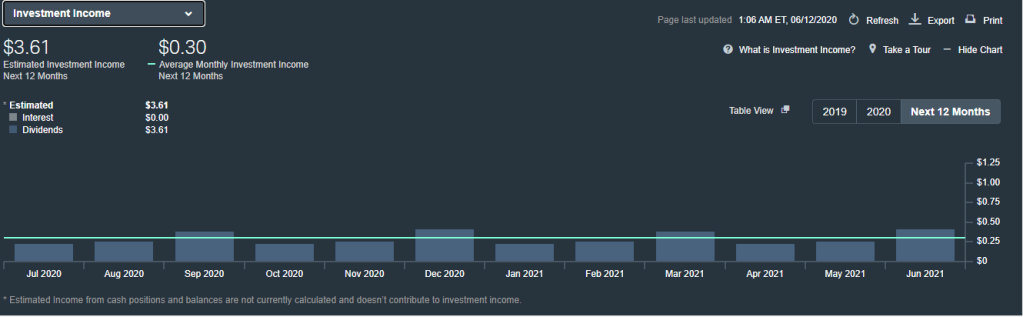
Chart showing current dividend income
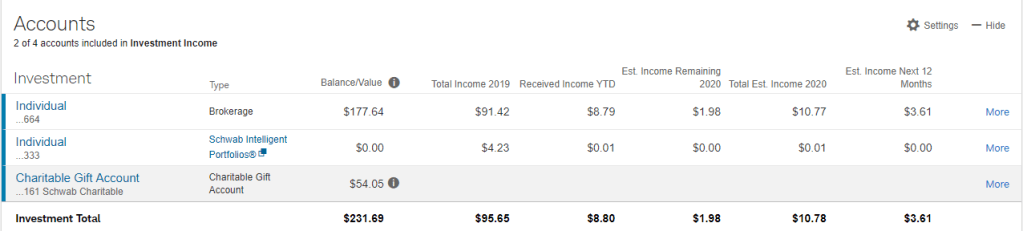
Table of last years, YTD, and estimated income. Interest gets added after it is applied to any money fluid cash not being used.

The charitable account that I have will become a place where I will put at least 5% of any money recieved once I have reached a basic quantiy of all stocks I plan on buying though I have been reconsidering to when I start recieving dividends equaling $1+.

Currently

After spending a month in the Chicago and spending majority of my savings on hotels, food, and a little entertainment and not able to find a place to live in enough time while working for $13/hr, I have come back to the Seattle area. Renting a room and working saving for a place here. Initially want to at least have 3 months worth of current rent saved up in a savings account before considering the next step. Included with that as well will be 3 months of expenses, fixed and variable. Going to wait till October to see where that’s at, having 20% of my paycheck being sent to my Barclay’s savings account. Waiting till October should be able to allow it to build with the percent contribution plus the 1.15% interest.

In the meantime, I will add to my Schwab brokerage, especially now that they offer a form of fractional shares. How I found out it works is that $5 is the minimum to buy a slice of a particular company that is qualified for the fractional share program that they offer. Allowed is the ability to select up to 10 at a time, making the minimum $50, maxing out at about $7,000. Needless to say, I just have 10 stocks that I used $50 to buy. Once I buy all on the table that I set up to guide me, than create a share quantity baseline to help me have a goal and to start building my account by adding more like bonds, treasuries, and CD’s with Schwab and/or Capital One bank since that with Capital One’s CD’s don’t require a minimum and would make it easier to pay off my credit card when I use it.

My Investment Income So Far

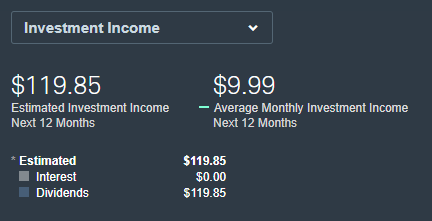
So far, I’ve combined a list of places I’ve worked with dividend paying stocks, businesses with HQ’s in the Pacific North-West, and suggestions by a youtuber Joseph Hogue. Since I couldn’t put more than 40 on each watchlist, I ended up making two and clicked on the header that made each list go according to price of each stock, low price to high price, then I printed. Opening a word document, I then proceeded to create categories of <$10, $10 – $50 , $50 – $100, and $100 – $1,000. With only a portion of my current paycheck going to the account I’d be making the transactions, this seemed like the best plan. In each price category, I’d use the higher end to determine how much I’d spend on buying stock. An example, in the $10 – $50 category, I used $50 as the amount I’d spend on each stock. So far, the range has been 1 quantity to 3 quantity. This has gotten me to about an average of $10/month currently, with the third month of each calendar quarter being the highest payout.

With Schwab currently being commission free, I’m able to buy a lot more than I used to, but quantity still be limited by the price. And with Schwab’s automated investment account, I can then then transfer the minimum amount required ($5,000) at the moment that it’s met, though I wish the minimum was slightly lower.

<$10

  1. HL
  2. GE
  3. F

$10 – $50

  1. GAIN
  2. ET
  3. AGNC
  4. DCP
  5. T
  6. SBR
  7. MAIN
  8. HRL
  9. FFNW
  10. UMPQ
  11. SCHN
  12. RANJY
  13. KR
  14. HFWA
  15. TSBK
  16. WY
  17. GBX
  18. BCC
  19. JWN
  20. COLB
  21. WAFD
  22. SFBC
  23. PCH
  24. AVA

$50 – $100

  1. FLIR
  2. FSBW
  3. BANR
  4. POR
  5. ECOL
  6. ALK
  7. FTV
  8. PCAR
  9. POPE
  10. EXPD
  11. SBUX
  12. BBSI
  13. NKE
  14. COLM
  15. LTC
  16. KO
  17. VZ
  18. EFA
  19. EMR
  20. XOM
  21. VTR
  22. IJR
  23. O
  24. BND
  25. VNQ
  26. GPC

$100 – $1,000

  1. DVY
  2. LOW
  3. AGG
  4. EXR
  5. VIG
  6. JNJ
  7. MMM
  8. AAPL
  9. SPY
  10. IDA
  11. UPS
  12. WMT
  13. LAD
  14. EXPE
  15. MSFT
  16. MSI
  17. COST
  18. BA

Figure 1 Current Income Level With Crossed Out Stocks

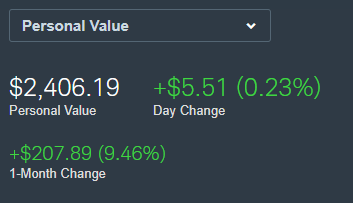
Figure 2 Current Level of Total Amount Invested.

Working on Creating a Passive Income Through Investing

            In an effort to free myself financially, I have decided to try a few things. Legally of course. First step, use my brokerage account through Schwab since it’s my primary means of investing. I have considered using Robinhood or one of the many others, but I have been using Schwab way more frequently and figure it wouldn’t hurt.

            The tickers I’m going to start with:

            AGNC

            MAIN

            SBR

            GAIN

            LTC

            BND

            As it stands right now, I am going to start with $2104.16. Fee for buying stock is $4.95 and would bring the buying power to gain each stock to $345.74. With these being mostly monthly dividend paying stocks, it should allow additional buying power along with any interest gained from cash not used sitting in the personal brokerage account.

            As soon as the markets open (9:30am EST/6:30am PST), the opportunity to buy  will present itself. Living in the Seattle area currently, and if I want to be able to check on conditions when the markets open, I would have to be up and ready by 6:30am.

            Most of what I want is to be able to have money to pay for basics along with being able to travel whenever I choose. Picked up a calendar that is themed with the 1,000 places to visit before you die. Figured it would be a good start for my traveling wants. Hopefully it won’t take too long to get to the point of being free and traveling the world, but being realistic does keep things in their place. Especially when the unexpected  happens and may divert time and energy. Right now, things are looking smooth.

Hoping to be able to keep an update of efforts and travels.

Till we meet again.